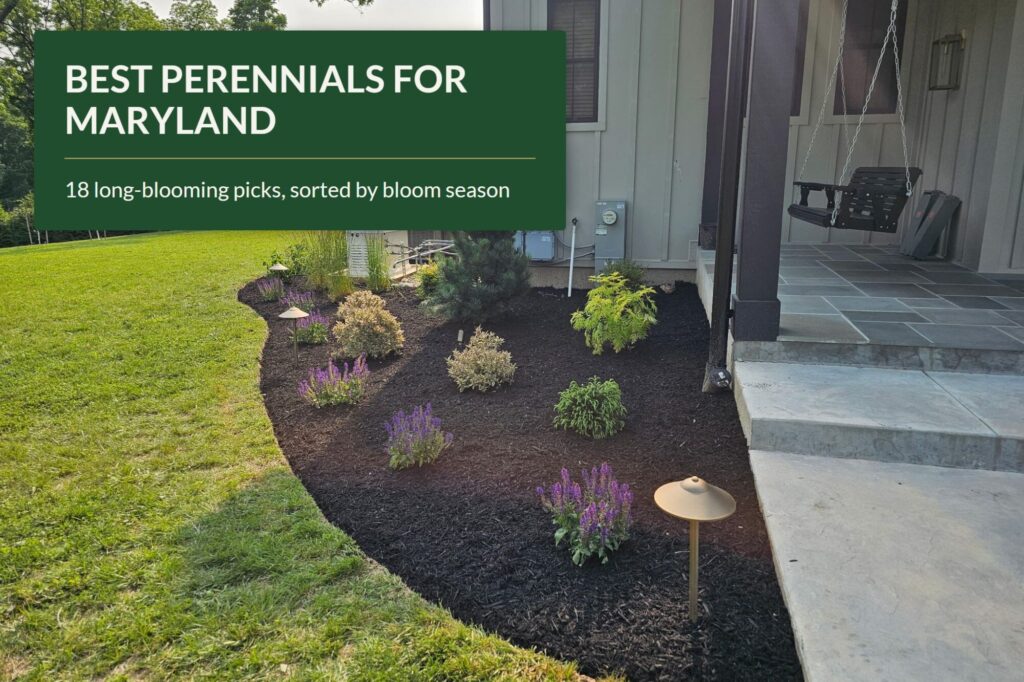
The short answer: The best perennials for Maryland are long bloomers that also tolerate clay, humidity and deer. ‘Cat’s Pajamas’ catmint and ‘April Night’ salvia open in May, ‘Rozanne’ geranium and calamint carry the summer, ‘Goldsturm’ black-eyed Susan, Maryland’s state flower, peaks in August, and ‘October Skies’ aster finishes at frost.
Most perennials flower for two or three weeks and then spend the rest of the season as green leaves. The plants in this guide are the exceptions: each either flowers for well over a month or comes back with a second flush when it is cut back, and together they can keep a bed in flower from early May to the first hard frost. That is the difference between a garden that peaks once in June and one that looks finished all season.
Maryland narrows the list. Harford County sits mostly in Zones 6b and 7a on the 2023 USDA Plant Hardiness Zone Map, so cold is rarely what kills a perennial here. USDA Agricultural Research Service Wet clay in winter, humid summers that bring powdery mildew, and deer are the real tests. Below are 18 long-blooming perennials, grouped by when they start to flower, each with its size, site fit and one honest drawback. For the trees that frame a perennial bed, our guide to flowering trees for Maryland is organized the same way.
Long-blooming perennials at a glance
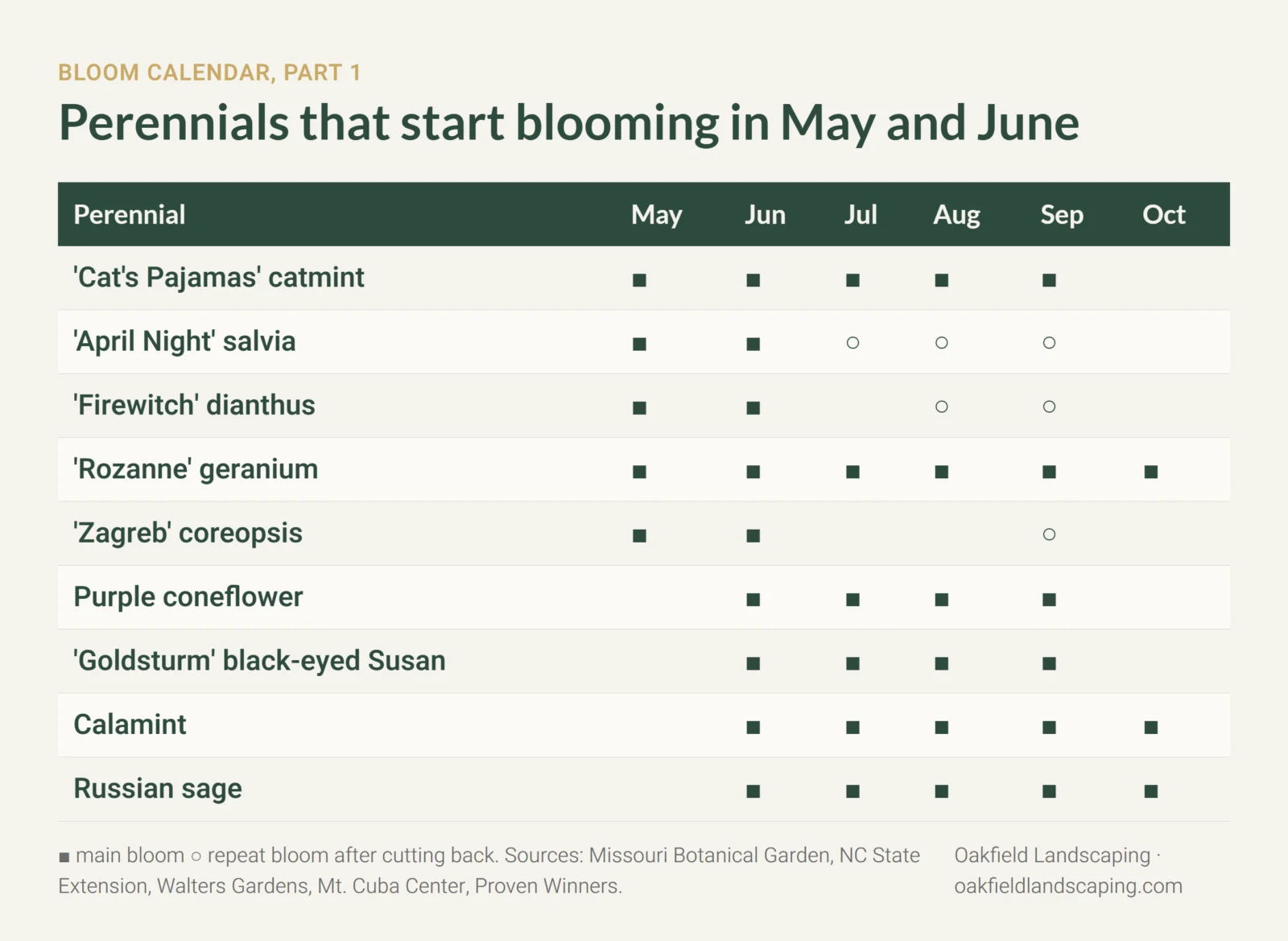
| Perennial | Main bloom | Height x width | Light | Clay soil | Deer |
|---|---|---|---|---|---|
| ‘Cat’s Pajamas’ catmint | May to Sep | 1-1.25 x 1.5 ft | Sun | Drained only | Avoided |
| ‘April Night’ salvia | May, repeats | 12-14 x 18 in | Sun | Tolerates | Resistant |
| ‘Firewitch’ dianthus | May to Jun, repeats | 6 x 12 in | Sun | No | Tolerant |
| ‘Rozanne’ geranium | Late May to fall | 1.5 x 2 ft | Sun to part shade | Tolerates | Tolerant |
| ‘Zagreb’ coreopsis | May to Jun, fall repeat | 1.5 x 1.5 ft | Sun | Drained only | Tolerant |
| Purple coneflower | Jun to Sep | 3-4 x 1-2 ft | Sun to part shade | Tolerates | Resistant |
| ‘Goldsturm’ black-eyed Susan | Jun to Sep | 2-3 x 1-2 ft | Sun | Tolerates | Tolerant |
| Calamint | Jun to frost | 1.5 x 2 ft | Sun | Drained only | Resistant |
| Russian sage | Jun to Oct | 2-4 x 2-4 ft | Sun | No | Resistant |
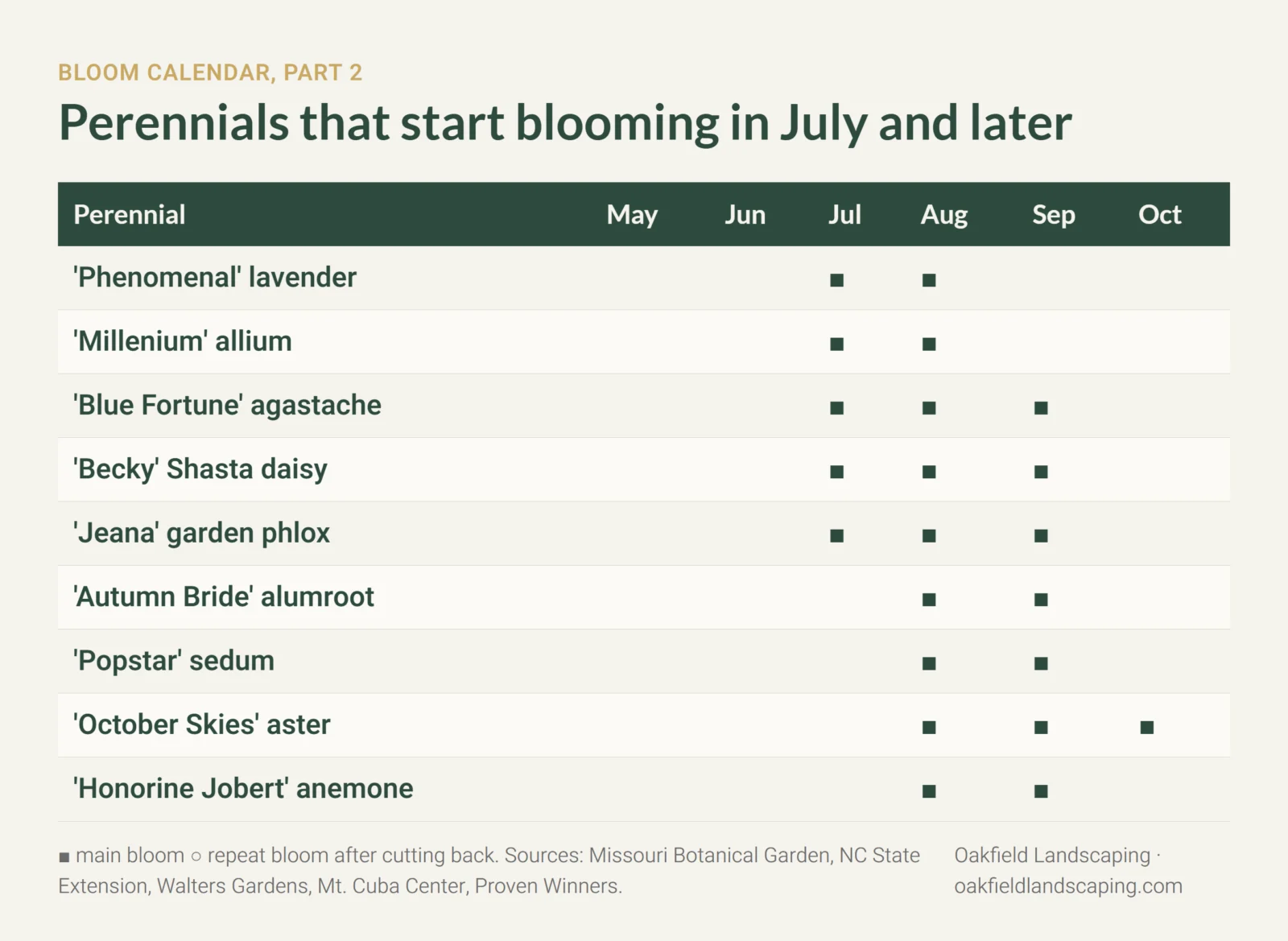
| ‘Phenomenal’ lavender | Jul to Aug | 1.5-2 x 2 ft | Sun | No | Tolerant |
| ‘Millenium’ allium | Jul to Aug | 1-1.5 x 1.5 ft | Sun | Drained only | Tolerant |
| ‘Blue Fortune’ agastache | Jul to Sep | 2-3 x 2 ft | Sun | No | Tolerant |
| ‘Becky’ Shasta daisy | Jul to Sep | 3-4 x 2-3 ft | Sun | Drained only | Tolerant |
| ‘Jeana’ garden phlox | Mid-Jul to early Sep | 5 x 4 ft | Sun to part shade | Tolerates | Not rated |
| ‘Autumn Bride’ alumroot | Aug to Sep | 1.5-3 x 2 ft | Part shade | Amend | Resistant |
| ‘Popstar’ sedum | Late summer | 10-12 x 20 in | Sun | No | Not rated |
| ‘October Skies’ aster | Aug to Oct | 1.5-2 x 2 ft | Sun | Tolerates | Resistant |
| ‘Honorine Jobert’ anemone | Aug to Sep | 3-4 x 2 ft | Sun to part shade | Amend | Resistant |
Starting in spring: May bloomers
These open as the tulips fade and set the first wave of color. Most of them rebloom if you cut them back after the first flush, which is what makes them long bloomers rather than spring-only plants.
‘Cat’s Pajamas’ catmint (Nepeta hybrid ‘Cat’s Pajamas’)
‘Cat’s Pajamas’ is a compact catmint covered in violet-blue spikes from May through September, and it starts earlier than other catmints. Missouri Botanical Garden lists it at 1 to 1.25 feet tall and about 1.5 feet wide, hardy in Zones 3 to 8, and notes that shearing the spikes after the first bloom brings on more flowers. Missouri Botanical Garden
It is sterile, so it won’t seed around the bed, and deer and rabbits tend to leave it alone. It wants full sun and handles dry soil once established. Design use: a soft edging along a walk or patio, or a repeated blue thread through the front of a border, where it hides the bare ankles of roses and taller perennials.
Its weak spot in Maryland is wet clay: Missouri Botanical Garden warns of crown rot in soil that stays too moist, so it needs a raised or well-drained spot. It also looks tired in the most humid stretch of summer, and a midsummer shearing is what brings it back.
‘April Night’ salvia (Salvia nemorosa ‘April Night’)
‘April Night’, sold in the Sallyrosa series, is a short, deep violet salvia bred to flower early. Its breeder, Walters Gardens, says it blooms up to a month ahead of other varieties and grows 12 to 14 inches tall and 18 to 20 inches wide in Zones 5 to 9, with excellent mildew resistance and tolerance of heat and humidity. Walters Gardens
Walters Gardens lists clay among the soils it accepts and rates it deer and rabbit resistant, which makes it one of the few early bloomers that suits an unamended Harford County bed. NC State Extension adds that cutting woodland sage’s spent stems back to the leaves at the base brings on a new round of flowers. Design use: a bold drift in the middle of a sunny border, or in front of roses and shrubs.
The rebloom only happens if someone cuts it back. Left alone after the first flush, it sets seed and looks scrappy by midsummer, so plan on a pair of shears in late June.
‘Firewitch’ dianthus (Dianthus gratianopolitanus ‘Firewitch’)
‘Firewitch’ is a low mat of blue-gray foliage that covers itself in clove-scented magenta flowers in May and June. Iowa State University Extension reported it as the Perennial Plant Association’s 2006 Perennial Plant of the Year. Iowa State University Extension
Missouri Botanical Garden gives it about 6 inches of foliage with flower stems to 6 inches more, spreading to a foot, in Zones 3 to 8. It handles heat and humidity better than most dianthus, and shearing after the main flush brings scattered blooms in late summer or early fall. Deer tolerate it. Design use: the front edge of a raised bed, spilling over a wall or the edge of a path. Missouri Botanical Garden
Drainage decides whether it lives. NC State Extension says cheddar pinks do not tolerate wet winter soil and develop crown rot where drainage is poor, so in Maryland clay plant it on a slope, in a raised bed or along a gravel edge, or expect to lose it after a wet winter.
‘Rozanne’ geranium (Geranium hybrid ‘Rozanne’)
‘Rozanne’ is the hardy geranium that changed what people expect from the genus: violet-blue, white-eyed flowers from late spring into fall. Purdue Extension notes it was named the Perennial Plant Association’s 2008 Perennial Plant of the Year and that it keeps blooming heavily through mid-autumn. Purdue Extension
Missouri Botanical Garden describes almost nonstop flowering on a mound 1 to 1.5 feet tall and up to 2 feet wide, with exceptional heat tolerance, and says a summer cutback brings a fresh flush for late summer and fall. NC State Extension lists clay among the soils it takes, for sun or part shade, and rates it resistant to deer and rabbits. Missouri Botanical Garden
Design use: weaving between shrubs, under roses or at the foot of hydrangeas, where its long stems scramble into neighboring plants. It pairs especially well with the panicle and smooth types in our guide to hydrangeas for Maryland.
Give it more room than the tag suggests. Purdue Extension gives a spread of about 28 inches, wider than the 2 feet many tags show, and by August its long stems lean over smaller neighbors. Cutting it back in midsummer keeps it tidier and brings a fresh fall flush.
‘Zagreb’ coreopsis (Coreopsis verticillata ‘Zagreb’)
‘Zagreb’ is a threadleaf coreopsis, a fine-textured mound of needle-like leaves topped with bright yellow daisies. The species is native to the eastern United States, according to NC State Extension, which now files it under Anacis verticillata. Missouri Botanical Garden gives ‘Zagreb’ 1 to 1.5 feet tall and 1.5 feet wide in Zones 3 to 9, flowering May to June, and says shearing in mid to late summer brings a fall rebloom. Missouri Botanical Garden
It handles heat, humidity and drought, and deer usually pass it by. Design use: a bright, airy filler at the front of a sunny bed, especially against blue salvia or catmint, or in a gravel garden.
In rich, moist soil it misbehaves. It spreads by rhizomes and seed there, Missouri Botanical Garden warns of crown rot in poorly drained ground, and NC State notes the stems turn weak and floppy. Lean, well-drained soil keeps it compact.
Starting in early summer: June bloomers
These pick up as the May flush fades and many of them run until September or frost. They are the backbone of a long-blooming bed, and several are tough enough for clay.
Purple coneflower (Echinacea purpurea)
Purple coneflower is the classic native prairie daisy, with drooping pink-purple petals around a coppery cone. NC State Extension describes it as native to the central and eastern United States, 3 to 4 feet tall and 1 to 2 feet wide, flowering from early summer into mid-fall, and lists clay among the soils it grows in. NC State Extension
It is drought tolerant once established and rated deer resistant. Bees and butterflies work the flowers all summer, goldfinches pick at the seed heads in fall, and NC State notes native bees nest in the hollow stems if you leave 12 to 24 inches standing. Design use: drifts in the middle of a sunny border or meadow-style planting, with black-eyed Susan and grasses.
You have to choose between tidy and wildlife-friendly. Once the cones set seed the plants look ragged by September, and deadheading them to keep the bed neat removes the seed the goldfinches come for. In a front-of-house bed, many homeowners cut half and leave half.
‘Goldsturm’ black-eyed Susan (Rudbeckia fulgida var. sullivantii ‘Goldsturm’)
Black-eyed Susan has been Maryland’s official state flower since 1918, according to the Maryland Manual. Maryland State Archives The state flower is Rudbeckia hirta, a short-lived species. For a garden bed, ‘Goldsturm’, a selection of the longer-lived orange coneflower, is the dependable choice.
Missouri Botanical Garden lists ‘Goldsturm’ at 2 to 3 feet tall and 1 to 2 feet wide in Zones 3 to 9, blooming June to September with 3 to 4 inch flowers, and notes it tolerates clay, deer and drought. It was the 1999 Perennial Plant of the Year. Missouri Botanical Garden Design use: big sweeps along a driveway or in front of evergreens, where the gold reads from a distance.
By late summer the foliage can let it down. Missouri Botanical Garden says angular leaf spot is common, and in a humid Maryland August the leaves often show dark spots. It also spreads by rhizomes into a solid mat, so plan to divide it every few years.
Calamint (Calamintha nepeta subsp. nepeta)
Calamint looks like a cloud of tiny white to pale lilac flowers over minty gray-green leaves, and it is one of the longest bloomers on this list. University of Illinois Extension reports it as the Perennial Plant Association’s 2021 Perennial Plant of the Year, flowering from early summer until frost and drawing bees and butterflies the whole time. University of Illinois Extension
NC State Extension gives it 1 to 1.5 feet tall and about 2 feet wide, for full sun and well-drained soil, and rates it deer and drought tolerant. Design use: softening the edges of a path or patio, or filling the gaps between bolder plants like coneflower and sedum.
Don’t expect one clump to last a decade. NC State calls calamint short-lived and notes it seeds around readily, so seedlings take over from the original plants. Pull the ones that land where you don’t want them.
Russian sage (Salvia yangii)
Russian sage, long sold as Perovskia atriplicifolia, is a woody-based perennial with silver stems and a haze of lavender-blue flowers. NC State Extension lists it at 2 to 4 feet tall and wide, flowering June to October in full sun, deer resistant and hardy in Zones 5 to 9. NC State Extension
Its airy, see-through habit makes it a good mid-border plant that doesn’t block the view, and it pairs well with ornamental grasses, black-eyed Susan and sedum. It is drought tolerant and has no serious pests.
Wet soil and shade are its undoing. NC State says to avoid poorly drained or wet ground and notes the plant tends to flop as the season goes on, worse in shade or rich soil. In Harford County clay, plant it on a slope or a raised bed and cut it back hard in early spring.
Starting in midsummer: July bloomers
These carry the bed through the heat of July and August, when many gardens go quiet. Most of them are pollinator magnets.
‘Phenomenal’ lavender (Lavandula × intermedia ‘Phenomenal’)
‘Phenomenal’ is a lavandin, a hybrid of English and Portuguese lavender, larger and later to bloom than English lavender, according to NC State Extension. Missouri Botanical Garden lists it, under its cultivar name ‘Niko’, at 1.5 to 2 feet tall and wide in Zones 5 to 8, flowering July to August, with improved resistance to Pythium root and stem rot. Missouri Botanical Garden
NC State Extension adds that lavandin wants full sun and well-drained, ideally alkaline soil, that deadheading extends the bloom, and that it should be trimmed in spring, not fall, because fall trimming pushes out tender growth. Deer leave it alone. Design use: lining a sunny walk or terrace, where people brush past the foliage, or massed on a dry, sunny bank.
Lavender is the plant on this list most likely to disappoint in Maryland. Missouri Botanical Garden says it commonly dies from winter wet and high summer humidity, and suggests rock mulch instead of bark. A flat clay bed rarely works: give it a raised bed, a slope or gravel, or skip it.
‘Millenium’ allium (Allium hybrid ‘Millenium’)
‘Millenium’ is an ornamental onion that forms a tidy clumping mound of grassy leaves topped with round, 2-inch rose-purple flower heads. Missouri Botanical Garden lists it at 1 to 1.5 feet tall and wide in Zones 5 to 8, blooming July to August, and tolerant of deer, rabbits and drought. Missouri Botanical Garden
It was named the 2018 Perennial Plant of the Year, according to Missouri Botanical Garden. NC State Extension notes this particular allium doesn’t reseed much, and the flowers draw bees through midsummer. Design use: a crisp edging in a sunny bed, or a midsummer accent with ‘October Skies’ aster and calamint.
Like most bulbs, it resents wet feet. Both sources warn of bulb rot in soggy soil, and Missouri Botanical Garden suggests working compost into clay for drainage. In a low spot that stays wet, expect it to thin out over a few winters.
‘Blue Fortune’ agastache (Agastache hybrid ‘Blue Fortune’)
‘Blue Fortune’ is an anise hyssop with dense spikes of lavender-blue flowers and licorice-scented leaves. Missouri Botanical Garden lists it at 2 to 3 feet tall and 1.5 to 2 feet wide in Zones 5 to 9, flowering July to September, and attractive to bees, hummingbirds and butterflies. Missouri Botanical Garden
NC State Extension says it handles humidity better than many hyssops and that deadheading brings on more flowers. Deer avoid it. Design use: the middle of a pollinator bed, with coneflower and black-eyed Susan, where the vertical spikes contrast with their daisy shapes.
Heavy clay is a deal-breaker. NC State says plainly that it will not tolerate heavy clay or poorly draining soil and recommends a raised bed, a container or a slope, and Missouri Botanical Garden adds that plants may not survive winter in hard clay that holds water. NC State Extension
‘Becky’ Shasta daisy (Leucanthemum × superbum ‘Becky’)
‘Becky’ is a tall, sturdy Shasta daisy with 3 to 4 inch white flowers. Missouri Botanical Garden lists it at 3 to 4 feet tall and 2 to 3 feet wide in Zones 5 to 9, blooming July to September on rigid stems that need no staking, and tolerant of deer, rabbits and drought. Missouri Botanical Garden
Its grower, Walters Gardens, lists it as the 2003 Perennial Plant of the Year. The flowers cut well and last in a vase. Design use: a bright white mass in the middle of a sunny border that reads well at dusk from a porch or terrace, or with Russian sage and black-eyed Susan.
Like lavender, it hates winter wet. NC State Extension says Shasta daisy is intolerant of poorly drained soil, so it needs a raised or well-drained spot in Maryland clay. University of Maryland Extension notes that most perennials left in place for more than three years crowd out their own centers, and Shasta daisy is one of the first to need dividing.
‘Jeana’ garden phlox (Phlox paniculata ‘Jeana’)
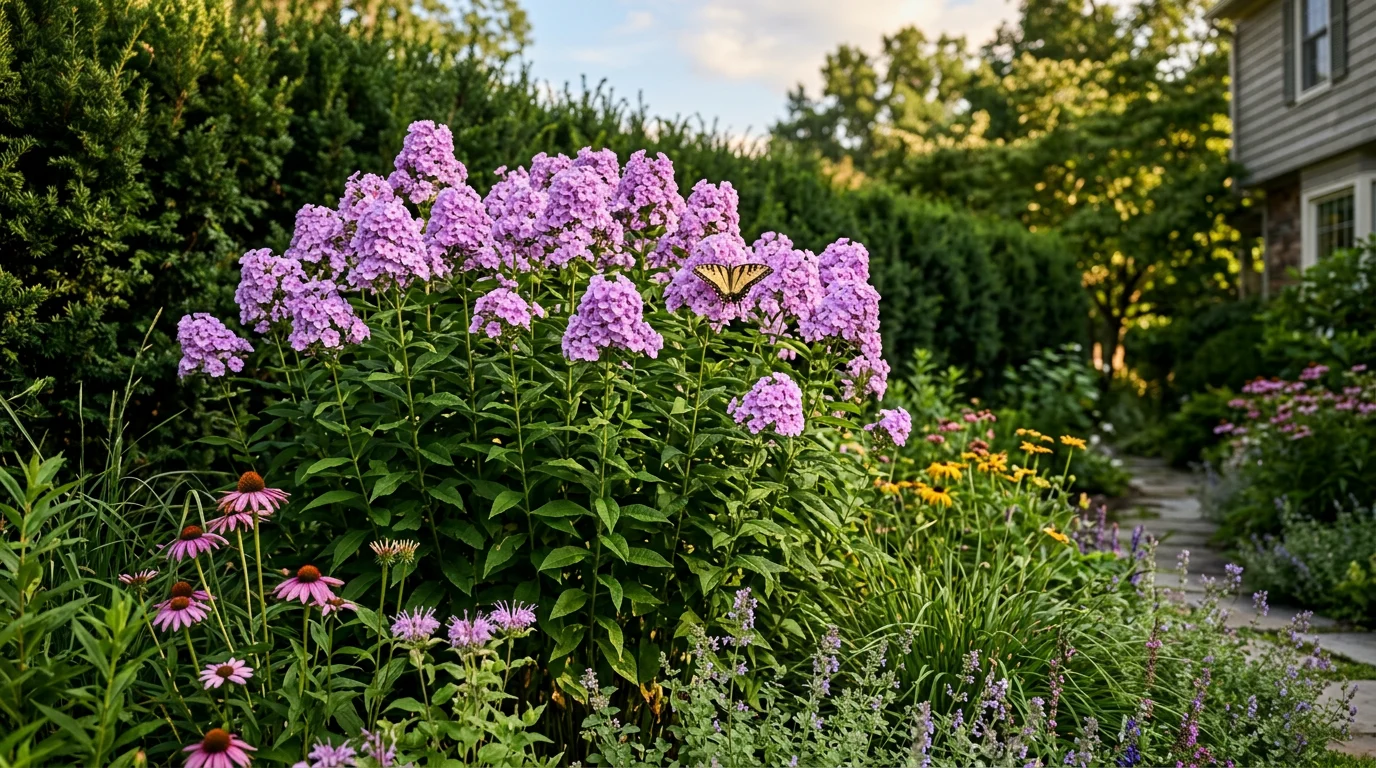
Garden phlox is a native perennial with big, fragrant flower heads, but NC State Extension counts powdery mildew among its serious problems, and in a humid Mid-Atlantic summer many cultivars end the season with gray, spotted leaves. ‘Jeana’ is the exception. In Mt. Cuba Center’s garden phlox trial in Delaware, it was the top performer, rated 4.8, with excellent mildew resistance, flowering from mid-July to early September and attracting more butterflies than any other phlox tested. Mt. Cuba Center
Its lavender-pink flower heads attract hummingbirds as well as butterflies. NC State Extension lists clay among the soils garden phlox takes, in sun to part shade. Design use: the back of a border, or a large summer mass near a porch or patio where you can watch the butterflies.
It is far bigger than most people expect: Mt. Cuba measured it at about 5 feet tall and 4 feet wide, so it belongs at the back of the bed. NC State also warns that garden phlox in general can suffer from phlox bugs, spider mites and root rot, so give it air circulation and avoid overhead watering.
Late summer into fall: August to October bloomers
These finish the season and are what keep a bed looking intentional after Labor Day. Two of them handle part shade.
‘Autumn Bride’ hairy alumroot (Heuchera villosa ‘Autumn Bride’)
Hairy alumroot is a native heuchera from the eastern United States, and ‘Autumn Bride’ is grown for its large, fuzzy, bright green leaves and its late wands of white flowers. Missouri Botanical Garden lists the foliage at 18 to 24 inches with flower stems to 3 feet, spreading 1.5 to 2 feet, flowering August to September in Zones 3 to 8, and handling hot, humid summers better than most heucheras. Missouri Botanical Garden
NC State Extension adds that deer and rabbits find the leaves unappetizing and that it tolerates black walnut. Design use: a shady border, the north side of a house or the edge of a woodland bed, where the leaves carry the bed all season and the flowers arrive when most shade plants are done.
It is not a plant for a hot, dry bed. It prefers rich, moist but well-drained soil and afternoon shade, and NC State notes the leaves scorch and the plant declines if the soil dries out completely.
‘Popstar’ sedum (Hylotelephium hybrid ‘Popstar’)
‘Popstar’, in Proven Winners’ Rock ‘N Grow series, is a compact upright sedum with blue-green leaves and domed heads of salmon-pink flowers in late summer. Proven Winners lists it at 10 to 12 inches tall and 16 to 20 inches wide, hardy in Zones 3 to 9, drought and salt tolerant and attractive to bees and butterflies. Proven Winners
Its low, compact habit suits the front of a bed. University of Maryland Extension suggests leaving perennial seed heads standing through winter for birds, and sedum’s dried heads are among the best-looking. Design use: the front of a sunny bed, along a driveway or walk, or with calamint and ‘Millenium’ allium.
Deer are the risk here. NC State Extension rates upright sedums resistant to rabbits but not deer, and says wet soils rot them and rich soil makes them weak. In a yard with heavy deer pressure, expect the flower buds to be browsed.
‘October Skies’ aromatic aster (Symphyotrichum oblongifolium ‘October Skies’)
Aromatic aster is a tough native aster with a balsam scent when the stems are crushed, and ‘October Skies’ is its compact, sky-blue selection. Missouri Botanical Garden lists it at 1.5 to 2 feet tall and wide in Zones 3 to 8, flowering August to October, doing well in sandy or clay soils, and less inclined to spread than the species. Missouri Botanical Garden
NC State Extension rates aromatic aster resistant to deer and rabbits and drought tolerant, and notes its long season runs from late summer until the first frost, a late source of nectar for bees and butterflies. Design use: the front of a sunny border, with ‘Goldsturm’ and grasses, or massed along a sunny slope.
Watch for powdery mildew, which both sources note and NC State links to poorly drained clay and poor air circulation. Full sun, space between plants and a light hand with the hose keep it in check.
‘Honorine Jobert’ Japanese anemone (Anemone × hybrida ‘Honorine Jobert’)
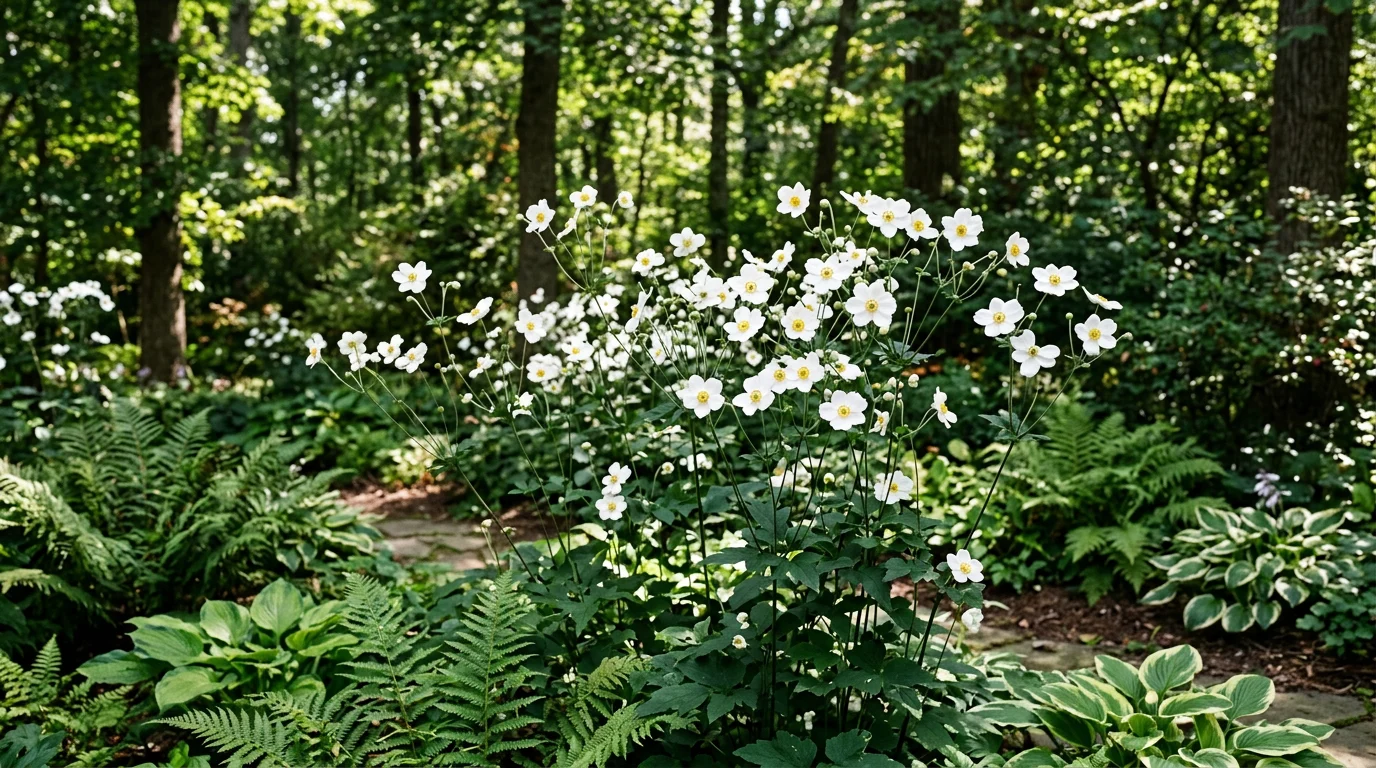
‘Honorine Jobert’ is the elegant white Japanese anemone, with 2 to 3 inch white flowers and yellow stamens held high on wiry stems. NC State Extension says it grows 3 to 4 feet tall, blooms for 4 to 8 weeks in August and September, was the Perennial Plant Association’s 2016 Perennial Plant of the Year, and is deer resistant. NC State Extension
It grows in sun or part shade in consistently moist, well-drained soil, and its flowers glow in the evening. Design use: the back of a partly shaded border, under high tree canopy or behind hostas and ferns, where little else blooms in September.
Plant it only where you’d be happy to see it spread. It travels by rhizomes, and NC State notes hybrid anemones form a ground cover when given room, which in a mixed bed means crowding out neighbors. A defined bed or a woodland edge suits it best.
Building a bed that blooms from May to frost
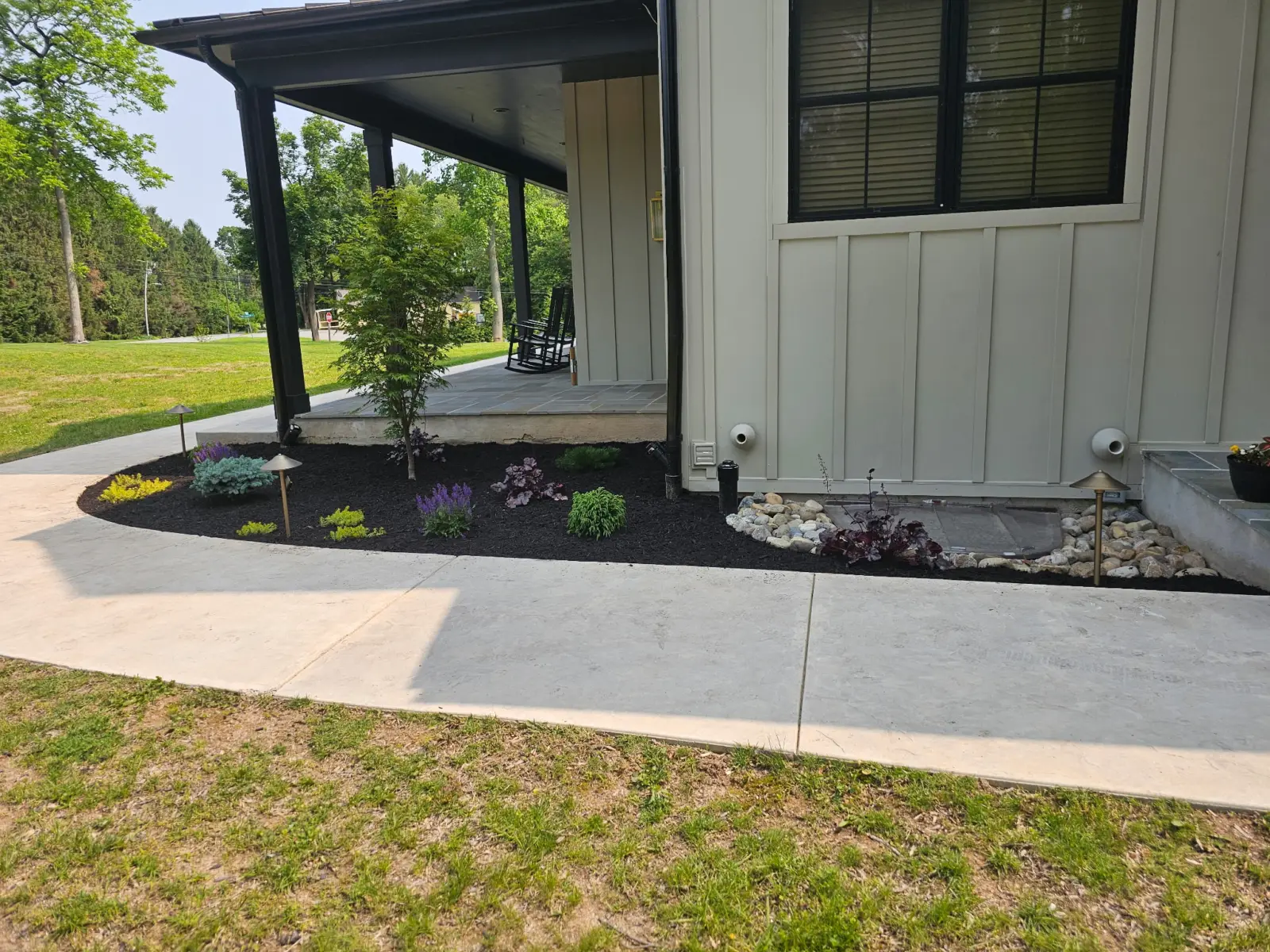
No single perennial flowers for six months, and the plants above that come closest, like ‘Rozanne’ geranium and calamint, still rest between flushes. Season-long color comes from succession: overlapping plants whose peaks follow one another. University of Maryland Extension makes the same point, noting that most perennials have a limited flowering window and that a bed with steady color needs several species with different bloom times. University of Maryland Extension
A simple way to plan it is to pick at least two plants from each bloom group in this guide and repeat them through the bed. For a sunny Maryland border, that might be ‘Cat’s Pajamas’ catmint and ‘April Night’ salvia for May, ‘Rozanne’ geranium and purple coneflower for June, ‘Goldsturm’ black-eyed Susan and ‘Jeana’ phlox for July and August, and ‘October Skies’ aster and ‘Popstar’ sedum to finish. Each group should cover roughly the same share of the bed, so no month looks bare.
Keeping the early bloomers going is mostly a matter of cutting them back. NC State Extension says catmint reblooms when sheared after flowering, and that woodland sage sends up new flowers if the spent stems are cut down to the basal leaves. NC State Extension That one task, done in late June, is the difference between a salvia that blooms for three weeks and one that is still flowering in September. It is part of the seasonal care our landscape maintenance crews handle on the gardens we look after, and we plan for it in every garden planting design.
Native or non-native perennials for a Maryland garden
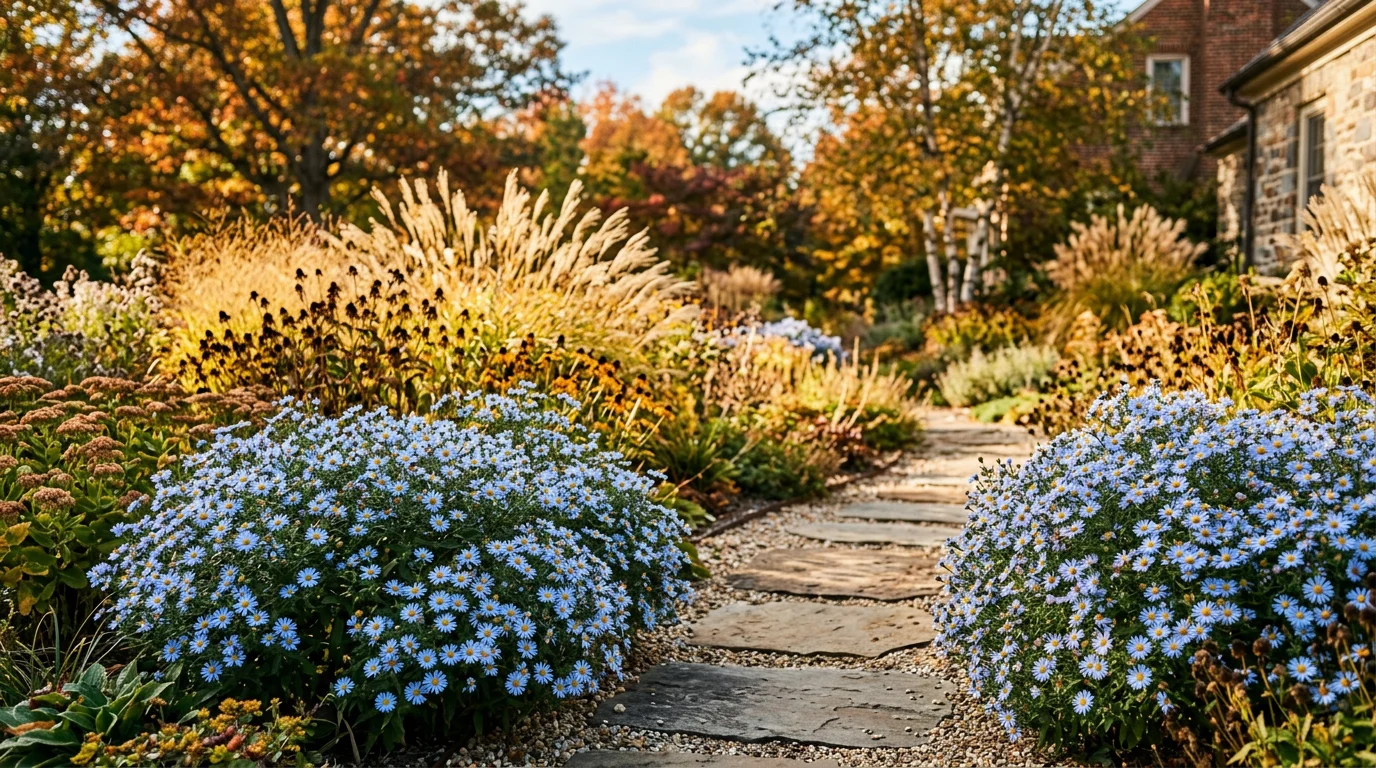
Six of the 18 plants here are cultivars of species native to the eastern United States: purple coneflower, ‘Goldsturm’ black-eyed Susan, ‘Zagreb’ threadleaf coreopsis, ‘Jeana’ garden phlox, ‘Autumn Bride’ hairy alumroot and ‘October Skies’ aromatic aster. The rest come from Europe and Asia, and several of them, catmint, salvia, lavender, calamint and Russian sage, are among the longest bloomers you can grow. None of the 18 are on the Maryland Prohibited Invasive Plant List.
One familiar perennial now is. The Maryland Department of Agriculture added orange daylily, the roadside ditch lily (Hemerocallis fulva), and its associated cultivars to the prohibited list on July 15, 2026, with nursery stock phased out over the following one to two years. Maryland Department of Agriculture That is why reblooming daylilies, a staple of long-bloom lists, are left off this one. If a bank of ditch lilies is spreading along your property, the plants in this guide make good replacements.
The practical answer for most yards is a mix: natives as the backbone, for the bees and butterflies they support, with a few long-flowering non-natives to carry color through the gaps. If a planting built only from Maryland natives appeals to you, our guide to native plants that thrive in Harford County goes further, and our article on designing a pollinator garden shows how to lay one out.
Planting perennials in Maryland clay
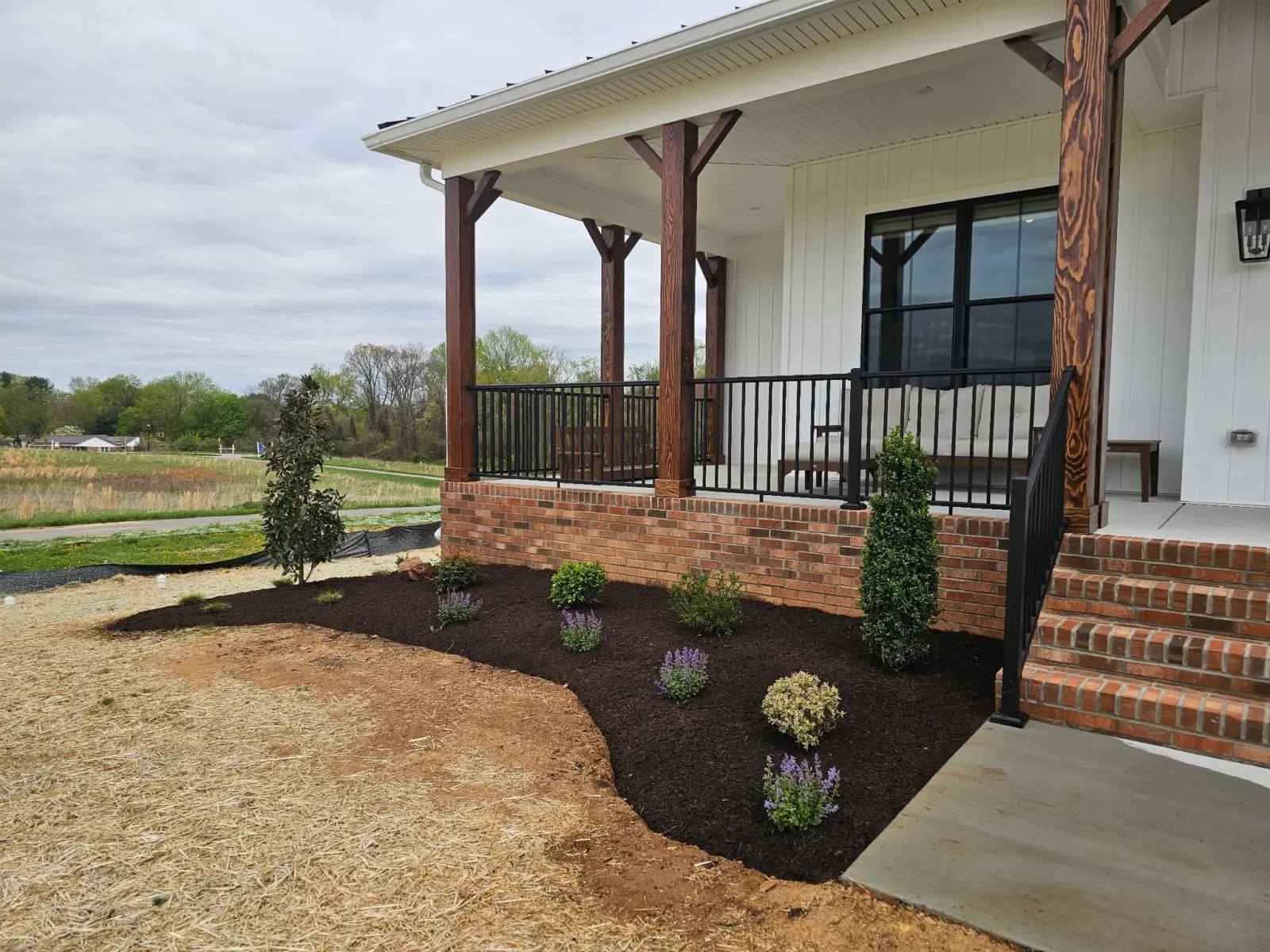
Clay is the reason more perennials fail in Harford County than cold does. The heavy clay loam common around Bel Air and much of Harford County stays wet through winter, and that is exactly the condition that kills lavender, agastache, Russian sage, dianthus and sedum, all of which NC State Extension says rot in poorly drained soil. Plants like ‘Rozanne’ geranium, purple coneflower, black-eyed Susan, garden phlox and aromatic aster are rated for clay and are the safer choices for an unamended bed.
For the drainage-sensitive plants, raise the bed rather than digging a hole in clay and filling it with compost, which can act like a bowl that holds water around the roots. NC State Extension recommends a raised bed, a container or a slope for ‘Blue Fortune’ agastache for exactly this reason, and the same approach works for lavender and Russian sage. If your yard has standing water after rain, our guide to fixing standing water in clay soil covers the causes and the fixes.
Timing matters too. University of Maryland Extension says early spring and fall are the best times to transplant perennials, and that spring and summer bloomers are best divided after they flower, in late summer or fall, while fall bloomers are divided in early spring. After the ground freezes, it suggests a 1-inch layer of mulch around the plants, kept off the crowns. The rest of the season’s timing, from cutting back in fall to dividing in spring, is in our fall prep guide for Harford County gardens and our spring checklist for Maryland homeowners. University of Maryland Extension
Planning a perennial garden?
The right mix depends on how many hours of sun the bed gets, how long the clay stays wet after rain, how much deer pressure the property sees and which months you most want color. Eric checks all of that on site before choosing a single plant. Our landscape design and installation work lays out perennials in drifts that follow one another through the season, beside the trees, shrubs and hydrangeas that give the garden its structure. If you are planning a new bed or rethinking a tired one, book a consultation and we will walk it with you.
Long-blooming perennial FAQs
What perennials bloom all summer long?
In Maryland, the closest to nonstop are ‘Rozanne’ geranium, calamint, ‘Cat’s Pajamas’ catmint and Russian sage, each of which flowers for three months or more, with ‘Becky’ Shasta daisy close behind. ‘April Night’ salvia joins them if you cut it back after each flush. Expect short pauses between flushes even on the best. In Harford County clay, ‘Rozanne’ and black-eyed Susan handle heavy soil best.
When is the best time to plant perennials in Maryland?
Early spring and early fall are best. University of Maryland Extension names both as the ideal windows, because cool air and regular rain help roots establish before summer heat or winter freezes. Container plants can go in through summer if you water them through dry spells. In Harford County, finish fall planting early enough that roots have several weeks to grow before the ground freezes.
Is lavender a perennial in Maryland?
Yes, if it has sharp drainage. Lavandin types like ‘Phenomenal’ are rated for Zones 5 to 8, so Maryland’s cold is rarely the problem. Wet clay in winter is, because it rots the roots. Plant lavender in a raised bed, on a slope or in gravelly soil, in full sun, and avoid trimming it in fall. In heavy Harford County clay, an unamended flat bed is where lavender most often fails.
How do you get salvia to bloom all summer?
Cut it back. Once the first flower spikes fade and the stems brown, NC State Extension recommends cutting them down to the leaves at the base, which pushes out a new round of flowers in a few weeks. Repeat after each flush, and give it full sun and well-drained soil. In Maryland, an early variety like ‘April Night’, which starts in May, has the longest runway for repeat flushes before frost.
Do annuals bloom longer than perennials?
Usually, yes. Annuals have one season to set seed, so many flower nonstop from late spring to frost, while most perennials bloom for a few weeks and spend the rest of the year building roots. University of Maryland Extension suggests adding annuals where you want steady color. The long-blooming perennials in this guide narrow the gap, and unlike annuals they come back every year.
How long do perennials take to bloom after planting?
Most container-grown perennials bloom in their first season, but the gardener’s rule of thumb is that they sleep the first year, creep the second and leap the third, reaching full size and full bloom by year three. Plants divided or planted in fall usually flower normally the next summer. In Maryland clay, slow establishment can stretch that by a season, so give new beds two years before judging them.