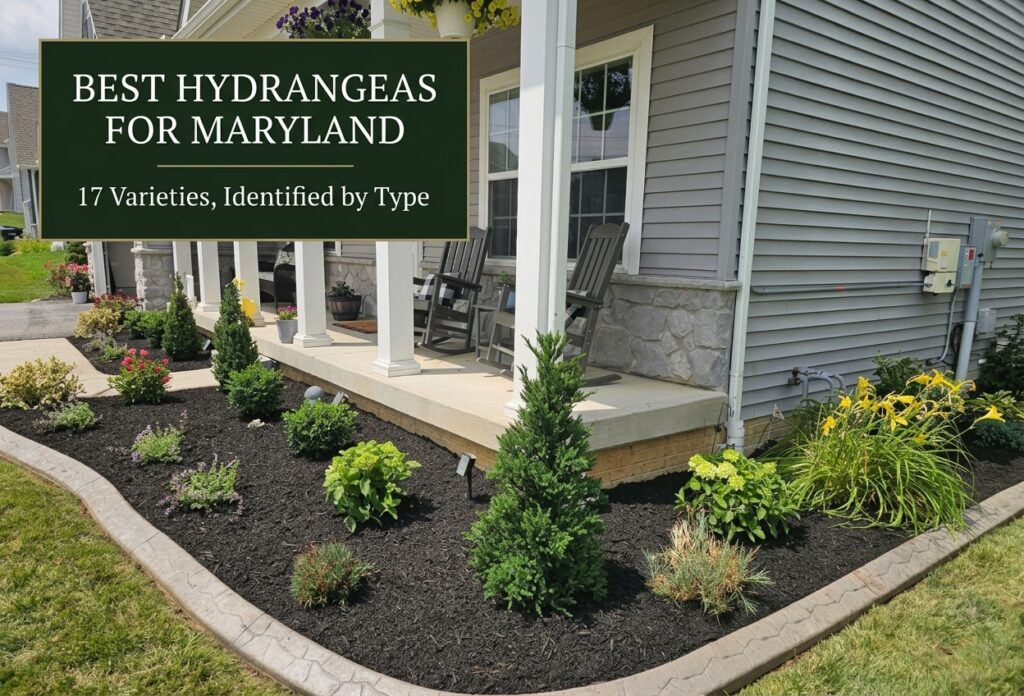
The short answer: The best hydrangeas for Maryland depend on your site. Panicle hydrangeas like Limelight handle the most sun and cold, native smooth hydrangeas like Annabelle bloom reliably in part shade, oakleaf hydrangeas give four seasons of interest, and bigleaf hydrangeas like Endless Summer deliver blue or pink flowers where soil is acidic.
“Hydrangea” covers six different shrubs and vines that grow, bloom, and fail in different ways. According to University of Maryland Extension, each hydrangea type has its own growing needs, and pruning at the wrong time for the type is the most likely reason a hydrangea fails to bloom. So the first step is knowing which one you have, or which one your site calls for. University of Maryland Extension
This guide sorts 17 hydrangeas that perform in Maryland by type. Each profile covers what the plant does, how big it gets, how it handles Maryland winters and clay soil, where it works in a design, and one honest drawback. Most of central Maryland sits in Zone 7a to 7b on the 2023 USDA Plant Hardiness Zone Map, which lets you look up your zone by entering a ZIP code. Pruning and bloom troubleshooting have their own guides, linked below. usda
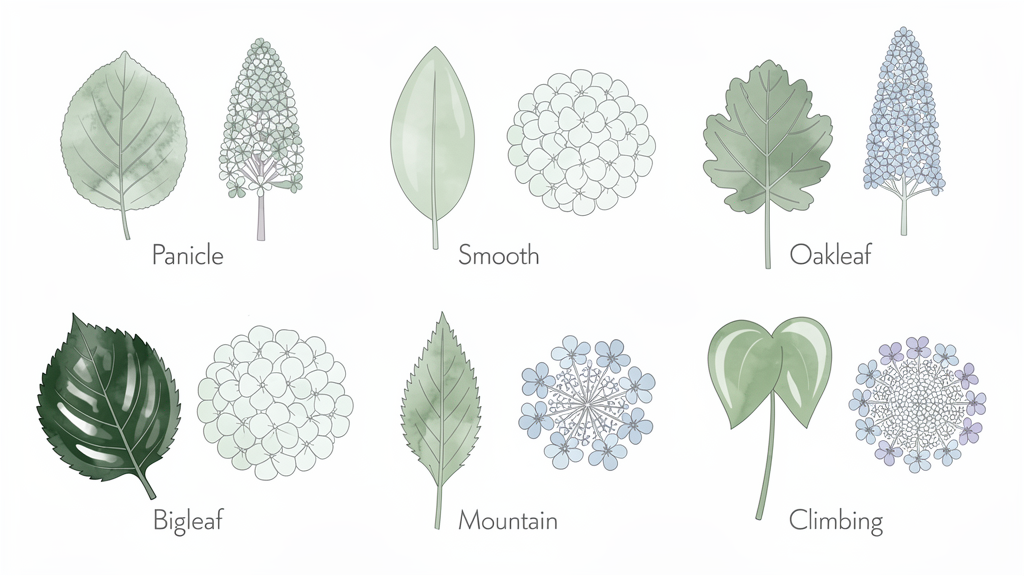
Hydrangea types at a glance
| Type | Leaf clue | Flower shape | Colors | Best Maryland light |
|---|---|---|---|---|
| Panicle (H. paniculata) | Small, oval, slightly rough | Cone | White, lime, aging pink | Full sun to part shade |
| Smooth (H. arborescens) | Thin, matte, broadly oval | Round or flat | White, some pink | Part sun to shade |
| Oakleaf (H. quercifolia) | Lobed like an oak | Cone | White, aging pink | Part shade |
| Bigleaf (H. macrophylla) | Large, thick, glossy | Mophead or lacecap | Blue, pink, purple, white | Morning sun, afternoon shade |
| Mountain (H. serrata) | Smaller, narrower bigleaf | Lacecap | Blue, pink | Part shade |
| Climbing (H. anomala subsp. petiolaris) | Rounded, glossy, on a vine | Flat lacecap | White | Shade to part shade |
Panicle hydrangeas (Hydrangea paniculata)
Panicle hydrangeas are the easiest type to succeed with in Maryland. They flower on new wood starting around mid-July, mostly in white, with some opening lime-green and others aging to pink, a color that tends to deepen with cooler temperatures. UMD Extension notes they like rich, loamy soil in full sun to partial shade, and the old cultivar ‘Grandiflora’ is the source of the nickname PeeGee hydrangea. University of Maryland Extension
Limelight (Hydrangea paniculata ‘Zwijnenburg’)
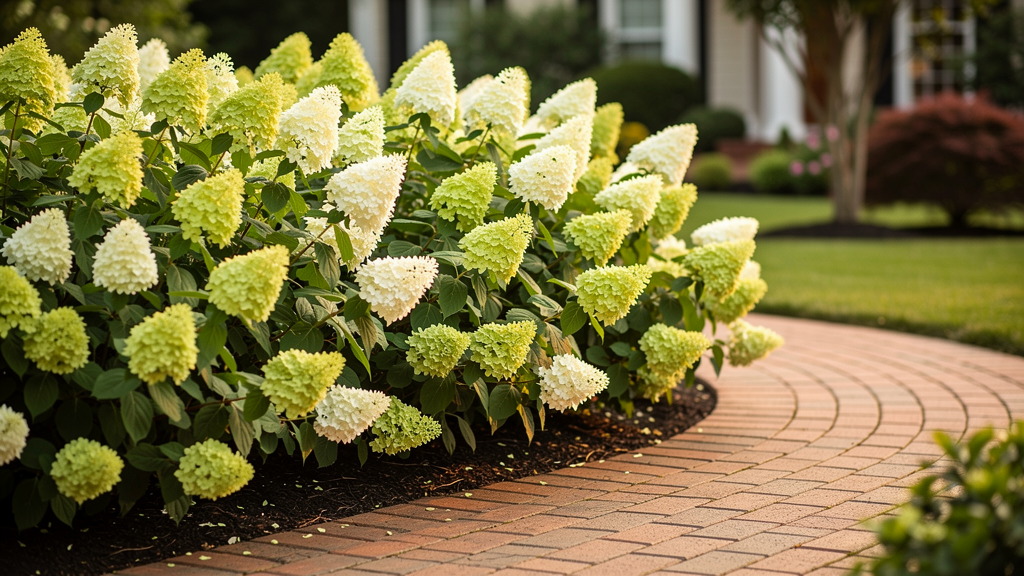
Limelight is the panicle most people picture: big, football-shaped heads that open chartreuse in midsummer, fade to cream, then pick up pink and burgundy as fall arrives. The breeder lists it at 6 to 8 feet tall and wide at maturity. provenwinnersdirect
In Maryland it handles full sun to light afternoon shade and tolerates clay as long as water drains away after storms. It works as an informal hedge, a back-of-border anchor, or a tree-form standard, and it is one of the flowering options in our guide to privacy screening plants for Maryland.
Honest caveat: it outgrows most foundation beds, and shearing it hard every spring to make it fit only leads to weak, floppy stems. For tighter spaces, the breeder’s Limelight Prime is a refined version with stronger stems and a more compact, upright habit at about 4 to 6 feet. provenwinners
Little Lime (Hydrangea paniculata ‘Jane’)
Little Lime is Limelight scaled down: the same lime-to-pink color arc on a plant about 3 to 5 feet tall and wide.
That size fits foundation plantings, mass plantings along a walk, and large containers on a sunny terrace. It shares Limelight’s cold hardiness, so a hard Maryland winter rarely costs it a season of flowers.
Honest caveat: the flower heads are noticeably smaller, so from the street it reads softer than Limelight photos suggest. Plant it in groups of three or more.
Bobo (Hydrangea paniculata ‘ILVOBO’)
Bobo is a true dwarf panicle, typically around 3 feet tall and a little wider, with white clusters so dense they nearly cover the leaves by late July.
Use it at the front of a sunny border, along a path, or in containers where a full-size panicle would overwhelm the space. It is one of the few hydrangeas that looks finished on a small patio.
Honest caveat: on a large property it disappears unless massed, and its fall blush is lighter and less dependable than Limelight’s.
Quick Fire (Hydrangea paniculata ‘Bulk’)
Quick Fire blooms roughly a month ahead of most panicles, opening white in early summer and turning rosy red well before other varieties color. It matures at about 6 to 8 feet.
Its value is timing. Paired with Limelight or Vanilla Strawberry, it stretches panicle season from early summer into fall, which makes it a strong pick for the back of a sunny mixed border.
Honest caveat: its flower heads are looser and more open than Limelight’s, so up close it looks airy rather than bold.
Vanilla Strawberry (Hydrangea paniculata ‘Renhy’)
Vanilla Strawberry opens cream, shifts to pink, and finishes strawberry red, often showing all three colors at once. Expect about 6 to 7 feet tall and 4 to 5 feet wide.
It earns a spot near a patio or entry where the color change can be watched up close, and it also works as a tall informal hedge in full sun.
Honest caveat: stems arch under the heavy heads, especially after summer thunderstorms, and the deepest reds need cool nights, so a hot Maryland August can leave the color muddy.
Smooth hydrangeas (Hydrangea arborescens)
Smooth hydrangea is the only hydrangea on this list native to Maryland. UMD Extension describes it as native to the eastern U.S., including Maryland, preferring moist, rich soil in partial sun or shade, and flowering in June, usually white and on new wood, sometimes with a second flush in late summer. Because flowers form on the current year’s growth, a harsh winter rarely costs a season of bloom. University of Maryland Extension
Annabelle (Hydrangea arborescens ‘Annabelle’)
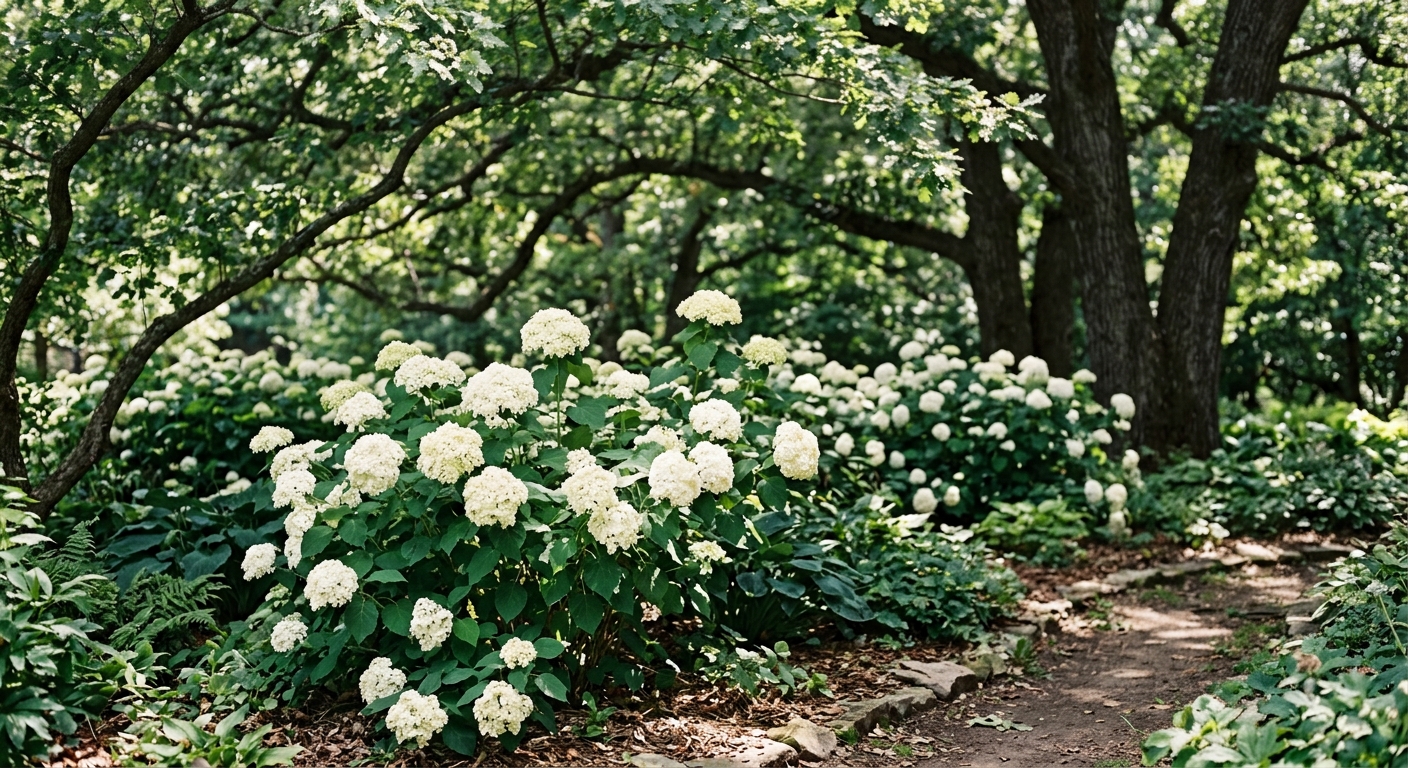
Annabelle produces huge, rounded white heads that open green and brighten to white. UMD Extension puts it at 3 to 5 feet tall with a spread of 4 to 6 feet. University of Maryland Extension
It is built for shade and part-shade beds: under high tree canopy, on the north and east sides of a house, or massed for a solid white summer display.
Honest caveat: stems flop after heavy rain, and its flowers are sterile, offering no nectar, pollen, or seed, so a fertile-flowered selection does more for wildlife. University of Maryland Extension
Incrediball (Hydrangea arborescens ‘Abetwo’)
The breeder bills Incrediball as an improved Annabelle, with very large white heads carried on sturdier stems that stay upright after heavy rain, at about 4 to 5 feet tall. provenwinners
It suits the same shady sites as Annabelle and is the better choice for formal or front-of-house plantings where flopping would be obvious.
Honest caveat: stronger stems are not storm-proof, and a heavy thunderstorm can still lean it. The heads are so large they can look out of scale in a small bed.
Invincibelle Spirit II (Hydrangea arborescens ‘NCHA4’)
Invincibelle Spirit II is the breeder’s update of the original pink smooth hydrangea, with darker leaves, stiffer stems, and larger, deeper pink flowers. It stays around 3 to 4 feet. provenwinners
It is a pink option for part shade where bigleaf hydrangeas keep failing, and it fits woodland edges and cottage-style borders.
Honest caveat: the pink softens and greens as flowers age in summer heat, so the color is less saturated than catalog photos.
Wild smooth hydrangea (Hydrangea arborescens)
The straight species carries flat, lacecap-style clusters. UMD Extension explains that fertile-flowered forms have only a few showy sterile florets around the edge, which is the typical wild look, and that the plant supplies nectar and pollen, feeds songbirds with its seed, and hosts the hydrangea sphinx moth caterpillar. It typically reaches 3 to 5 feet and spreads by suckers. University of Maryland Extension
It belongs on woodland edges, shaded slopes, native plantings, and pollinator gardens.
Honest caveat: the flowers are modest, and it spreads into a colony, so it is not a plant for a crisp, formal bed.
Oakleaf hydrangeas (Hydrangea quercifolia)
Oakleaf hydrangeas are the easiest type to identify: the lobed leaves look like an oak’s. They carry large white clusters in late June and July on old wood, with some cultivars aging to pink, prefer partial shade and moist soil, and reliably turn plum-red, burgundy, scarlet, or orange in fall. UMD Extension also notes the species is native to the Southeast but not to Maryland, which matters if you are planting to native-only standards. University of Maryland Extension
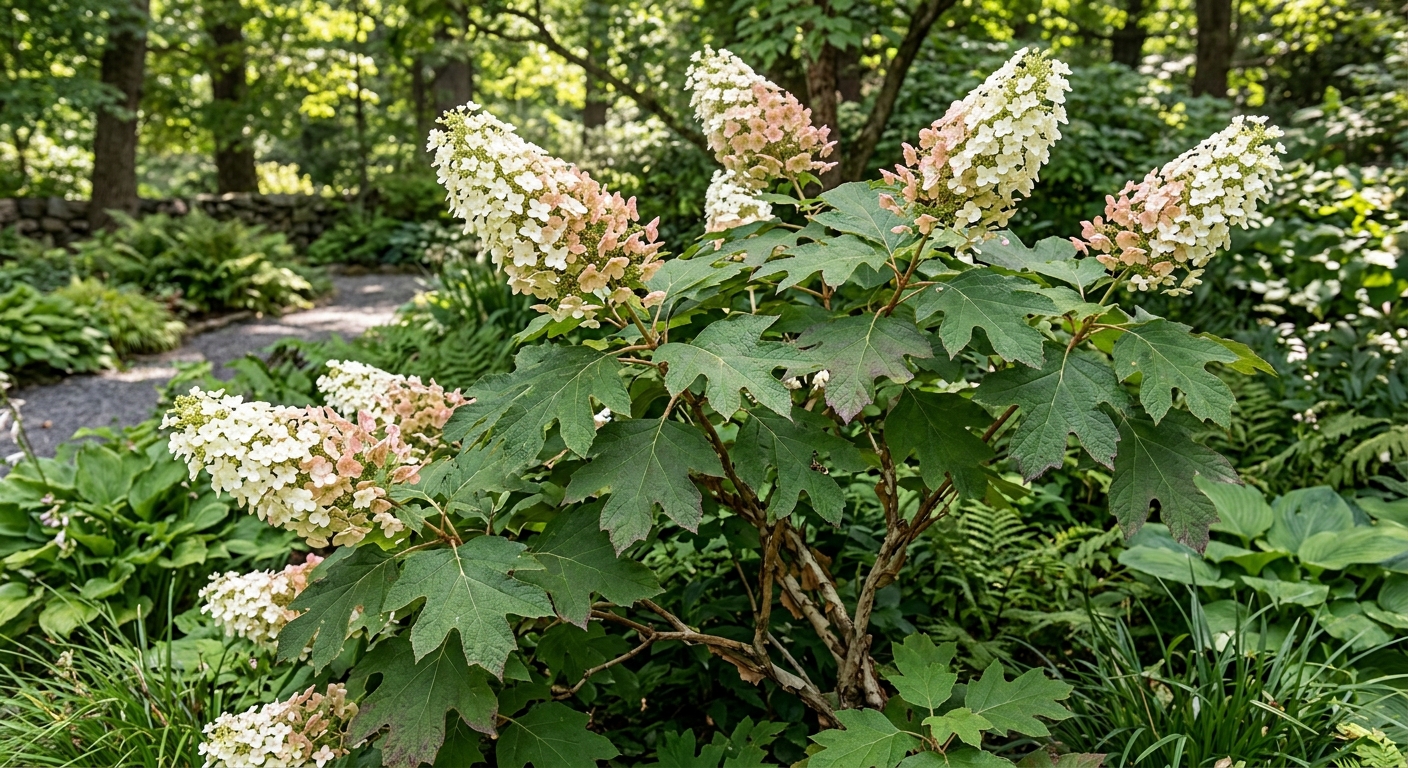
Oakleaf hydrangea (Hydrangea quercifolia)
The straight species delivers four seasons: summer flowers, strong fall color, peeling cinnamon bark in winter, and bold foliage the rest of the year. It grows 6 to 8 feet tall and often wider as it suckers.
Morning sun with afternoon shade gives the best fall color. Use it on woodland edges, in large beds, or as a loose screen under tall trees, and plant it on a slight rise if your soil is heavy clay.
Honest caveat: bacterial leaf spot hits oakleaf hydrangeas harder than other types, usually during warm, wet weather in late spring and early summer, and the plant sulks or rots in soil that stays wet. University of Maryland Extension
Snow Queen (Hydrangea quercifolia ‘Flemygea’)
Snow Queen holds large, upright white flower cones above the foliage, aging to pink, on a plant about 6 to 8 feet tall. It is one of the parents of Ruby Slippers.
It suits large properties, the back of shade borders, and specimen spots where its size can be appreciated.
Honest caveat: it blooms on old wood, so any cutting to control size removes next year’s flowers. Give it room from day one.
Ruby Slippers (Hydrangea quercifolia ‘Ruby Slippers’)
Ruby Slippers came out of the U.S. National Arboretum in Washington, D.C. It is a cross of ‘Snow Queen’ and ‘Pee Wee’, introduced in 2010, with flowers that open white, turn pink, and mature to ruby red, plus mahogany-red fall color. The Arboretum reports a size of about 3.5 feet tall and 5 feet wide at seven years. Missouri Botanical GardenU.S. National Arboretum
This is the oakleaf for smaller yards and foundation beds, and a strong Mid-Atlantic-bred choice for part shade.
Honest caveat: it is still an old-wood bloomer, so a late freeze or winter deer browsing can take the buds, and “compact” still means 5 feet wide.
Bigleaf hydrangeas (Hydrangea macrophylla)
UMD Extension calls bigleaf the most commonly grown hydrangea in Maryland, available in mophead and lacecap forms, with reblooming cultivars that flower on both old and new wood. They bloom from mid-June into August from buds set the previous season, and deer, severe cold, drought, or late frosts can kill those overwintering buds. University of Maryland ExtensionUniversity of Maryland Extension
Soil pH sets the color. Per UMD Extension, acidic soil around pH 5.0 to 5.5 produces blue, slightly acidic to alkaline soil around 6.0 to 6.5 produces pink, and purple falls in between. Extension recommends sulfur or iron sulfate for lowering pH rather than aluminum sulfate, which can burn roots. Get a soil test before trying to change color. Bigleaf types also wilt in afternoon heat even when soil is moist; if they perk up overnight, that is heat stress, not thirst. University of Maryland ExtensionUniversity of Maryland Extension
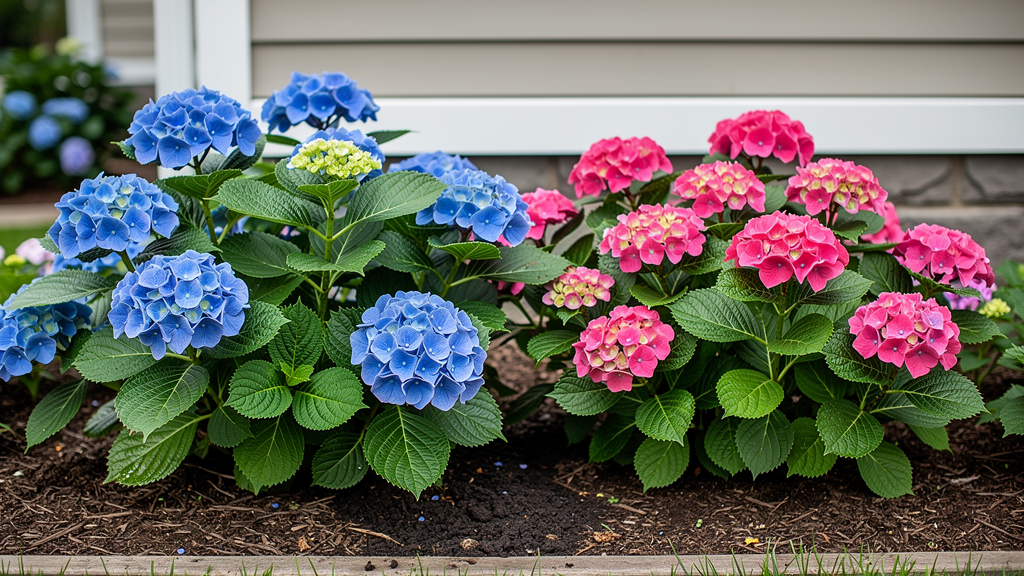
Endless Summer The Original (Hydrangea macrophylla ‘Bailmer’)
Endless Summer was the first widely sold reblooming bigleaf: a mophead that flowers on both old and new wood, blue or pink depending on pH, at roughly 3 to 5 feet.
It fits east-facing foundation beds and large containers, and it is the bigleaf to choose if winter keeps taking your flowers.
Honest caveat: rebloom is a backup, not a guarantee. The new-wood flush needs a long season and good light, so in heavy shade or after a late freeze it can arrive late and light. It still wilts in afternoon sun.
Nikko Blue (Hydrangea macrophylla ‘Nikko Blue’)
Nikko Blue is the classic mophead, with large heads that turn deep blue in acidic soil, on a plant about 4 to 6 feet tall. It blooms on old wood only.
It suits shaded foundation plantings and sheltered spots near a house wall, where the wall softens winter cold.
Honest caveat: this is the plant most often behind “my hydrangea won’t bloom.” One late freeze, winter deer browsing, or a fall cutback means no flowers that year.
Twist-n-Shout (Hydrangea macrophylla ‘PIIHM-I’)
Twist-n-Shout is a reblooming lacecap: flat clusters of tiny fertile flowers ringed with showy florets, pink or periwinkle by pH, with red fall foliage. It grows about 3 to 5 feet.
The small fertile flowers are the ones that actually support pollinators, so lacecaps are the better bigleaf choice for pollinator-minded gardens, woodland edges, and part-shade mixed borders. University of Maryland Extension
Honest caveat: lacecaps are subtle from a distance and won’t give the curbside punch of a mophead.
Mountain and climbing hydrangeas
These two are less common but solve specific problems: a small shady space, and a shady vertical surface.
Tuff Stuff (Hydrangea serrata ‘MAK20’)
Mountain hydrangea looks nearly identical to bigleaf and carries lacecap-style flowers, and it is one of only two commonly grown species that can bloom blue or purple. Tuff Stuff is a reblooming selection about 2 to 3 feet tall, pink or blue by pH, with red fall color. University of Maryland Extension
It works at the front of shade borders, in small courtyards, and in containers.
Honest caveat: it is small and less showy than a mophead, and because it looks so much like bigleaf, keep the label so no one prunes it at the wrong time.
Climbing hydrangea (Hydrangea anomala subsp. petiolaris)
Climbing hydrangea attaches itself with small root-like holdfasts, so it scales a wall or structure without being tied. It carries flat white lacecap flowers in late spring on old wood and can eventually cover 30 to 50 feet of a large support. University of Maryland Extension
UMD Extension ranks climbing hydrangeas among the best vines for shade, which makes it ideal for north-facing stone walls, mature tree trunks, and pergola posts. University of Maryland Extension
Honest caveat: it can be slow to establish before it flowers well, often several years, and the holdfasts grip hard, so keep it off painted siding and wood trim. University of Maryland Extension
How to tell hydrangea types apart
Start with the leaves. Oak-shaped lobes mean oakleaf. A vine clinging to a wall or tree is climbing hydrangea. Thick, glossy, oversized leaves suggest bigleaf; thinner, matte leaves suggest smooth; smaller, rougher oval leaves suggest panicle.
Then look at the flowers. Cone-shaped clusters point to panicle or oakleaf. Round mopheads or flat lacecaps point to bigleaf, smooth, or mountain. Blue or purple flowers narrow it to bigleaf or mountain hydrangea, since those are the only commonly grown species that produce those colors. University of Maryland Extension
Finally, check timing. In central Maryland, smooth hydrangeas open in June, bigleaf from mid-June, oakleaf in late June, and panicle hydrangea is the last species to flower. University of Maryland Extension
Old wood vs new wood: why type decides pruning
Per UMD Extension, oakleaf, bigleaf, mountain, and climbing hydrangeas flower on old wood, smooth and panicle hydrangeas flower on new wood, and reblooming bigleaf and mountain cultivars flower on both. That single fact decides when you can cut without losing flowers. Timing and technique for each type are in our step-by-step guide to pruning hydrangeas in Maryland. University of Maryland Extension
Do hydrangeas need full sun? Matching type to your Maryland site
Mostly, no. UMD Extension cautions that although plant tags may promise full-sun tolerance, hydrangeas in full sun need more water, may bloom for a shorter period, and can scorch, because several species evolved in woodlands. Panicle hydrangeas are the exception and take full sun to part shade. Smooth, oakleaf, bigleaf, and mountain types do best with morning sun and afternoon shade, and climbing hydrangea tolerates real shade. University of Maryland Extension
Soil comes next. Many Maryland yards, especially around newer homes, sit on compacted clay subsoil that drains slowly. Look up your lot’s soil type in the USDA Web Soil Survey, and put oakleaf and panicle hydrangeas where water doesn’t stand after a storm.
For small yards, look at Bobo, Little Lime, Ruby Slippers, Tuff Stuff, and Invincibelle Spirit II. For large properties, Limelight, Snow Queen, the oakleaf species, and climbing hydrangea on a mature tree give the scale. If you want a flowering tree to pair with them, see our best ornamental trees for Maryland.
Native vs non-native hydrangeas in Maryland
Only smooth hydrangea is native to Maryland. Oakleaf is native to the Southeastern U.S. but its range doesn’t extend into Maryland, and panicle, bigleaf, mountain, and climbing hydrangeas come from East Asia. University of Maryland Extension
For pollinators, flower form matters as much as origin. The showy part of many hydrangea blooms is sterile and provides no pollen, while the smaller, less showy fertile flowers do support pollinators. Wild smooth hydrangea and lacecap forms feed pollinators; mopheads like Annabelle and Nikko Blue mostly don’t. A planting that mixes both gets the display and the ecological value. University of Maryland Extension
Planning a hydrangea planting?
Choosing the right hydrangea is mostly about matching type to light, drainage, and space. Oakfield designs and installs hydrangea plantings as part of our landscape planting design and installation work across Harford County and the Bel Air area. Schedule a design consultation and we’ll walk your property and recommend the varieties that fit.
Hydrangea FAQs
Do deer eat hydrangeas?
Yes. UMD Extension notes that hungry deer will eat hydrangea buds and foliage in every season if plants are unprotected. Oakleaf, bigleaf, and mountain types suffer most, because winter browsing removes the buds for next summer’s flowers, while panicle and smooth types rebuild flowers on new growth. In deer-heavy parts of Maryland, pair plantings with fencing or a rotating repellent program. University of Maryland Extension
When do hydrangeas bloom in Maryland?
Maryland’s hydrangea season runs from June into fall in a predictable order. Smooth hydrangeas open in June, bigleaf types from mid-June into August, oakleaf in late June and July, and panicle hydrangeas starting in mid-July. Reblooming bigleaf varieties add later flushes. Plant one of each type and a central Maryland garden gets close to four months of color. University of Maryland Extension
When is the best time to plant hydrangeas in Maryland?
Fall is the best time, followed by early spring. UMD Extension recommends planting shrubs in fall, in winter when the ground isn’t frozen, or in early spring, and avoiding summer planting when plants are in full leaf. Container-grown plants are more flexible but need steady watering. In central Maryland, mid-September through October gives roots weeks of warm soil before winter. umd
How do you care for hydrangeas in clay soil?
Start with a soil test, plant slightly high so the root crown sits above the surrounding clay, water deeply rather than often, and keep a few inches of mulch over the root zone. Skip heavy high-nitrogen feeding, which can push leaves at the expense of flowers. In Maryland, oakleaf and panicle hydrangeas are the least tolerant of standing water, so check drainage before planting them in heavy clay. University of Maryland Extension
Can you propagate hydrangeas from cuttings?
Yes. University of Missouri Extension recommends softwood cuttings in early summer, taken from the tips of shoots that haven’t flowered, about 3 to 5 inches long with at least three leaves; layering a low branch into soil also works. Check the tag first, because reproducing patented or trademarked plants may be prohibited. Many named Maryland favorites, including Limelight, are patented. muddyrivernewsillinois

With over 10 years of experience locally in Maryland, Oakfield Landscaping has a team of skilled professionals ready to deliver exceptional services.
Start your project
Ready to create a landscape that enhances your property and reflects your vision?
Our design process begins with an in-depth consultation:
- Walk your property and discuss your vision
- Review your functional & aesthetic preferences
- Assess existing landscape conditions
- Explain our design-installation process and timeline
- Answer your questions about our approach