The short answer: The best conifers for Maryland are the ones bred for heat and humidity rather than mountain cold. Deodar and blue Atlas cedar make the big specimens, loblolly and Virginia pine are the tough natives, Japanese umbrella pine is the medium showpiece, and dwarf Hinoki cypress, ‘Blue Star’ juniper and Japanese plum yew carry the small beds.
Maryland is harder on conifers than most people expect. Harford County sits mostly in Zones 6b and 7a on the 2023 USDA Plant Hardiness Zone Map, cold enough in winter for nearly anything, but the summers are long, hot and humid, and the heavy clay loam we dig into around Bel Air holds water that rots the roots of dry-country evergreens. That is why University of Maryland Extension now says Colorado blue spruce is no longer recommended for planting in the state, and why the conifers that last here tend to come from the Himalayas, North Africa, Japan and our own coastal plain rather than the Rockies. University of Maryland Extension
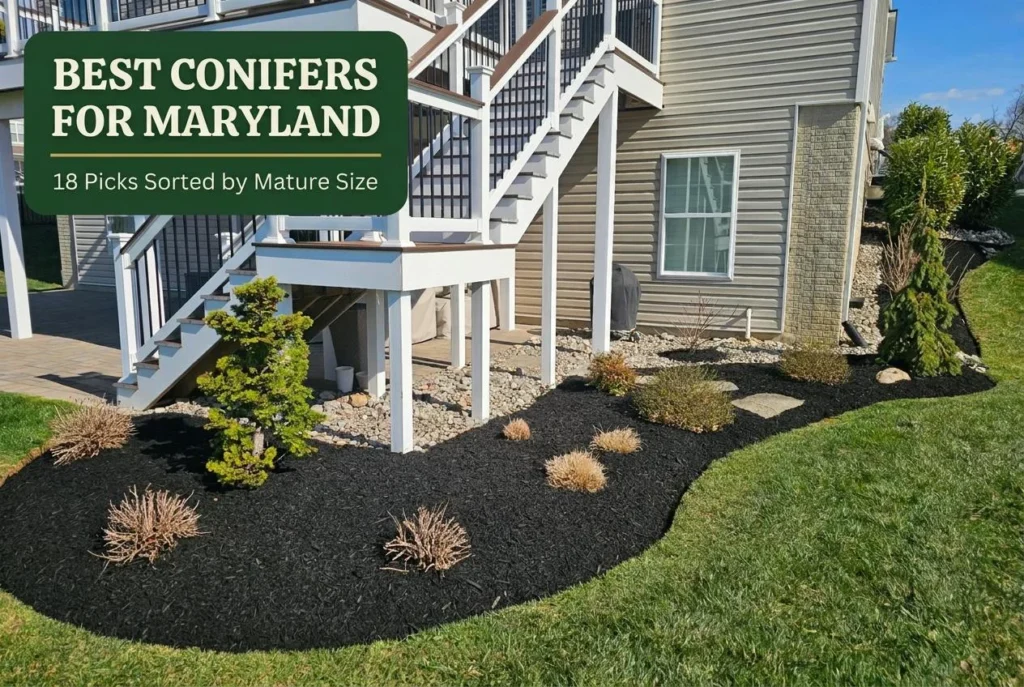
Below are 18 conifers for landscaping in Maryland, sorted by mature size, each with its site fit, design use and one honest drawback. If you need a fast screen rather than a specimen, our guide to fast-growing privacy trees for Maryland covers white pine, Norway spruce and hemlock, and the Green Giant vs. Leyland cypress vs. Emerald Green comparison covers the arborvitae, cypress and junipers people plant in rows.
Maryland conifers at a glance
| Conifer | Mature size | Growth | USDA zones | Best use |
|---|---|---|---|---|
| Deodar cedar | 40 to 50 ft tall | Medium | 7 to 8 | Soft, weeping specimen on a big lawn |
| Blue Atlas cedar | 40 to 60 ft tall | Medium | 6 to 9 | Silver-blue specimen, the blue spruce substitute |
| Loblolly pine | 40 to 90 ft tall | Fast | 6 to 9 | Fast native pine for wet, poorly drained ground |
| Virginia pine | 40 to 80 ft tall | Slow | 4 to 8 | Native pine for dry clay banks |
| Oriental spruce | 50 to 60 ft tall | Slow | 4 to 7 | Narrow, dark green spruce for a formal lawn |
| Atlantic white cedar | 30 to 50 ft tall | Medium | 4 to 8 | Native steeple for a damp corner |
| Japanese black pine | 20 to 60 ft tall | Medium | 5 to 8 | Sculptural pine for salty, windy sites |
| Japanese umbrella pine | 25 to 30 ft tall | Very slow | 5 to 8 | The collector’s centerpiece |
| Weeping Norway spruce | 4 to 15 ft, trained | Medium | 3 to 7 | Living sculpture by an entry or wall |
| Weeping blue Atlas cedar | 3 to 12 ft, trained | Slow | 6 to 7 | Blue cascade over a wall or arch |
| Dwarf Alberta spruce | 10 to 13 ft tall | Very slow | 3 to 6 | Formal cone in a container or knot garden |
| Japanese plum yew | 5 to 10 ft tall | Slow | 6 to 9 | Deer-proof evergreen for shade |
| Dwarf Hinoki cypress | 3 to 6 ft tall | Slow | 4 to 8 | Year-round focal point in a foundation bed |
| Bird’s nest spruce | 2 to 8 ft tall | Slow | 3 to 7 | Low mound for the front of a border |
| Dwarf mugo pine | 3 to 5 ft tall | Slow | 3 to 7 | Sunny slope, rock garden, deer country |
| ‘Golden Mop’ false cypress | 3 to 5 ft tall | Slow | 5 to 7 | Gold color for part shade |
| ‘Blue Star’ juniper | 1 to 3 ft tall | Slow | 4 to 8 | Blue accent along a walk |
| ‘Blue Rug’ creeping juniper | 4 to 6 in. tall | Medium | 3 to 9 | Evergreen groundcover for a dry bank |
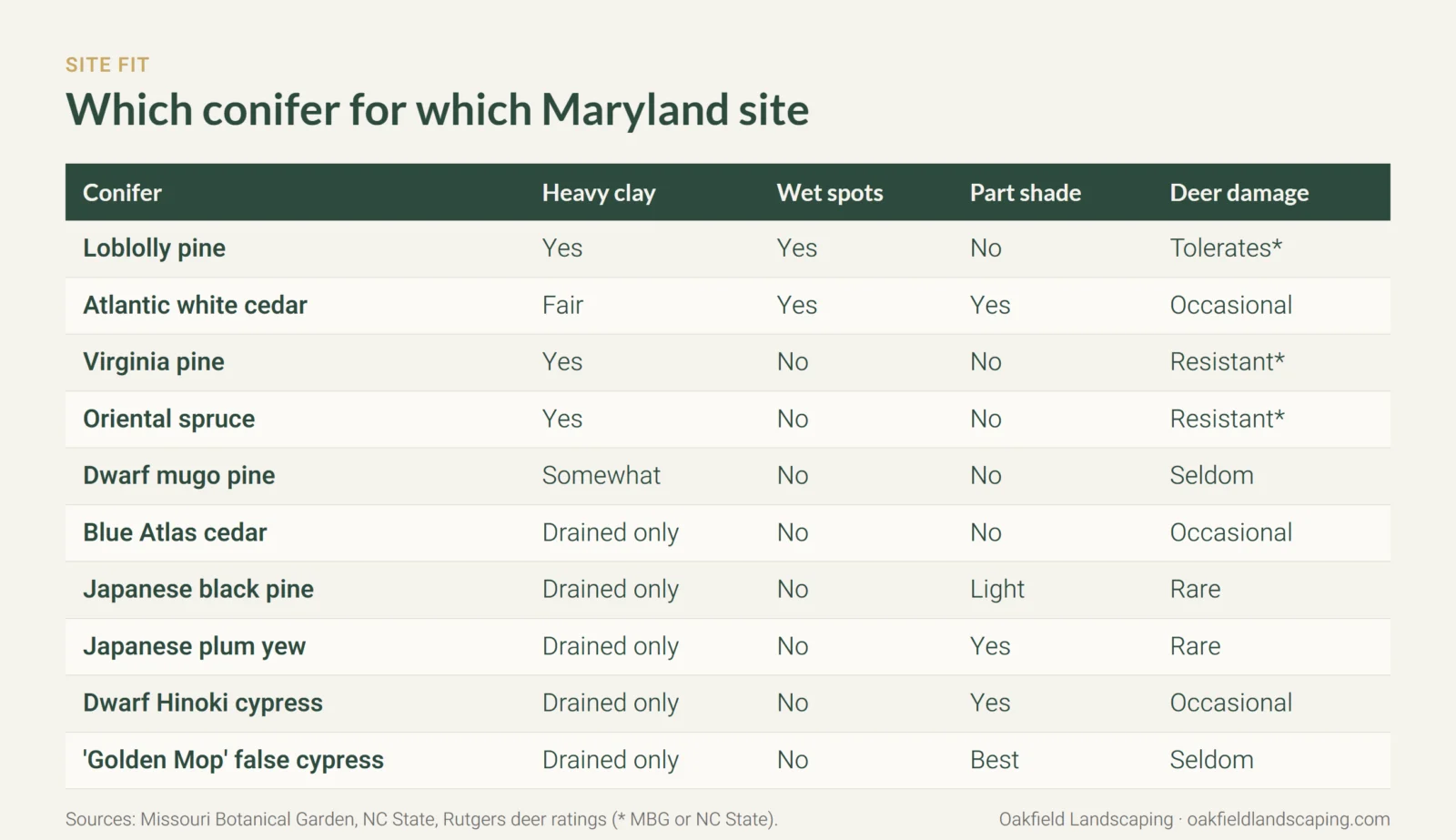
Large conifers for Maryland (40 feet and up)
The specimen and skyline trees. They belong on the larger lots toward Fallston, Forest Hill and Jarrettsville, where a 30-foot spread has room.
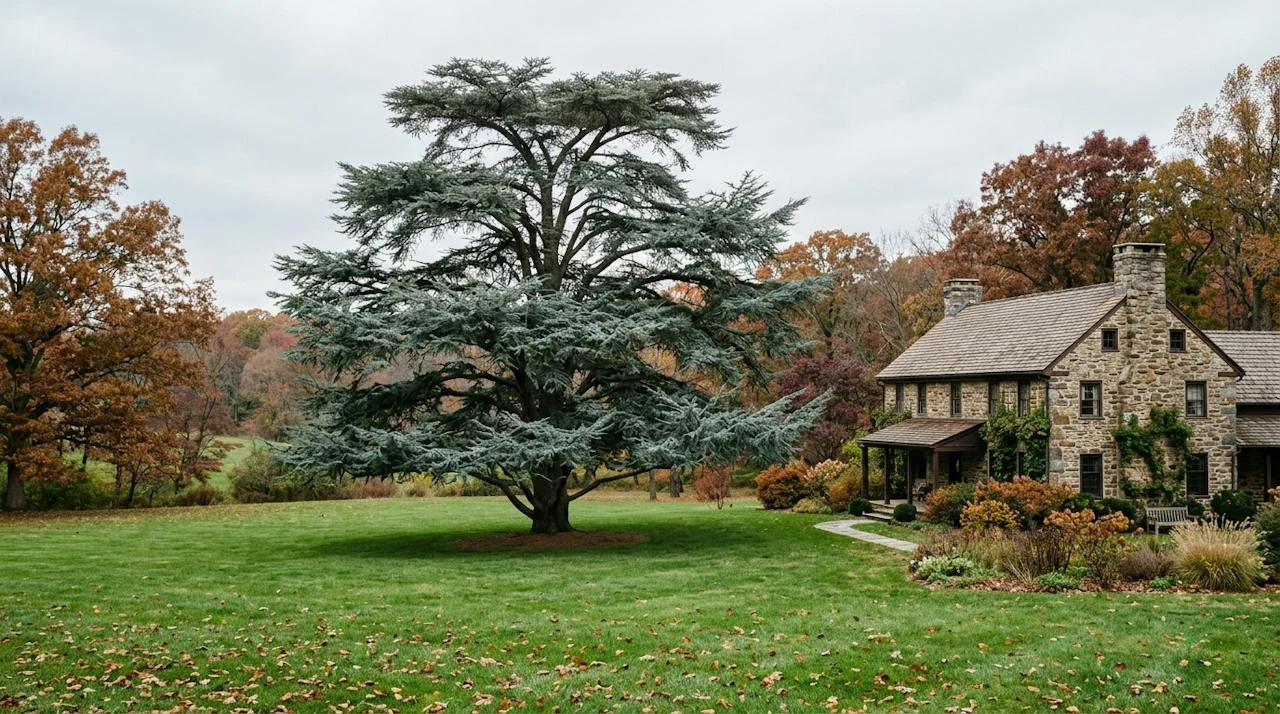
Deodar cedar (Cedrus deodara)
Deodar is the softest-looking of the true cedars, with long, gray-green needles, a drooping leader and branch tips that sweep toward the ground. Missouri Botanical Garden lists it at 40 to 50 feet tall and 30 to 40 feet wide in cultivation, at a medium growth rate, and notes it has the best tolerance of hot, humid summers among the true cedars. Missouri Botanical Garden
It wants full sun and deep, well-drained, acidic loam, and it handles drought once established. Design use: the single specimen at the far end of a long lawn, where the low, skirted branches can stay on the ground. University of Maryland Extension names the cultivar ‘Karl Fuchs’ as one of its suggested replacements for blue spruce.
Honest caveat: It is rated for Zones 7 and 8, so it is at its cold edge in the 6b pockets of northern Harford County, and it does not tolerate poorly drained, wet soil. Plant it on a slope or a raised berm, never in the low corner.
Blue Atlas cedar (Cedrus atlantica ‘Glauca’)
Blue Atlas cedar gives you the silver-blue color people want from a Colorado spruce, on a tree that actually likes Maryland summers. Missouri Botanical Garden puts it at 40 to 60 feet tall and 30 to 40 feet wide, pyramidal when young and flat-topped with long, horizontal branches in age, hardy in Zones 6 to 9 and tolerant of heat, humidity and drought once established. Missouri Botanical Garden
Give it full sun and well-drained, acidic soil. University of Maryland Extension includes it among its recommended blue spruce alternatives. Design use: an estate specimen framed by open lawn, or the backdrop to a terrace where its blue reads against a dark house.
Honest caveat: The wide, layered branches break under heavy wet snow, so keep it clear of the driveway and the roof line. Tip blight occasionally shows up, and Rutgers rates Atlas cedar as occasionally severely damaged by deer, so young trees need a cage.
Loblolly pine (Pinus taeda)
Loblolly is the fast native pine of the coastal plain, and its name comes from an old word for a mudhole, which tells you where it grows. Missouri Botanical Garden lists it as fast-growing to 40 to 90 feet tall and 20 to 40 feet wide, usually 40 to 50 feet in a landscape, in Zones 6 to 9. Missouri Botanical Garden
It is one of the few conifers that prefers moist, acidic soil with poor drainage, and Missouri Botanical Garden calls it an excellent tree for low areas and lists deer among the things it tolerates. Design use: a fast, airy evergreen grove at the back of a property, or the tall conifer beside a rain garden on the clay soils of the lower county.
Honest caveat: It has no shade tolerance at all, and in the wild it can pass 90 feet, so it needs open sky and distance from the house. Southern pine beetle, pine engraver beetle and fusiform rust are its main problems.
Virginia pine (Pinus virginiana)
Virginia pine is the scrubby native pine that NC State Extension notes often grows in pure stands in old fields, and the Maryland Manual lists it among the state’s native trees. It earns a place on a hard site. NC State Extension lists it at 40 to 80 feet tall and 10 to 30 feet wide, growing slowly, hardy in Zones 4 to 8, and notes that it grows well on eroded, poor, dry ground including clay. NC State Extension
The same source calls it deer resistant and moderately pollution tolerant for a pine. Missouri Botanical Garden gives a smaller landscape range of 30 to 60 feet, which matches what we see on residential lots. Design use: a naturalized grove on a dry, sunny bank where nothing else wants to grow, underplanted with native grasses.
Honest caveat: It is not a refined tree. NC State notes it is susceptible to wind damage and pitch canker and has numerous pest and disease problems. Use it where character matters more than symmetry.
Oriental spruce (Picea orientalis)
Oriental spruce is the elegant spruce: short, glossy, dark green needles on a dense, narrow pyramid. NC State Extension puts it at 50 to 60 feet tall but only 15 to 20 feet wide, growing slowly in Zones 4 through 7, and tags it as clay tolerant, drought tolerant and deer resistant. NC State Extension
That narrow footprint is the selling point. It is one of the few large conifers that fits along a side property line or beside a two-story house without overwhelming it, and University of Maryland Extension lists it as a blue spruce alternative. Design use: a formal pair flanking a long view, or a single dark vertical against a pale stone house.
Honest caveat: The sources do not fully agree. NC State calls it a cool-climate tree that struggles in heat and humidity, and University of Maryland Extension lists it among the spruces Cytospora canker can infect. Plant it on well-drained ground with good air movement, and expect it to be slower here than in Pennsylvania.
Medium conifers for Maryland (20 to 40 feet)
Medium conifers are the right scale for a quarter-acre to half-acre lot in Bel Air or Abingdon: big enough to anchor a corner of the house, small enough that you are not limbing them up off the roof in 20 years.
Atlantic white cedar (Chamaecyparis thyoides)
Atlantic white cedar is a native of the coastal swamps and bogs from Maine to Florida, and the Maryland Manual lists it among the state’s native trees. Missouri Botanical Garden gives it a steeple-shaped crown 30 to 50 feet tall, hardy in Zones 4 to 8, in full sun to part shade, with medium to wet soil and a tolerance for some wet ground. Missouri Botanical Garden
It is the native conifer for a damp spot that drowns most evergreens. Design use: a loose cluster of three at the edge of a pond, a swale or a yard with standing water on clay after storms, where its fine, blue-green foliage reads as a native grove.
Honest caveat: It is a bog plant, so it does best in peaty, sandy soil and sulks on dry, compacted clay. It wants shelter from strong wind, it has some susceptibility to juniper blight and bagworms, and Rutgers rates it as occasionally severely damaged by deer.
Japanese black pine (Pinus thunbergii)
Japanese black pine is the pine of Japanese gardens and the seashore: dark green, stiff needles, conspicuous whitish buds and a habit that takes well to shaping. Missouri Botanical Garden lists it at 20 to 60 feet tall and about 12 feet wide in cultivation, hardy in Zones 5 to 8, and notes it tolerates salt and some drought. Missouri Botanical Garden
Rutgers rates it as rarely damaged by deer. Design use: a sculptural accent pruned in the cloud style, or a wind and salt-tolerant evergreen on the waterfront lots along the Bush River, where Coastal Plain soils and shoreline wind narrow the plant list, a setting we cover for Abingdon properties.
Honest caveat: Missouri Botanical Garden lists both pinewood nematode and Diplodia tip blight among its problems. Penn State Extension advises against planting two- and three-needled pines near older pines already infected with Diplodia. Buy from a clean source and keep it watered through drought.
Japanese umbrella pine (Sciadopitys verticillata)
Japanese umbrella pine is not a true pine at all but the only member of its own plant family, with thick, glossy needles held in whorls like the ribs of an umbrella. Missouri Botanical Garden lists it at 25 to 30 feet tall and 15 to 20 feet wide in American gardens, hardy in Zones 5 to 8, with no serious insect or disease problems. Missouri Botanical Garden
It wants full sun to light afternoon shade and moist, rich, slightly acidic, well-drained soil that never dries out. Design use: the collector’s specimen in a courtyard or beside a front walk where people see it up close, the kind of plant we cover in our piece on sourcing specimen plants big-box stores don’t carry.
Honest caveat: It is very slow. Missouri Botanical Garden says it often reaches only 4 to 5 feet in its first 10 years, so buy the size you want to look at on day one.
Weeping and small conifers (about 15 feet and under)
This group fills the space between a shrub and a tree: an entry, a foundation corner, a courtyard. The two weepers take whatever shape their staking gives them.
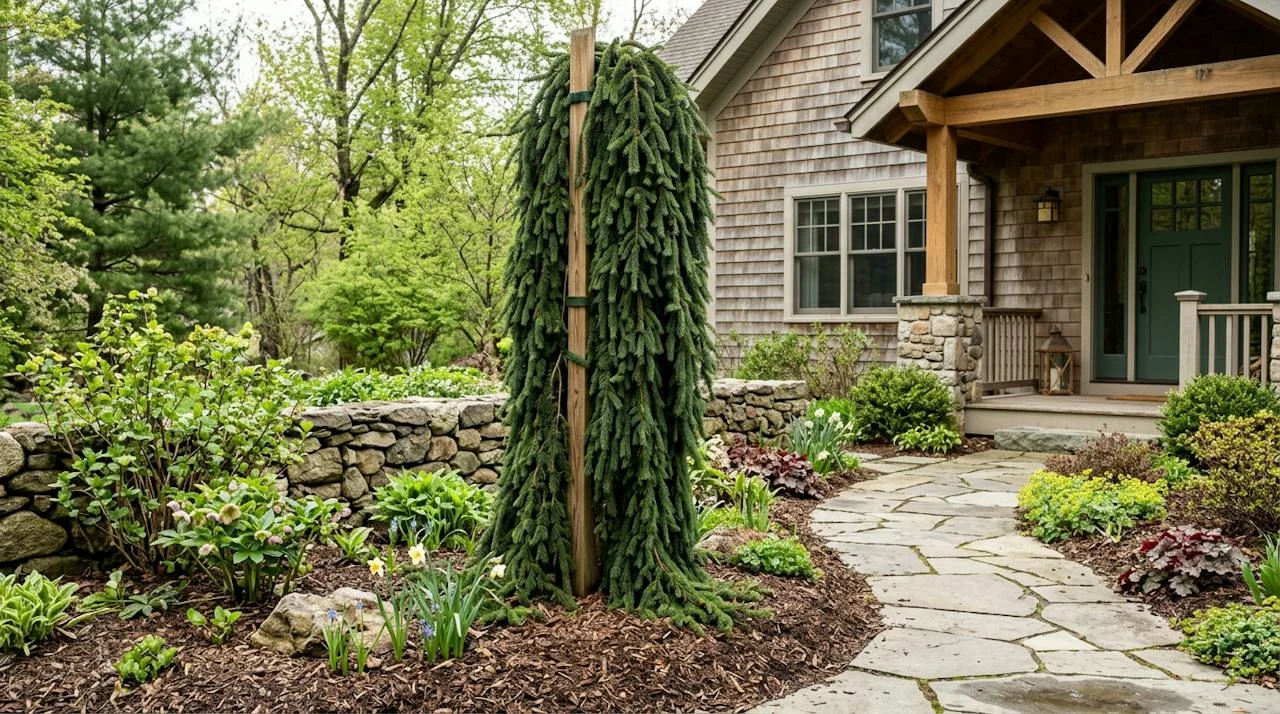
Weeping Norway spruce (Picea abies ‘Pendula’)
Weeping Norway spruce has no fixed shape. Missouri Botanical Garden explains that, left alone, it spreads across the ground as a woody groundcover, while a staked leader turns it into a 10 to 15 foot tree with branches that hang straight down like a curtain. It is hardy in Zones 3 to 7 and tolerates deer and urban conditions. Missouri Botanical Garden
Give it full sun and evenly moist, acidic, well-drained soil. Design use: a vertical sculpture beside an entry or against a stone wall, or a sprawling mound spilling over a boulder.
Honest caveat: Missouri Botanical Garden notes it prefers cool summers and often grows poorly south of Zone 7, which makes central Maryland the edge of its comfort. Cytospora canker and spider mites are the problems to watch, and it needs staking for years to hold an upright shape.
Weeping blue Atlas cedar (Cedrus atlantica ‘Glauca Pendula’)
Weeping blue Atlas cedar is the silver-blue weeper you see trained over garden arches and along walls. Missouri Botanical Garden lists it at 3 to 12 feet tall and wide depending on training: a supported leader climbs slowly, about a foot a year, and can be stopped at a set height and allowed to cascade. Missouri Botanical Garden
It shares the species’ love of sun, drought tolerance once established and deep, well-drained acidic soil. Design use: espaliered along a wall or trained over an entry arch, where it reads as a blue waterfall in winter.
Honest caveat: Without a gardener’s hand it becomes a shapeless blue heap, so plan on years of staking and tying. Heavy snow breaks the long arms, and tip blight can occur.
Dwarf Alberta spruce (Picea glauca ‘Conica’)
Dwarf Alberta spruce is the neat, soft-needled cone sold by the thousand every December. Missouri Botanical Garden lists it at 10 to 13 feet tall over many years, growing only 2 to 4 inches a year, and Rutgers rates it as rarely damaged by deer. Missouri Botanical Garden
Virginia Tech’s extension guide treats it as a usable landscape plant in full sun to part shade, adaptable to most soils. Design use: a matched pair in large containers at a door, or the formal punctuation in a knot or parterre garden. Virginia Tech
Honest caveat: This one is a gamble here. Missouri Botanical Garden says it should not be grown in the eastern U.S. south of Zone 6, and Penn State Extension calls it one of the spruce spider mite’s preferred hosts. Mites brown it from the inside out within months, so plan on checking it every spring and fall, and treat it as a container plant you can replace.
Japanese plum yew (Cephalotaxus harringtonia)
Japanese plum yew looks like a yew with longer, softer, glossier needles, and it fixes the biggest problem yews have in Maryland, deer, while adding good heat tolerance. Missouri Botanical Garden lists it at 5 to 10 feet tall and wide, slow-growing, hardy in Zones 6 to 9, with good heat tolerance and no serious insect or disease problems. Missouri Botanical Garden
It prefers part to full shade, which makes it one of the few conifers for the north side of a house or under tall trees. Rutgers rates Japanese plum yew as rarely damaged by deer, against a “frequently severely damaged” rating for true yews. Design use: a low evergreen hedge or foundation mass in shade, where true yews would be browsed.
Honest caveat: It is slow, often taking 10 years to reach 4 feet, and it still wants moist, well-drained soil. On the heaviest clay we plant it slightly high in an amended bed.
Dwarf conifers for Maryland (under 6 feet)
Dwarf conifers hold color and structure in the front bed all winter without outgrowing the window. Every one in this group dislikes wet feet.
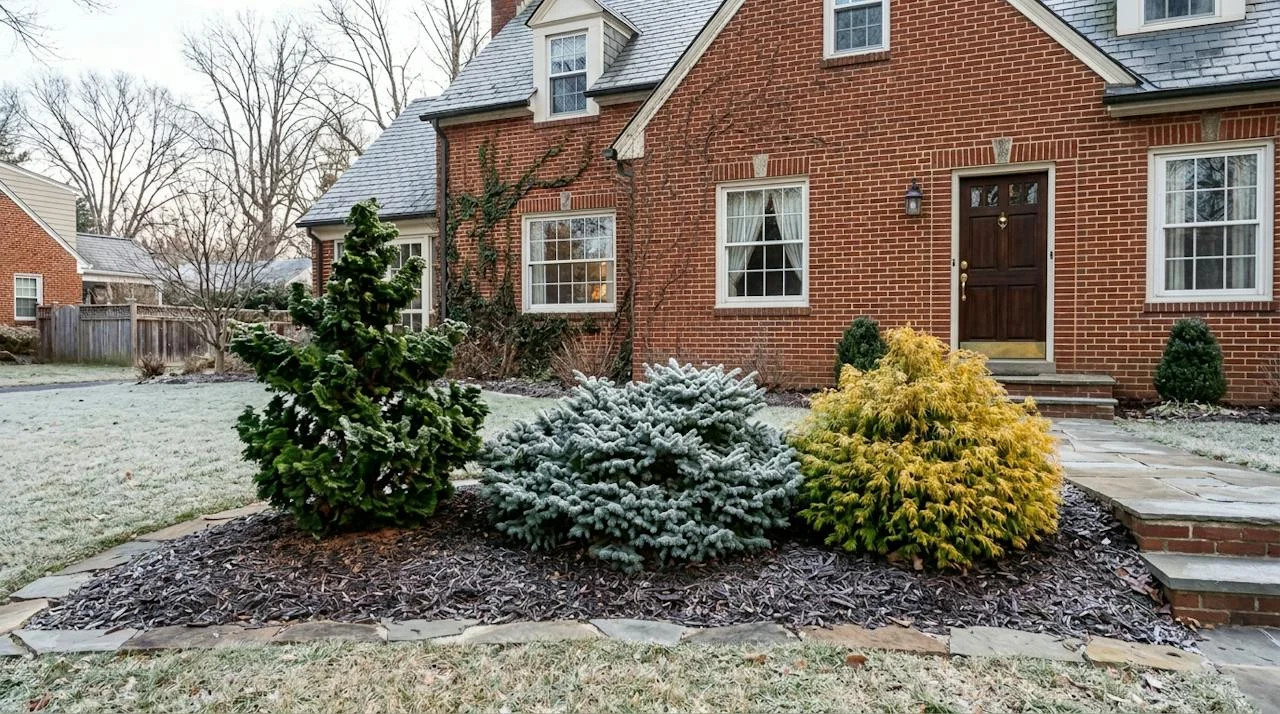
Dwarf Hinoki cypress (Chamaecyparis obtusa ‘Nana Gracilis’)
‘Nana Gracilis’ is the dwarf Hinoki with dark green, shell-shaped sprays of foliage in a slightly irregular pyramid. Missouri Botanical Garden lists it at 3 to 6 feet tall and 2 to 4 feet wide, though its own notes say it reaches about 3 feet in 10 years and can eventually reach 6 to 9 feet. It is hardy in Zones 4 to 8. Missouri Botanical Garden
It takes full sun to part shade and average, well-drained soil, with shelter from wind. Design use: the focal point of a foundation bed or a Japanese-style garden, where its texture holds up to close viewing. The full-size Hinoki used as a screen is covered in the privacy tree comparison linked above. For a screen in a tight side yard, our guide to tall, narrow privacy trees for small yards profiles columnar hollies, oaks and hornbeams instead.
Honest caveat: Missouri Botanical Garden says to avoid wet, poorly drained soils, and root rot is its most common failure on Maryland clay. It is also susceptible to bagworms, and Rutgers rates Hinoki cypress as occasionally severely damaged by deer.
Bird’s nest spruce (Picea abies ‘Nidiformis’)
Bird’s nest spruce is a dwarf Norway spruce that forms a flat-topped mound with a slight hollow in the center, the “nest.” Missouri Botanical Garden says it typically grows 1 to 2 feet tall and 3 to 4 feet wide in its first 10 years and can eventually reach about 8 feet tall and 10 to 12 feet wide over 30 years. Missouri Botanical Garden
It wants full sun and evenly moist, acidic, well-drained soil, and it tolerates deer and urban conditions. Design use: the low, wide evergreen at the front of a border or the corner of a walk, where it reads as a living boulder.
Honest caveat: Like weeping Norway spruce, it often grows poorly south of Zone 7, so central Maryland is its limit. Cytospora canker and red spider mites are the pests to watch, and “dwarf” eventually means 10 feet wide.
Dwarf mugo pine (Pinus mugo var. pumilio)
Dwarf mugo is a low, dense, many-stemmed pine from the mountains of central Europe. Missouri Botanical Garden lists var. pumilio at 3 to 5 feet tall and 6 to 10 feet wide, hardy in Zones 3 to 7, and notes it is somewhat tolerant of clay and tolerates deer, drought and dry soil. Missouri Botanical Garden
For a smaller space, the cultivar ‘Mops’ matures at about 3 feet tall and wide. Design use: a sunny slope, a rock garden or the front of a dry bed where deer browse everything else.
Honest caveat: It prefers cool summers and hates wet, poorly drained soil, and pine needle scale and sawflies can be serious. Buy a named dwarf form rather than an unlabeled mugo, since the species itself grows much larger.
‘Golden Mop’ threadleaf false cypress (Chamaecyparis pisifera ‘Golden Mop’)
‘Golden Mop’ is a mound of fine, stringy, golden-yellow foliage that holds its color all year. Missouri Botanical Garden lists it at 3 to 5 feet tall and wide, about 2 to 3 feet in its first 10 years, hardy in Zones 5 to 7. Missouri Botanical Garden
Unusually for a gold conifer, it does best in part shade, which keeps the foliage from scorching in a Maryland July. Rutgers rates Japanese false cypress as seldom severely damaged by deer. Design use: a bright accent in a part-shade bed, paired with dark green dwarf Hinoki or blue juniper for contrast.
Honest caveat: It needs moist, well-drained soil and shelter from strong wind, and root rot and bagworms are its weak points.
‘Blue Star’ juniper (Juniperus squamata ‘Blue Star’)
‘Blue Star’ is a slow, irregular mound of short, sharp, silver-blue needles. Missouri Botanical Garden lists it at 1 to 3 feet tall and 1 to 4 feet wide, about a foot tall after five years, hardy in Zones 4 to 8, and tolerant of deer, drought, erosion and rocky soil. Missouri Botanical Garden
Rutgers rates it as seldom severely damaged by deer. Design use: a blue accent repeated along a front walk, at the edge of a dry stream bed, or in the hot strip by a driveway where most plants fry.
Honest caveat: It is intolerant of wet soil and develops root rot on poorly drained clay, and Phomopsis twig blight browns the tips in rainy springs. Plant it high, in gritty soil, with sun all day.
‘Blue Rug’ creeping juniper (Juniperus horizontalis ‘Wiltonii’)
‘Blue Rug’ is the flattest conifer on this list: a silver-blue mat only 4 to 6 inches tall that spreads 6 to 8 feet wide and turns plum-purple in winter. Missouri Botanical Garden lists it in Zones 3 to 9, tolerant of heat, drought, poor soil, erosion and deer. Missouri Botanical Garden
Design use: an evergreen groundcover for a sunny bank too steep to mow, or a soft edge spilling over a wall. University of Maryland Extension lists purple as the normal winter color of creeping juniper, so the plum cast in January is not a problem.
Honest caveat: It is intolerant of wet soil, gets tip blight in wet springs, and older plants can die out in the center. In our experience it also does not suppress weeds until it closes in, so plan on hand-weeding for the first couple of seasons.
Deciduous conifers: the ones that drop their needles
Not every conifer is evergreen. Missouri Botanical Garden names larch, dawn redwood and bald cypress as deciduous conifers: they bear cones and needles like a pine, color up in fall and then go bare for winter. Missouri Botanical Garden
For Maryland, two of the three are excellent. Bald cypress is native here, Missouri Botanical Garden notes its range runs along the coast from Maryland to Texas, and it handles clay and wet soil better than almost any tree, which is why we profile it in our best shade trees for Maryland guide. Dawn redwood, per the same source, grows into a narrow 70 to 100 foot spire with red-bronze fall color and also tolerates clay and wet ground; the privacy guide above covers it as a fast screen for big lots. European larch is the one to skip: Missouri Botanical Garden rates it for Zones 2 to 6 and notes it often performs poorly in hot, humid conditions. Missouri Botanical Garden
The practical point: a bald cypress or dawn redwood turning rust-brown in November is doing exactly what it should.
Native conifers for Maryland and why they matter
The Maryland Manual’s list of native trees includes these conifers: Atlantic white cedar, bald cypress, eastern hemlock, eastern white pine, loblolly pine, Virginia pine and eastern red cedar, and it even pictures red cedars growing in Harford County. Maryland Manual
Natives earn their place because they are already adapted to the heat, the clay and the local insects, and they feed the birds that rely on them in winter. But native is not the same as easy. Eastern hemlock is beautiful and shade-tolerant, yet University of Maryland Extension calls hemlock woolly adelgid a serious pest of hemlock in Maryland and notes a heavily infested tree can die within four years. University of Maryland Extension
Our approach is to build the bones of a property from natives where the site suits them, white pine and red cedar on the dry slopes, loblolly and Atlantic white cedar in the wet ground, and to use non-native conifers like the cedars and umbrella pine as the focal points. Our guide to native plants that thrive in Harford County covers the shrubs and perennials that fill in around them.
Popular conifers that struggle in Maryland
Several of the most-searched conifers are ones we steer clients away from.
Colorado blue spruce is the big one. University of Maryland Extension states plainly that it is no longer recommended for planting in Maryland because summers are too hot and humid and winters too warm, and calls Cytospora canker one of its most damaging diseases. The same office names Rhizosphaera needle cast the most important needle disease of spruce in the state. Compact forms such as ‘Fat Albert’ carry the same weakness. University of Maryland Extension
True firs struggle too. Missouri Botanical Garden says Nordmann fir grows poorly in heavy clay and is not recommended in hot, humid summers south of Zone 6, and Penn State Extension lists Fraser fir among the hosts of Phytophthora root rot, which thrives in poorly drained soil. Penn State Extension
Japanese and English yews grow well enough, but Rutgers rates yews as frequently severely damaged by deer, the worst category on its list, so wherever deer move through a property they tend to be browsed hard over winter. Rutgers Cooperative Extension Japanese plum yew is the swap. For the blue color, use blue Atlas cedar; for a formal cone, use Oriental spruce or a dwarf Hinoki; for winter structure in deer country, use mugo pine, Japanese black pine or ‘Blue Star’ juniper.
Planting conifers in Maryland clay, and why evergreens turn brown
Drainage decides more conifer plantings than any other factor. Phytophthora root rot, as University of Maryland Extension puts it, is present at low levels throughout Maryland but becomes a problem on wet sites, so the first decision is where the water goes. University of Maryland Extension
University of Maryland Extension’s planting guidance is specific: dig the hole no deeper than the root ball and at least twice as wide, set the root flare at soil level, and backfill with the native soil rather than compost, because roots in a rich, fluffy hole tend to stay there instead of growing out into the surrounding clay. On a heavy site we raise the whole bed rather than the planting hole, which is the same advice the extension gives for improving soil across the entire future root area. University of Maryland Extension
Browning is the other worry, and much of it is normal. University of Maryland Extension explains that pines shed their older interior needles every fall after they turn yellow, with no harm to the tree. Winter burn is different: on dry, windy, sunny days with the ground frozen, needles lose water the roots cannot replace, and the damage shows up in spring. That is why we water new conifers deeply through the fall, so they go into winter fully hydrated. University of Maryland Extension
Two pests round out the list. University of Maryland Extension names arborvitae, cedar, juniper, spruce and pine as the conifers bagworms damage most, and notes the damage is permanent because conifers cannot replace lost foliage, so hand-pick the bags through winter, before the May hatch. On spruces, Virginia Tech suggests tapping a branch over white paper in spring and fall to check for spider mites. University of Maryland Extension
Planning a conifer planting?
The right conifer is mostly a question of drainage, light, deer and how big the space really is, and those are things Eric checks on the ground before a single plant is ordered. Our landscape design and installation work pairs each conifer with the spot it will thrive in, from a single specimen cedar to a full foundation planting of dwarf conifers. If you are weighing options for your property, schedule a consultation and we will walk it with you.
Conifer FAQs
Are all evergreens conifers?
No. Many broadleaf evergreens keep their leaves all winter without being conifers, including holly, boxwood, rhododendron, mountain laurel and southern magnolia. Conifers are the cone-bearing plants with needles or scales, such as pines, spruces, cedars, cypresses and junipers. In a Maryland landscape the two are usually combined, with hollies and conifers sharing the evergreen backbone of a design.
Can you cut the top off a conifer to control its height?
It is rarely a good idea. Penn State Extension notes that most needled evergreens will not regrow from a cut back to bare, brown wood, that lost lower branches do not come back, and that topping cuts are undesirable. Yews are the exception, and University of Maryland Extension adds junipers, hemlock, false cypress and arborvitae. The real fix is choosing a conifer whose mature size fits.
Do conifers like wet soil?
Most do not. Penn State Extension lists yews, junipers, false cypress, hemlock, white pine, Fraser fir and arborvitae among the hosts of Phytophthora root rot, which thrives in poorly drained soil, a constant risk on Maryland clay. The exceptions are bald cypress, loblolly pine and Atlantic white cedar, which tolerate wet sites. For a damp corner in Harford County, choose one of those or improve drainage before planting.
Can conifers grow in pots in Maryland?
Yes, if the conifer is a true dwarf and the pot is large. Dwarf Alberta spruce, dwarf Hinoki cypress, ‘Blue Star’ juniper and dwarf mugo pine all do well in containers. Use a large, frost-proof pot with a drainage hole and a gritty mix, keep it watered through dry winter spells when the soil is not frozen, and treat a potted spruce as more replaceable than one in the ground through a Zone 6b to 7a winter.
Do conifers need full sun?
Most do. Missouri Botanical Garden lists the pines, spruces, cedars and junipers in this guide for full sun, and they thin out and lose color in shade. A few handle less light: Japanese plum yew prefers part to full shade, ‘Golden Mop’ false cypress does best in part shade, and Atlantic white cedar and dwarf Hinoki tolerate part shade. For the north side of a Maryland house, plum yew is the most reliable conifer.
When is the best time to plant conifers in Maryland?
Fall is the best time, from September until the ground freezes, followed by early spring. University of Maryland Extension lists fall, winter while the soil is workable, and early spring as the best planting windows and advises avoiding summer. Fall-planted conifers grow roots in warm soil before spring, but they need deep watering until the ground freezes to avoid winter burn.