The short answer: For most Maryland privacy screens, Thuja ‘Green Giant’ beats Leyland cypress: it grows nearly as fast, handles clay, and skips the cankers that kill Leylands after hard winters. Leyland cypress suits only owners who accept a 20 to 50 year tree. Emerald Green arborvitae is the narrow-space pick, but only where deer cannot reach it.
These three trees fill most of the privacy rows planted in Maryland, and they are usually compared as if they were interchangeable. They are not. Leyland cypress is a hybrid of two Pacific coast conifers that does best where summers are cool and moist. Green Giant is a hybrid arborvitae that the U.S. National Arboretum received from a Danish nursery in 1967 and later released as a Leyland replacement. Emerald Green is a narrow selection of American arborvitae, a tree native to eastern Canada and the northeastern United States. Most of Harford County maps to Zone 6b to 7a on the 2023 USDA Plant Hardiness Zone Map, and the heavy clay loam over piedmont rock we plant into around Bel Air, plus humid summers, decides which of the three lasts.
Our guide to the best fast-growing privacy trees for Maryland covers the whole category. This one goes species by species: the three headliners in depth, then 15 alternatives people weigh against them, grouped by how wide each tree gets at maturity, because width, not height, decides whether a screen fits your property line. Sizes come from NC State Extension, the Missouri Botanical Garden and breeders; deer ratings come from Rutgers Cooperative Extension. Every profile names a real drawback.
Green Giant vs. Leyland cypress vs. Emerald Green at a glance
| Tree | Mature size | Growth | Deer damage | Wet clay | Best for |
|---|---|---|---|---|---|
| Leyland cypress | 60 to 70 ft x 10 to 15 ft | Very fast | Occasionally severe | Poor | Short-term fast screen |
| Thuja ‘Green Giant’ | 40 to 60 ft x 12 to 20 ft | Very fast | Resistant | Fair | Tall screen with room |
| Western red cedar | 50 to 70 ft x 15 to 25 ft | Fast | Occasionally severe | Fair | Cool, moist sites only |
| Cryptomeria ‘Yoshino’ | 30 to 50 ft, narrow | Medium | Seldom severe | Poor | Soft texture, designed look |
| Nellie R. Stevens holly | 15 to 30 ft x 8 to 25 ft | Fast | Occasionally severe | Poor | Broadleaf screen, barrier |
| American holly | 40 to 60 ft x 10 to 20 ft | Slow | Rare | Fair | Native, deer country |
| Eastern red cedar | 30 to 40 ft x 10 to 20 ft | Medium | Seldom severe | Poor | Dry, tough, native |
| Hinoki cypress | 50 to 75 ft x 10 to 25 ft | Medium | Occasionally severe | Poor | Specimen screen, acreage |
| Arizona cypress | 40 to 60 ft x 15 to 20 ft | Slow | Moderate | Poor | Blue color on a dry slope |
| ‘Spring Grove’ arborvitae | 20 to 30 ft x 10 to 12 ft | Fast | Low (breeder) | Fair | Mid-size screen to test |
| ‘Techny’ arborvitae | 10 to 15 ft x 6 to 10 ft | Slow | Frequently severe | Good | Full, mid-height hedge |
| ‘Nigra’ arborvitae | 20 to 30 ft x 5 to 10 ft | Slow | Frequently severe | Good | Taller, still slim |
| Emerald Green arborvitae | 12 to 14 ft x 3 to 4 ft | Slow | Frequently severe | Good | Narrow side yards |
| ‘North Pole’ arborvitae | 10 to 15 ft x 3 to 5 ft | Not listed | Frequently severe | Good | Narrowest arborvitae |
| ‘DeGroot’s Spire’ arborvitae | 15 to 30 ft x 4 to 5 ft | Slow | Frequently severe | Good | Tall, pencil-thin accent |
| ‘Taylor’ eastern red cedar | 20 to 25 ft x 3 to 4 ft | Medium | Seldom severe | Poor | Narrow, deer-tough, dry |
| ‘Spartan’ juniper | 15 to 20 ft x 5 ft | Not listed | Seldom severe | Poor | Narrow screen in sun |
| ‘Skyrocket’ juniper | 15 ft x 2 ft | Fast | Seldom severe | Poor | Better choices exist |
Deer column: Rutgers Cooperative Extension categories (rarely, seldom severely, occasionally severely, frequently severely damaged). Green Giant is not on the Rutgers list; its rating is NC State Extension’s. ‘Spring Grove’ is the breeder’s claim.
Green Giant vs. Leyland cypress vs. Emerald Green: the head-to-head
On speed, Green Giant and Leyland cypress are close enough that speed should not decide it. NC State Extension says Leyland can add up to 3 feet a year when young, and that Green Giant can add 3 to 4 feet a year in ideal conditions. Both reach 40 to 70 feet. Where they part ways is everything after year ten. NC State gives Leyland a typical lifespan of 20 to 50 years and Green Giant 40 to 60, and it labels Leyland a problem plant with shallow roots, poor adaptation to hot summers and incurable cankers and root rots. The U.S. National Arboretum, which introduced Green Giant, reports no serious pest or disease problems and calls it an excellent substitute for Leyland cypress. On deer, Rutgers rates Leyland as occasionally severely damaged; NC State lists Green Giant as deer resistant.
Emerald Green is a different tool for a different job. It is slow, it tops out around 12 to 14 feet, and it stays 3 to 4 feet wide, so it fits a strip where Green Giant, at 12 to 20 feet wide, would swallow the yard. Choose by the space you have and the deer you have. A deep strip and deer pressure: Green Giant. A narrow strip inside a fence: Emerald Green. A tree you want to last as long as you own the house: not Leyland. Planning for year thirty rather than year three is the idea behind our approach to landscapes designed to mature over decades.
Wide screens: trees that spread 10 feet or more
These trees block a second-story view and a neighbor’s roofline, and they need a planting strip at least as deep as half their mature width. They suit the acre lots around Fallston and the larger properties farther north, where a screen can grow into a grove.
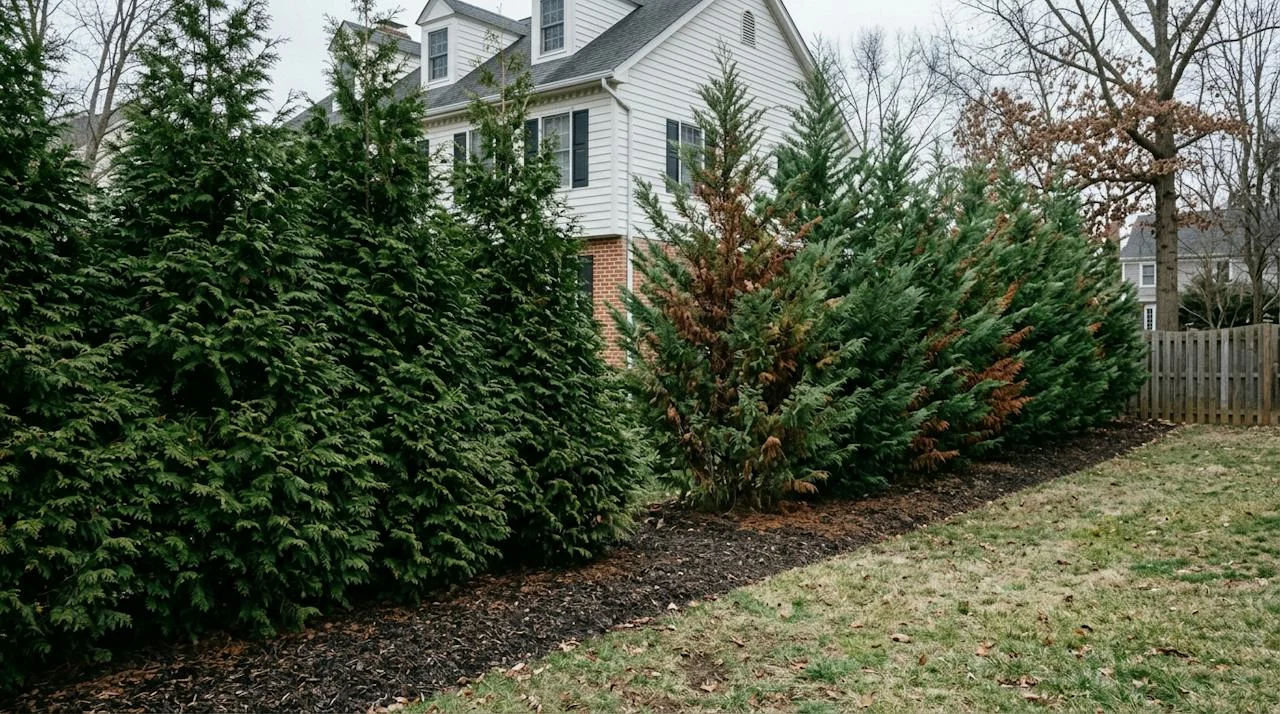
Leyland cypress (Cupressus × leylandii)
Leyland cypress is the fastest common screening conifer and the one we most often steer clients away from. It is an accidental hybrid of Monterey cypress and Nootka cypress that first appeared on an English estate. It has carried several botanical names, sold for years as x Cupressocyparis leylandii and filed by NC State as x Hesperotropsis leylandii. NC State Extension lists it at 60 to 70 feet tall and 10 to 15 feet wide, notes that it has reached 50 feet in 15 years, and gives a typical lifespan of 20 to 50 years.
Maryland is where it struggles. NC State says the shallow roots leave it poorly adapted to hot summers and that big trees tend to topple, and it lists bagworm, Armillaria and Phytophthora root rots, and Seiridium and Botryosphaeria cankers, all of the rots and cankers incurable. University of Maryland Extension adds that Leylands are hardy to Zone 6 but do not tolerate sudden winter temperature swings, and that winter injury opens the door to canker and Cercospora needle blight. Per UME’s canker fact sheet, the spores travel in spring rain, fungicides do not work, and the only control is pruning several inches below the canker.
Honest caveat: A single-species Leyland row is one bad winter away from a gap. UME advises replacing a tree once more than a third of it is damaged and recommends mixing evergreen borders rather than relying on one species. If you already have healthy Leylands, keep them watered and mulched through dry spells, since UME ties both cankers to drought stress.
Thuja ‘Green Giant’ (Thuja standishii x plicata ‘Green Giant’)
Green Giant is a hybrid of western red cedar and Japanese arborvitae. The U.S. National Arboretum received it from the D.T. Poulsen nursery in Denmark in 1967, tested it, and describes it as vigorous, rich green through its hardiness range and free of serious pest or disease problems. It won the Pennsylvania Horticultural Society Gold Medal in 1998. The Arboretum puts it at about 30 feet after 30 years and up to 60 feet tall and 12 to 20 feet wide at maturity, growing in soils from sandy loam to heavy clay.
NC State Extension says it resists most insects, diseases, periodic drought and deer, keeps its deep green color through winter, and needs little pruning to hold a tidy shape. It prefers full sun with light afternoon shade. In a design it is the backbone of a tall screen along a deep property line, spaced so each tree keeps its lower branches, which the spacing section below covers.
Honest caveat: It gets genuinely big, and it is not bulletproof on wet ground: NC State lists bagworms as occasional pests and root rot in poorly drained soil, and the tree does not tolerate salt spray or salty soil. Keep it away from a salted driveway edge and out of the low corner that holds water in March.
Western red cedar (Thuja plicata)
Western red cedar is Green Giant’s western parent and the largest tree in the cypress family. NC State Extension lists it at 50 to 70 feet tall and 15 to 25 feet wide, growing 2 to 3 feet a year, with drooping branches and upturned tips. It wants consistently moist, well-drained, organic soil and does not tolerate drought or dry wind.
People search for it because the name shows up on Green Giant tags. In a design it belongs on a cool, moist, partly shaded site, such as a north-facing slope or a stream edge on a large property.
Honest caveat: NC State says the species suffers in hot, humid climates, and Rutgers rates western arborvitae as occasionally severely damaged by deer. On a sunny piedmont lot, plant Green Giant, which carries the useful traits without the heat problem.
Japanese cedar ‘Yoshino’ (Cryptomeria japonica ‘Yoshino’)
Cryptomeria is the screen to choose when a row of arborvitae would look generic. NC State Extension lists the species at 50 to 70 feet tall and 20 to 30 feet wide with medium growth, and describes ‘Yoshino’ as a narrower pyramidal to columnar selection at 30 to 50 feet. It calls the species deer resistant, slightly salt tolerant and a good alternative to Leyland cypress; Rutgers rates it seldom severely damaged.
It prefers rich, moist, well-drained, acidic soil but adapts, and takes full sun to part shade. Soft, curved needles and reddish peeling bark make it read as a specimen planted in a line rather than a hedge.
Honest caveat: It wants moisture and drainage at the same time, the hardest combination on Maryland clay, and NC State lists leaf spot and leaf blight among its problems. Plant it high on an amended bed, never in a wet swale.
Nellie R. Stevens holly (Ilex x ‘Nellie R. Stevens’)
Nellie Stevens is the broadleaf alternative: glossy dark leaves, heavy red berries and real speed. NC State Extension says this hybrid of English and Chinese holly quickly reaches 15 to 30 feet tall and 8 to 25 feet wide, tolerates heavy clay and handles heat and drought better than many hollies. It is a female that still sets some fruit without a male nearby.
Its dense, prickly foliage makes it a barrier as well as a screen, and it clips well into a formal hedge or anchors a mixed screen in front of taller conifers.
Honest caveat: NC State advises avoiding wet sites and giving it some afternoon shade to prevent leaf scorch, and notes chlorosis on alkaline soil. Rutgers rates it occasionally severely damaged by deer, so it is less deer-proof than its spines suggest.
American holly (Ilex opaca)
American holly is the native evergreen for deer country. NC State Extension describes it as slow-growing to 40 to 60 feet tall and 10 to 20 feet wide, branched to the ground, highly deer resistant and suited to privacy screens and hedges. Rutgers puts it in its best category, rarely damaged.
It grows in moist, neutral to acidic soil in sun to part shade and tolerates occasional wet or dry spells, though not flooding. Birds take the berries through winter, which makes it a strong fit for the plantings in our guide to native plants that thrive in Harford County.
Honest caveat: It is slow, it dislikes limestone soil, and only females fruit, and only with a male nearby. NC State does not recommend it for small yards; buy it as large as access allows.
Eastern red cedar (Juniperus virginiana)
Eastern red cedar is Maryland’s native screening juniper, the tree that colonizes old fence lines. NC State Extension lists it at 30 to 40 feet tall and 10 to 20 feet wide, calls its drought resistance the best of any conifer native to the eastern United States, and notes high salt tolerance and resistance to deer. Rutgers rates it seldom severely damaged.
It handles poor, rocky and dry ground, feeds cedar waxwings with its blue cones, and makes an informal buffer at a meadow edge. NC State suggests spacing it 12 to 24 feet apart.
Honest caveat: It shares cedar-apple rust with apples and crabapples, attracts bagworms, will not take continuously wet soil, and its foliage turns bronze to yellow-brown in winter, which surprises people who expected a green wall in January.
Hinoki cypress (Chamaecyparis obtusa)
Hinoki cypress has fan-shaped, flat sprays and a soft, layered look. NC State Extension lists the species at 50 to 75 feet tall and 10 to 25 feet wide with medium growth, and notes that its size keeps it out of most landscapes while many dwarf cultivars fit home yards.
It prefers moist, fertile loam but adapts to other well-drained soils, likes full sun with some shelter from wind, and makes a specimen-quality screen on a large property.
Honest caveat: NC State calls it difficult to transplant and lists root rot, bagworms and juniper blight. Rutgers rates it occasionally severely damaged by deer. It is a tree to plant a few of, well, on drained ground.
Arizona cypress ‘Carolina Sapphire’ (Hesperocyparis arizonica ‘Carolina Sapphire’)
‘Carolina Sapphire’ is the silver-blue selection people want for color. For the species, NC State Extension gives 40 to 60 feet tall and 15 to 20 feet wide, full sun, sharp drainage, moderate drought and salt tolerance, moderate deer resistance, and screen spacing of at least 7 feet. Its description puts growth at 4 to 8 inches a year, far slower than its reputation.
It works as a color accent in a mixed screen or as a full screen on a sunny, well-drained bank.
Honest caveat: NC State lists its hardiness from Zone 7a south, so colder Zone 6b pockets in northern Harford County sit outside that range, and it is somewhat susceptible to canker. Flat, compacted clay that stays wet in spring is the wrong place for it.
Medium screens: 5 to 12 feet across
These are the in-between trees for a strip that is too tight for Green Giant and too exposed for a pencil-thin arborvitae. They work along a side lot line or as a second row in front of taller trees.
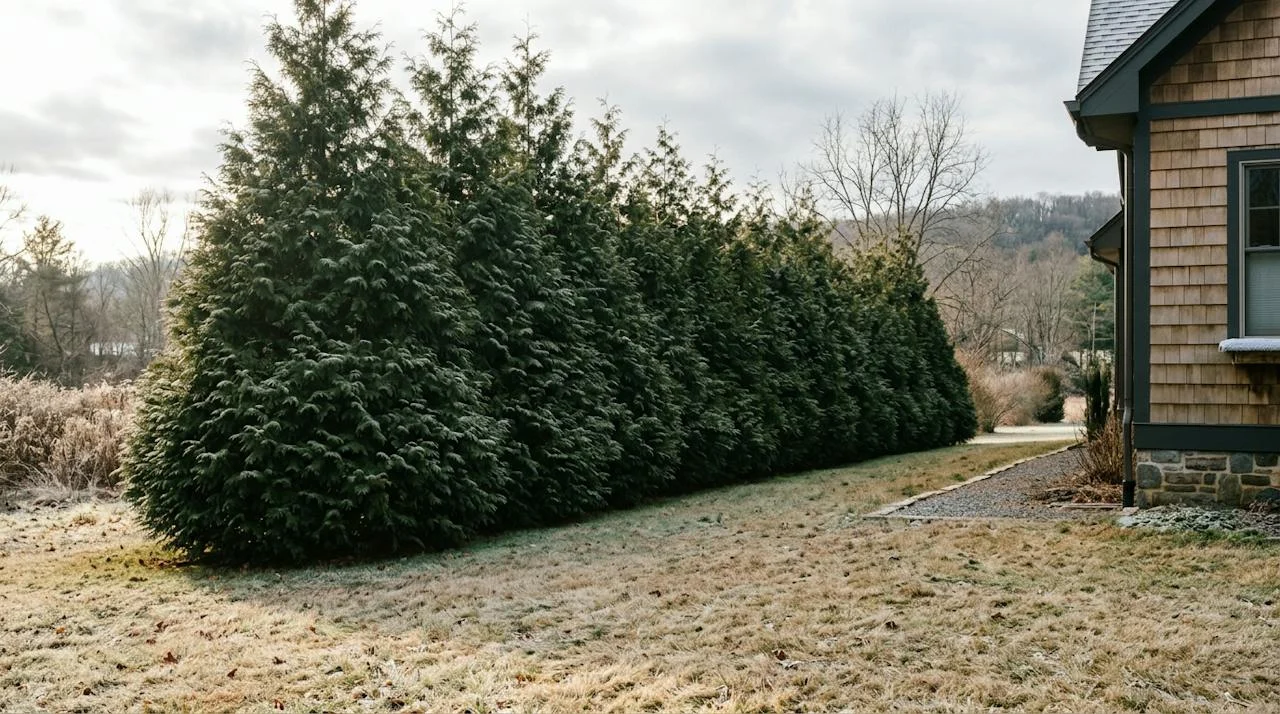
‘Spring Grove’ western arborvitae (Thuja plicata ‘Grovepli’)
Proven Winners lists ‘Spring Grove’ at 20 to 30 feet tall and 10 to 12 feet wide, Zones 5 to 8, with recommended spacing of 12 to 15 feet. The breeder says it was selected for winter color and hardiness, grows fast and resists deer browsing.
That size makes it a useful middle ground: tall enough to screen a second story, narrow enough for a typical side yard.
Honest caveat: Every claim here is the breeder’s, and it is a western red cedar, the species NC State says suffers in hot, humid climates. Treat it as promising rather than proven in Maryland, and mix it with a tree with a longer local record.
‘Techny’ arborvitae (Thuja occidentalis ‘Techny’)
‘Techny’, also sold as ‘Mission’, is a compact, broad-based American arborvitae. The Missouri Botanical Garden lists it at 10 to 15 feet tall and 6 to 10 feet wide, Zones 2 to 8, with rich dark green foliage that does not yellow in winter and tolerance for clay.
It makes a fuller hedge than Emerald Green at a similar height and suits a mid-height screen around a patio or along a fence.
Honest caveat: It is still American arborvitae, the species Rutgers rates frequently severely damaged by deer, and it grows slowly.
‘Nigra’ arborvitae (Thuja occidentalis ‘Nigra’)
‘Nigra’ is the taller dark green American arborvitae. The Missouri Botanical Garden lists it at 20 to 30 feet tall and 5 to 10 feet wide, Zones 3 to 7, conical, with good green color all year and tolerance for clay.
It reaches second-story height on a footprint not much bigger than Emerald Green’s, which is useful between houses.
Honest caveat: Deer pressure is the same as every American arborvitae, and Zone 7 is the warm end of its listed range.
Narrow screens: 5 feet across or less
Narrow trees are for side yards, fence lines and the strip between a driveway and the neighbor. Arborvitae dominate this group, and junipers are the deer-tolerant answer. For layering them with shrubs, see our guide to privacy screening plants that work year-round in Maryland.
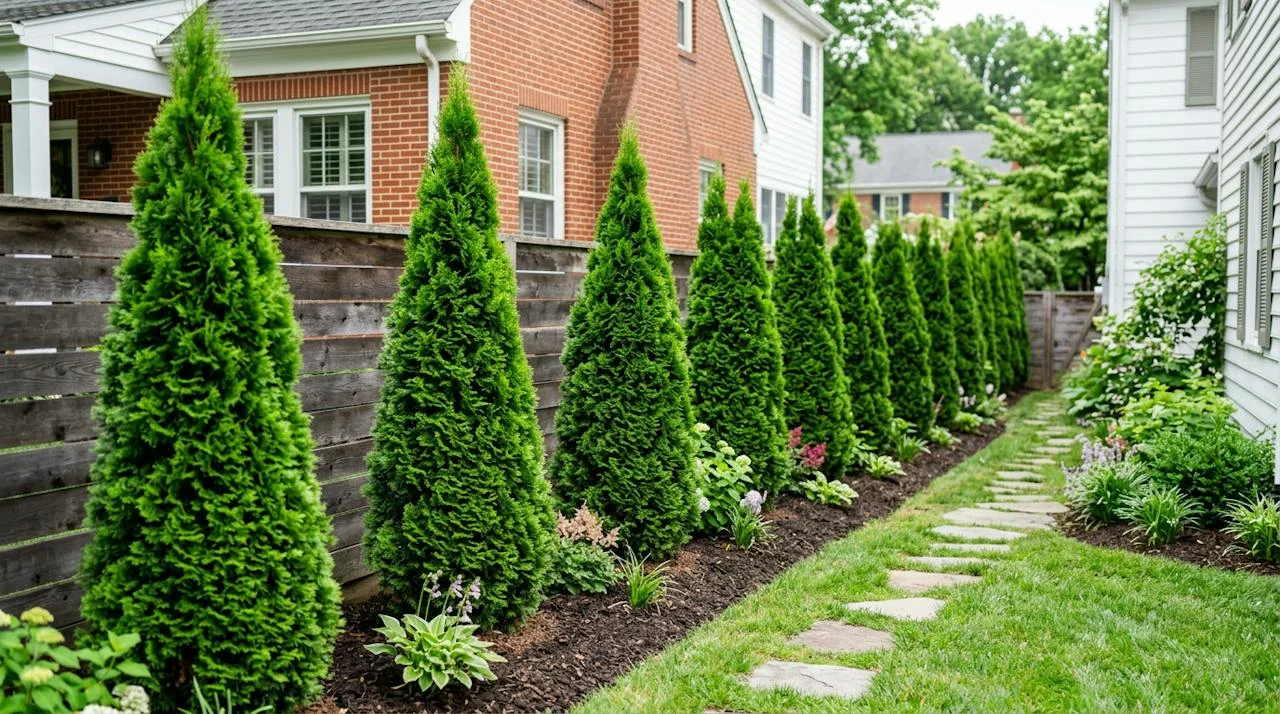
Emerald Green arborvitae (Thuja occidentalis ‘Smaragd’)
Emerald Green, also sold as ‘Emerald’ and ‘Smaragd’, is a semi-dwarf, narrowly pyramidal American arborvitae. The Missouri Botanical Garden lists it at 12 to 14 feet tall and 3 to 4 feet wide, most often seen at 7 to 15 feet, with glossy bright green sprays and a range of Zones 2 to 7. NC State Extension rates American arborvitae as slow-growing.
According to NC State Extension, the species tolerates clay, wet sites and air pollution and grows best in moist, neutral to alkaline loam with high humidity. The Missouri Botanical Garden suggests light afternoon shade in hot summers, so an east exposure beats south-facing siding in the warmer Zone 7a parts of the county. It is the tree for a narrow side yard, a fence line with three or four feet of bed, or formal repeated verticals.
Honest caveat: Deer. Rutgers puts American arborvitae in its worst category, and NC State calls deer browsing a serious problem; ice and snow can also break stems. On an unfenced lot near the deer corridors around Bel Air, expect browse up to the height you meant to screen unless you fence or spray.
‘North Pole’ arborvitae (Thuja occidentalis ‘Art Boe’)
‘North Pole’ is the narrowest of the common arborvitae. Proven Winners lists it at 10 to 15 feet tall and 3 to 5 feet wide, Zones 3 to 8, with spacing of 3 to 5 feet. The breeder describes it as a selection of ‘Wintergreen’ made by Art Boe of Faribault, Minnesota, narrower than Emerald Green and resistant to winter burn.
It suits the tightest spots: beside an entry, between windows, or a fence line where every inch counts.
Honest caveat: It is American arborvitae, so the deer rating does not change, and its sizes come from the breeder rather than an extension trial.
‘DeGroot’s Spire’ arborvitae (Thuja occidentalis ‘DeGroot’s Spire’)
NC State Extension describes ‘DeGroot’s Spire’ as a slow, narrow, conical American arborvitae introduced in 1980, listed at 15 to 30 feet tall and only 4 to 5 feet wide, with twisted, citrus-scented sprays. It tolerates clay and needs mulch to keep its roots moist.
It is a tall, pencil-thin accent more than a wall: three in a row frame a view without blocking light.
Honest caveat: It is slow, it dislikes dry and exposed sites, it can brown in winter wind and break under ice, and deer treat it like any arborvitae. NC State notes young plants may need side shoots pruned to stay narrow.
‘Taylor’ eastern red cedar (Juniperus virginiana ‘Taylor’)
‘Taylor’ is the narrow form of the native red cedar. NC State Extension lists it at 20 to 25 feet tall and 3 to 4 feet wide with blue-green foliage, deer resistant, drought tolerant and tolerant of poor soil, and suggests it as a screen or an accent along a driveway.
It is the narrow tree to choose where deer strip arborvitae and the ground is dry and sunny.
Honest caveat: NC State says the only thing it will not tolerate is wet soil, and cedar-apple rust can occur. Skip rich, heavily fed beds and anywhere water pools.
‘Spartan’ juniper (Juniperus chinensis ‘Spartan’)
The Missouri Botanical Garden lists ‘Spartan’ at 15 to 20 feet tall and about 5 feet wide, Zones 4 to 9, with dark green foliage, tolerance for clay, some drought and deer, and a note that it does not tolerate wet soil. Rutgers rates Chinese juniper cultivars seldom severely damaged.
It makes a dense, formal-looking narrow screen in full sun.
Honest caveat: The Garden lists tip and needle blights, rust diseases, canker, bagworms and root rot in poorly drained soil. On heavy clay it needs a raised bed.
‘Skyrocket’ juniper (Juniperus scopulorum ‘Skyrocket’)
‘Skyrocket’ is the classic silver-blue column. The UConn Plant Database says it grows quickly to about 15 feet tall and only 2 feet wide, and Rutgers rates Rocky Mountain juniper cultivars seldom severely damaged by deer.
It reads as a strong vertical accent in a gravel or dry garden.
Honest caveat: UConn notes the species is not tolerant of high humidity, is susceptible to juniper blights and hosts cedar-apple rust. In Maryland’s summers, ‘Taylor’ is the better narrow juniper.
Leyland cypress vs. arborvitae, and arborvitae vs. juniper
The searches behind this guide often pit families against each other, and the families behave differently on a Maryland lot. Arborvitae, including Green Giant, tolerate clay and, for American arborvitae, wet sites. Junipers, including eastern red cedar, ‘Taylor’ and ‘Spartan’, want sun and drainage and fail in standing water. Leyland cypress sits in the middle on soil but brings shallow roots and the canker problem.
Deer split them the other way. Rutgers rates American arborvitae frequently severely damaged, Leyland occasionally severely damaged, and the junipers and red cedar seldom severely damaged. So the practical rule: on wet clay with deer, Green Giant; on wet clay inside a fence, American arborvitae such as Emerald Green or ‘Nigra’; on a dry, sunny bank with deer, a juniper or red cedar. Leyland does not win any of those matchups outright.
Disease and pests cut across families. University of Maryland Extension’s bagworm guidance names arborvitae, cedar, juniper, spruce and pine as the most frequently damaged hosts. Junipers add cedar-apple rust, Leyland adds canker. That is why mixing families in one screen is safer than repeating one tree.
How far apart to plant a Green Giant privacy fence (and the other two)
Spacing decides how long you wait and what the screen looks like in year twenty. Our rule of thumb is to plant at roughly 60 to 75 percent of the tree’s mature width for a continuous screen, and to set the row back from the line by at least half that width so it never grows onto the neighbor’s side. For Green Giant, 12 to 20 feet wide, that means about 8 to 10 feet on center. The Missouri Botanical Garden suggests 5 to 6 feet for a quick screen; that closes faster but crowds the trees, and crowded conifers lose their inner and lower branches. If you want a conifer as a single specimen rather than a row, our Maryland conifer guide, sorted by mature size covers the cedars, pines and dwarf forms that suit that role.
For Leyland cypress, 10 to 15 feet wide, the same math gives 7 to 10 feet. Emerald Green, 3 to 4 feet wide, goes on about 3 foot centers, and ‘North Pole’ on the breeder’s 3 to 5 feet. For the wider alternatives, the published figures are 12 to 15 feet for ‘Spring Grove’, at least 7 feet for Arizona cypress, and 12 to 24 feet for eastern red cedar.
If you need privacy sooner, buy larger trees rather than tightening the spacing. On deeper strips, a staggered double row of two or three species reads as a woodland edge, survives the loss of one tree, and blocks angled views from a neighbor’s deck. Our notes on planning privacy on large Harford County properties cover screens at acreage scale.
Planting a screen in Maryland clay, and keeping bagworms and deer off it
Most screens fail at planting, not at selection. University of Maryland Extension recommends a hole no deeper than the root ball and at least twice as wide, the root flare at soil level, and no compost in the hole, since on clay it holds water against the roots; if the whole strip is compacted, work compost into the top several inches across the bed instead. UME’s watering guidance says to check new plantings daily for two weeks and at least weekly for two years, watering deeply when the top six inches are dry. If the strip holds water after rain, fix that first; our guide to standing water on Harford County clay explains how.
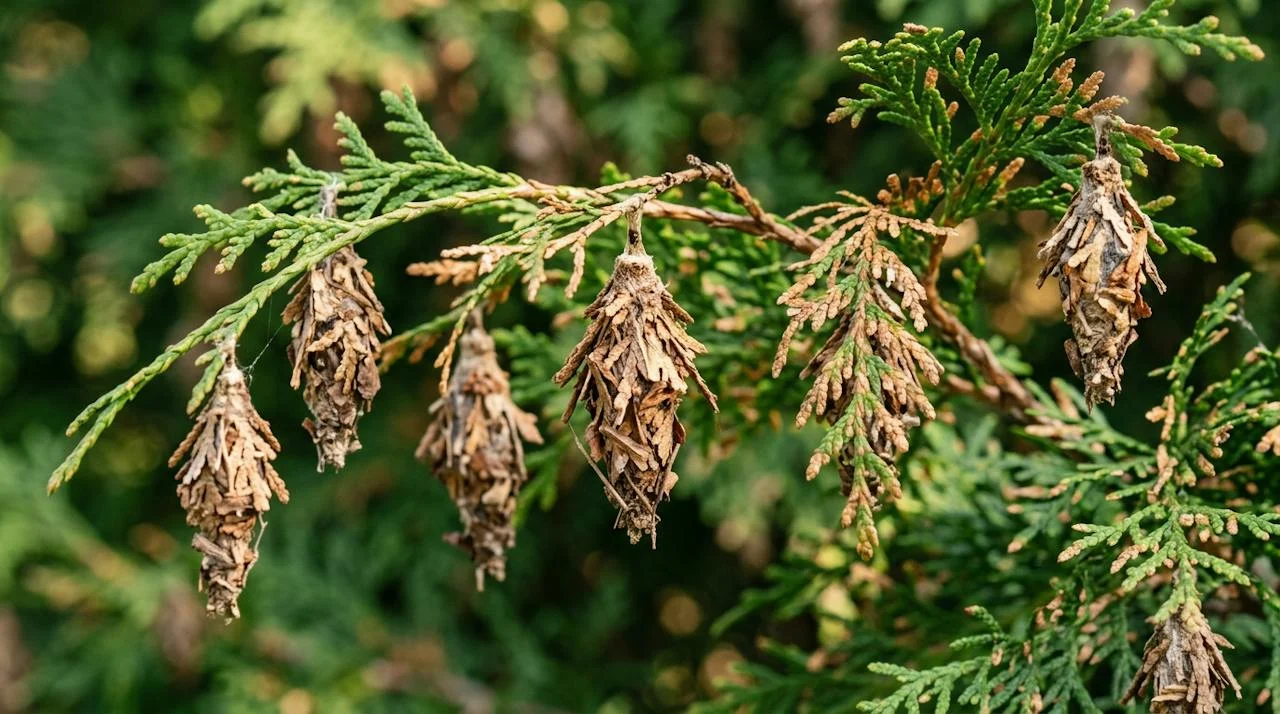
Then watch for bagworms. According to University of Maryland Extension, the caterpillars usually hatch in May in central Maryland, each female leaves 200 to 1,000 eggs in her bag, and conifers cannot replace the foliage they lose, so heavy infestations can kill a tree. Hand-picking bags in fall, winter or early spring, before the May hatch, is the simplest control on a short row. Walk the screen in June, not September.
For deer, Rutgers is clear that no plant is deer proof and that local herds and winter weather change the outcome. Use the ratings to pick the species, then plan on fencing or repellent for anything rated occasionally or frequently damaged.
Planning a privacy screen?
Choosing between Green Giant, Leyland cypress and Emerald Green is the easy half. Measuring the strip, finding where water sits in March, reading the deer pressure and matching each tree’s width to the space is what decides whether the screen works in year one and year twenty. Our landscape design and installation work starts with a walk along that property line, and the same people who walk it plant it. Planning the screen together with the beds in front of it is what our garden and planting design service does. Schedule a consultation and bring your sightlines and questions.
Green Giant, Leyland cypress and arborvitae FAQs
How long do Leyland cypress trees live?
NC State Extension gives Leyland cypress a typical lifespan of 20 to 50 years, depending on the site, compared with 40 to 60 years for Green Giant. In Maryland the low end is common, because winter temperature swings, drought stress and canker shorten its life. On Harford County clay, plan a Leyland screen as a 20 to 30 year planting, not a permanent one.
Do deer eat Green Giant arborvitae?
Deer usually leave Green Giant alone. NC State Extension lists it as deer resistant, though Rutgers does not rate it, and its western red cedar parent sits in the Rutgers occasionally damaged group. Young, freshly planted trees are the most exposed. In Harford County, where browse pressure is heavy, protect a new row through its first winter or two.
How fast does Emerald Green arborvitae grow?
Slowly. NC State Extension rates American arborvitae as a slow grower, and the Missouri Botanical Garden lists Emerald Green maturing at about 12 to 14 feet. Plant it for a narrow, finished look rather than speed. In Maryland, buying 5 to 6 foot plants shortens the wait more than any fertilizer, and deer protection matters more than either.
Are Leyland cypress roots invasive?
Leyland cypress roots are better described as shallow than invasive. NC State Extension says the shallow roots leave the tree poorly adapted to hot summers and that large trees tend to topple. UME adds that shallow roots make it prone to drying out. On wet Maryland clay, give a Leyland row room to fall clear of the house and drive, because large trees are the ones that topple.
What is the fastest growing arborvitae?
Thuja ‘Green Giant’ is the fastest widely available arborvitae: NC State Extension says it can grow 3 to 4 feet a year in ideal conditions, and the U.S. National Arboretum rates its growth as rapid. ‘Spring Grove’ is sold as fast too, on the breeder’s word. Emerald Green and other American arborvitae are slow, which is the trade for their narrow shape.
When is the best time to plant arborvitae in Maryland?
Fall is best, followed by winter when the ground is not frozen and early spring; University of Maryland Extension advises against summer planting. Fall planting gives roots weeks of warm soil before frost. In Harford County, mid-September through November lets roots settle before the ground cools, followed by deep watering through the next two summers.