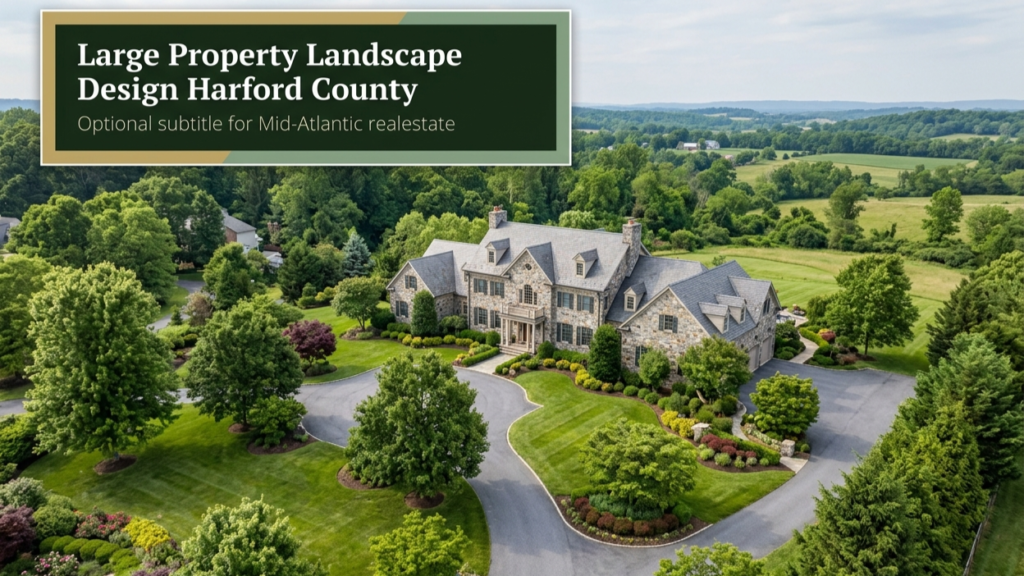
You bought your Harford County property because you wanted space. Room for the kids to play, privacy from neighbors, maybe a workshop or a pool without being on top of your house. But now you’re standing in the backyard staring at two, three, maybe five acres of patchy grass, overgrown trees along the property line, and a front entry that looks like every other new construction driveway in Bel Air.
You know it could be beautiful. You’ve driven past those estate properties on Aldino Road or up in Monkton with the mature trees, the layered plantings along the driveway, the privacy that looks natural instead of like a fortress. But every time you think about tackling your own property, it feels overwhelming. Where do you even start when you have this much land? And every landscaper you’ve talked to treats your two acres like it’s just a bigger version of their typical half-acre suburban job—same plants, same approach, just more of everything.
Here’s the thing: landscaping a large property in Harford County requires a completely different approach. It’s not about planting more shrubs or mowing a bigger lawn. It’s about zoning your property by use, selecting plants that work at estate scale, creating privacy that looks natural, and building a design that gets better every year as everything matures. Done right, your landscape becomes a valuable, low-maintenance asset. Done wrong, you’ve got an expensive maintenance nightmare that never looks quite right.
This guide walks you through how to plan landscape design for large properties in Harford County—what makes estate-scale projects different, how to think about your property in zones, and what to look for in a design partner who actually understands working at this scale.
Why Large Properties Need a Different Landscape Design Approach
Designing for two or more acres isn’t just “regular landscaping but bigger.” It requires completely different thinking about spatial planning, visual hierarchy, plant selection, and long-term maintenance.
Here’s what changes when you’re working at estate scale. First, you need to design in zones based on use and visibility—your front entry needs different treatment than your backyard living area, which needs different treatment than the wooded buffer along your back property line. On a small lot, you might get away with treating the whole yard the same way. On a large property, that approach creates visual chaos and maintenance headaches.
Second, plants must be selected for their mature size, not how they look on installation day. That cute little evergreen that’s three feet tall at the nursery? In ten years it’s going to be fifteen feet wide. Plant ten of them in a row because they look sparse at planting, and in a decade you’ve got an overgrown mess. Large property landscape design in Harford County requires thinking in decades, not seasons.
Third, long sight lines require layered depth. When someone’s looking down your driveway from the road or across your backyard from the house, they need to see layers of trees, shrubs, and groundcover at different heights and depths. Single-row plantings look flat and institutional at estate scale.
Finally, materials and plant quality matter more. Big box store shrubs are bred for fast growth and quick sale—they look great for two years, then they’re either overgrown or dead. Estate landscaping harford county md requires specialty-grade materials sourced from growers who supply commercial and estate projects, not weekend DIYers.
At Oakfield, we use a design-build model specifically because it ensures continuity across your entire property. You’re not dealing with a designer who hands off drawings to a separate installation crew who may or may not understand the vision. Eric’s involved from the initial site walk through final planting, so the design that looked great on paper actually gets executed the right way in your soil, on your slopes, in your specific growing conditions.
Key Considerations When Planning a Large Property Landscape
Before you plant a single tree or install the first shrub, you need to think through five planning priorities. Skip these, and you’ll end up with costly mistakes, maintenance nightmares, and a landscape that fights your property’s natural features instead of working with them.
1. Site Assessment: Understanding Your Property’s Natural Features
Your property already has a story—topography, drainage patterns, existing trees, soil conditions. Good design reads that story and works with it instead of against it.
Start with topography and drainage. Where does water flow when it rains hard? Where are the low spots that stay wet? Where are the high, dry areas? On a large Harford County property, you might have clay soil that drains poorly in one zone and sandy loam that drains fast in another. You can’t use the same plant palette across both areas.
Look at your existing tree canopy. Which mature trees are worth preserving and designing around? Which dead or declining trees need to come out before you start installing new plantings? Specimen trees—especially native Oaks, Tulip Poplars, and mature evergreens—add instant value and maturity to a landscape. Don’t bulldoze them just to start fresh.
Identify your sun and shade zones. That sunny front entry is going to need completely different plants than the shaded woodland edge along your back property line. Walk your property at different times of day. Where does morning sun hit? Where’s it blazing hot in the afternoon? Where’s it shaded all day under your tree canopy?
Harford County sits in USDA Zone 7a, which means we get cold enough winters to kill marginally hardy plants but warm enough summers to stress cool-climate plants. Add in our heavy clay soil that doesn’t drain well, and you need plants selected specifically for these conditions—not whatever looks good at the garden center.
Finally, identify views worth preserving and areas needing screening. Maybe you’ve got a beautiful view toward the hills that you want to frame with plantings. Maybe you’ve got a neighbor’s barn or a utility easement you want to screen. Good design enhances what’s already good and hides what’s not.
2. Zoning Your Property by Use and Visibility
Here’s how to think about a large property: it’s not one landscape, it’s several distinct zones that need to work together as a cohesive whole.
Your front entry zone is about curb appeal and first impressions. This is where you use specimen trees, formal foundation plantings, and landscape lighting. When someone drives up your driveway or pulls into your circle drive, this is what they see. It needs to look intentional, mature, and well-maintained. Long driveways benefit from rhythmic plantings—trees or large shrubs planted at intervals to create visual movement as you drive in.
Living zones are the areas around your house where you actually spend time—patios, pool areas, outdoor kitchens, fire pit areas. These need structure, privacy from neighbors or from other parts of your property, and plantings that create rooms and boundaries. You want evergreens for year-round screening, flowering shrubs for seasonal interest, and layered plantings that give you privacy without making you feel boxed in.
Transition zones are where your formal, maintained landscape starts to blend into the more natural areas of your property. This is where native perennials, ornamental grasses, and naturalistic shrub borders work beautifully. You’re creating a gradual shift from manicured to natural, not a hard line where mowed lawn suddenly stops and woods begin.
Natural buffers and woodland edges are the low-maintenance areas at the edges of your property. If you back to woods or have large sections you don’t actively use, these areas should be planted with native trees and shrubs that require minimal care once established. Think Eastern Red Cedar, native Dogwoods, Serviceberry, and understory shrubs like Viburnum and Spicebush.
Service and utility areas are the parts of your property you need but don’t want to see—HVAC units, trash enclosures, pool equipment, storage sheds. Strategic evergreen screening makes these disappear without building fences or structures.
When Oakfield designs a large property, we map these zones during the initial consultation. It’s the foundation that makes everything else work.
3. Privacy Without Creating a Fortress
One of the biggest advantages of a large property is space to create real, layered privacy without resorting to a single row of Leyland Cypress or arborvitae planted six feet apart like a prison fence.
Here’s the better approach: multi-layer privacy screening using small trees, large shrubs, and perennials at different depths. Instead of one hedge, you create three or four layers of plantings at different heights and distances. From inside your property, you see depth and texture. From outside, they see green layers that block views without looking institutional.
Native evergreens give you year-round screening that actually looks good. Eastern Red Cedar is an underused native that’s perfectly suited to Harford County’s clay soil and provides dense screening once established. White Pine grows faster and creates a softer screen. American Holly adds year-round structure with the bonus of berries for birds.
Mix in deciduous trees and shrubs for seasonal interest. River Birch with its peeling bark, Serviceberry with spring flowers and fall color, Oakleaf Hydrangea for texture and late-season blooms. In summer you’ve got full privacy. In winter you’ve still got screening from the evergreens, but with added visual interest from bark and branch structure.
Stagger your plantings for depth. Don’t line everything up in a row. Plant in irregular, overlapping groupings. Place a cluster of three White Pines here, a grouping of mixed evergreen shrubs there, some understory Dogwoods in front. The result looks natural, not planted.
And for privacy landscaping large property bel air homeowners specifically, consider your property’s orientation. If your main outdoor living area faces west, you need serious afternoon screening from summer sun. If you back to open farmland, you might want a naturalistic mixed border that provides privacy without blocking the pastoral view entirely.
This is where Oakfield’s experience with Harford County properties makes a real difference. We know which plants provide the density you need, which ones actually survive in our clay soil, and how to arrange them so they don’t look like you planted a hedge and called it a day.
4. Planning for Long-Term Maturity
The biggest mistake in large property landscape design is designing for how everything looks on installation day instead of how it’ll look in five, ten, or twenty years.
That Dogwood that’s eight feet tall when we plant it? In ten years it’s going to be twenty feet tall with a fifteen-foot spread. Plant three of them six feet apart because they look sparse at installation, and in a decade they’re crowded, competing for light, and declining.
Here’s how we plan for maturity at Oakfield. First, we space plants based on their mature canopy spread, not their nursery size. Yes, things look a little sparse for the first few years. That’s what perennials and ornamental grasses are for—filling space while the permanent woody plants are growing into their mature size.
Second, we use specimen-grade materials sourced from specialty growers, not whatever’s on sale at the big box store. There’s a huge difference between a $30 shrub grown for fast turnover and a $75 specimen-grade plant with a strong root system and proper form. The cheap one might not make it through its first winter in Harford County clay. The good one is still looking great twenty years later.
Third, we select plants with year-round interest that gets better as they mature. River Birch develops that beautiful peeling bark as it ages. Oakleaf Hydrangea’s stems get thicker and more architectural. Witch Hazel becomes a sculptural multi-stem specimen. These aren’t plants that peak in year three and decline—they become more valuable over time.
Finally, we consider succession and seasonal progression. When the spring-blooming Serviceberry is finishing, the summer Hydrangeas are starting. When those fade, fall color from native Viburnums and Dogwoods takes over. Winter interest comes from evergreens, ornamental grasses that stand through snow, and the structure of deciduous trees.
This long-term thinking is what separates estate landscaping from typical residential work. You’re not decorating for this weekend’s barbecue. You’re creating a landscape that appreciates in value and beauty for decades.
5. Maintenance Realities for Large Properties
Let’s be honest about maintenance. A large property requires ongoing care, and pretending otherwise sets you up for disappointment.
But here’s the good news: proper design dramatically reduces maintenance burden. Native plants adapted to Harford County conditions require less water, less fertilizer, and less replacement than non-native ornamentals that struggle in our clay soil and Zone 7a winters. A naturalistic woodland border requires almost no maintenance once established—maybe some pruning every few years, that’s it.
Phased plantings spread both cost and maintenance burden over time. You don’t have to install everything at once. Start with high-visibility areas and add sections as budget and time allow. Each phase gives you time to learn how your property drains, where things grow well, and what level of maintenance you’re comfortable with.
Design for the maintenance level you’ll actually sustain. If you love gardening and have time for detailed perennial borders, great—we’ll design them. If you travel six months a year and want a landscape that looks great with minimal input, we’ll design for that instead. There’s no wrong answer, but there is a wrong design for your lifestyle.
Many of our Harford County clients opt for ongoing maintenance programs tailored to their property size. Seasonal cleanup in spring and fall, pruning and deadheading through growing season, leaf removal, mulch refresh. You get the landscape you want without spending every weekend maintaining it.
And this is important: maintenance requirements should inform your design from the beginning, not be an afterthought. If a design requires weekly deadheading and constant pruning to look good, it’s the wrong design for a large property unless you’ve got full-time grounds staff.
Design Elements That Work at Estate Scale
Large properties can accommodate design features that smaller lots simply can’t handle. Use that space to add elements that bring movement, sound, lighting, and layered beauty across your landscape.
Mature Tree Installation
Nothing anchors a large property landscape like mature trees. While the rest of your plantings are establishing, properly installed specimen trees provide immediate presence and scale.
Shade trees like Oak, Maple, and Tulip Poplar create structure and define space. In ten years that Oak is providing shade over your patio. In thirty years it’s the dominant feature of your landscape. Ornamental trees like native Dogwoods, Serviceberry, and Redbud add seasonal flowers, fall color, and wildlife value without growing so large they overpower everything else.
Here’s what matters with mature tree installation: proper planting technique and aftercare. A badly planted specimen tree is a waste of thousands of dollars. The root flare must be at grade, not buried. The root ball must be properly scarified so roots can grow out into surrounding soil. Staking must support without restricting trunk movement. And watering for the first two years is non-negotiable.
At Oakfield, we source specimen trees from growers who supply commercial and estate projects—field-grown trees with proper root systems, not container stock that’s been growing in a pot for years with circling roots. The difference in establishment and long-term health is dramatic.
Water Features for Large Properties
If you’ve got the space, a well-designed water feature adds sound, movement, and focal points across long sight lines in ways that plantings alone can’t achieve.
Custom ponds designed to look natural, not like a plastic tub dropped in the ground. We build these to integrate with surrounding plantings—native grasses along the edges, rocks that match your property’s natural stone, depth and circulation that keeps water healthy without constant chemical treatment.
Naturalistic streams and cascading waterfalls work especially well on properties with elevation change. Instead of fighting a slope with retaining walls, you turn it into a feature. The sound of running water carries across your property, creating a sensory experience beyond just visual appeal.
And water features at estate scale become focal points that organize the rest of your landscape. The pond becomes the destination at the end of a path. The stream defines the boundary between two zones. The waterfall creates a reason to sit in a particular spot and look back toward the house.
This is one area where experience really matters. A badly designed water feature is a maintenance nightmare and an eyesore. We’ve seen plenty in Harford County—poor circulation, incorrect depth, wrong plant selection, liner showing through rocks. When it’s done right, a water feature looks like it’s always been there.
Landscape Lighting for Scale and Safety
On a large property, landscape lighting isn’t just decorative—it’s functional. You need to see where you’re walking on a long driveway or pathway. You need to know where the steps are. And you want your landscape to look as good at night as it does during the day.
Pathway lighting along driveways and walkways provides safety and visual guidance. Low-voltage LED fixtures every eight to ten feet creates a runway effect that’s beautiful and functional. No one’s tripping over curbing or wandering off the path in the dark.
Uplighting specimen trees creates drama and depth at night. Those mature Oaks or Dogwoods that define your landscape during the day become sculptural silhouettes at night. You see layers of light and shadow instead of a black void beyond your windows.
Ambient layers for entertaining zones—subtle wash lighting on your patio plantings, downlighting from trees over seating areas, accent lighting on water features. The goal is creating atmosphere without harsh spotlights.
LED systems designed for large properties are more energy-efficient and lower-maintenance than older halogen systems. You’re lighting a larger area, so efficiency matters. And with proper zoning, you can control what’s on—maybe just the driveway lights most nights, full property lighting when you’re entertaining.
Native Plantings and Pollinator Gardens
Large properties give you space to incorporate native plantings and pollinator gardens that support local ecosystems while providing low-maintenance, high-impact beauty.
Maryland native perennials like Black-eyed Susan, Joe Pye Weed, and native Asters are perfectly adapted to our clay soil and climate. They don’t need supplemental water once established. They don’t need fertilizer. They provide flowers from late spring through fall. And they support native pollinators and birds that non-native ornamentals often don’t.
Native grasses like Little Bluestem and Switchgrass add texture and movement. They look good through winter, standing up through snow and ice. They provide cover and food for birds. And they require basically zero maintenance—maybe cut back once in early spring, that’s it.
Native shrubs like Viburnum, Spicebush, and Buttonbush work beautifully in transition zones and woodland edges. They provide food for wildlife, they’re adapted to Harford County conditions, and they don’t require the constant care that non-native ornamentals do.
This is where large properties really shine. You’ve got room to create whole sections devoted to native plantings that benefit the local ecosystem while requiring minimal maintenance from you. These transition zones between your maintained landscape and natural areas look intentional, not neglected—which is exactly what you want.
How to Phase a Large Property Landscape Project
Here’s the reality: you don’t have to do everything at once. Phased design lets you spread investment over time while maintaining design coherence from start to finish.
Start with high-visibility zones—your front entry and the main living areas where you spend time. These give you immediate impact and enjoyment while the rest of the property remains in planning stages. A well-designed entry with mature trees, specimen plantings, and lighting transforms how your property feels every single day.
Phase two typically includes privacy screening and additional tree installations. Once your main areas look great, you want to screen views you don’t want and frame views you do. This might be evergreen borders along property lines, mixed naturalistic plantings blocking a neighbor’s outbuilding, or specimen trees defining spaces in your backyard.
Later phases address natural transition zones and woodland edges—areas that matter for the overall design but don’t need immediate attention for daily enjoyment. These lower-maintenance zones can be installed once the high-traffic areas are complete and established.
At Oakfield, we approach phased projects with a complete design vision from the beginning. The master plan shows the entire property buildout, then we create a logical implementation sequence based on your priorities and budget. You’re never guessing what comes next or hoping phases will somehow tie together—the continuity is built into the plan from day one.
This approach also lets you see how your property drains, where things grow well, and what maintenance level works for your lifestyle before committing to the entire property. You learn from each phase, and that knowledge informs the next one.
And importantly, each phase is complete and beautiful on its own. You’re not living on a construction site for years. Each installation is finished, mulched, and looking good before we move to the next phase.
For a more detailed look at the complete design and installation process, check out our complete guide to landscape design and installation in Harford County. It walks through everything from initial consultation through final planting and ongoing care.
What to Look for in a Landscape Design Partner for Large Properties
Not every landscaping company can handle estate-scale projects. There’s a real difference between professionals who understand large properties and those who treat them like oversized suburban yards.
Here’s what separates the two. First, look for a design-build model where the same team handles design and installation. When you hire a designer who hands off drawings to a separate installation crew, things get lost in translation. Details get missed. The crew doesn’t understand the reasoning behind plant placement. You end up as the go-between trying to manage both parties.
With a design-build approach, there’s single-point accountability from consultation through completion. Eric walks your property, creates the design, sources the materials, and oversees installation. If something needs to change based on site conditions, decisions get made in real-time by someone who understands the entire vision.
Second, look for demonstrated experience with large-scale spatial planning and zoning. Ask to see completed projects on properties similar to yours in size and scope. Ask how they approach privacy screening, how they think about mature plant size, how they handle properties with significant topography or drainage challenges.
Third, verify they have access to specialty plant materials beyond what’s available at retail nurseries. Estate-scale landscapes require specimen-grade trees and shrubs, often in larger sizes than typical residential projects. That requires relationships with commercial growers and specialty nurseries, not just a truck and a Home Depot credit card.
Fourth, look for transparent budgeting and phased planning options. Large property projects represent significant investment. You need a partner who can clearly explain costs, provide detailed proposals, and work with you to create an implementation plan that fits your budget and timeline.
Fifth, proven experience in your local soil and climate matters enormously. What works beautifully in Pennsylvania or Virginia might fail in Harford County’s heavy clay soil. A design partner needs to know which plants actually thrive here, not just which ones look good in a catalog.
Finally, look for post-installation support and maintenance options. Estate landscapes require ongoing care. A company that installs and disappears leaves you trying to figure out pruning schedules, fertilization needs, and seasonal care on your own.
At Oakfield, Eric’s personally involved in every project from initial consultation through final walk-through. That level of continuity is rare and valuable—you’re working with someone who knows your property, understands your goals, and takes personal responsibility for the outcome.
Our 60+ five-star Google reviews reflect clients across Harford and Baltimore Counties who appreciate transparent communication, quality materials, and designs that actually get installed the way they were drawn. We’re not the biggest landscaping company in the area. We’re the one where Eric’s still answering his own phone and walking every property himself.
Common Mistakes to Avoid When Landscaping a Large Property
Large properties amplify small mistakes into expensive, long-term problems. Here’s what to avoid.
Using plants suited for small yards at estate scale. Those compact evergreens bred for foundation plantings around a suburban ranch? They look ridiculous at the end of a quarter-mile driveway. Scale your plant selection to your property size.
Ignoring drainage and topography. Water flows downhill. If you plant moisture-sensitive shrubs in a low spot that stays wet, they’re dead by next spring. Work with your property’s natural drainage, not against it.
Single-species hedges that create monoculture risk. Plant 50 Leyland Cypress in a row, and when disease or pest pressure hits that species, you lose 50 trees at once. Mixed plantings spread risk.
Designing for day one instead of mature growth. Everything looks sparse at installation. That’s temporary. Crowding plants because you want immediate fullness creates maintenance nightmares in five years.
Trying to maintain too much formal landscape on a large lot. Perennial borders that need constant deadheading might work around a patio. They don’t work across three acres. Match your design to the maintenance level you’ll sustain.
Hiring separate designers and contractors. The designer creates a beautiful plan. The contractor installs something cheaper or easier. You’re stuck mediating. Design-build eliminates this coordination nightmare.
Planting too close to property lines without considering mature size. That tree that’s five feet tall at planting will be 40 feet wide at maturity. Plant it three feet from the property line, and in fifteen years it’s your neighbor’s problem.
Ignoring seasonal progression. Designing for one season—spring flowers, for example—leaves you with nothing of interest the other nine months of the year. Estate landscapes need four-season appeal.
Underestimating establishment time and care. Even drought-tolerant, low-maintenance plants need regular water for their first two years. Budget time and resources for establishment, or watch your investment die.
Skipping the master plan and winging it. Installing “a little here, a little there” without overall vision creates a landscape that never comes together. Start with the plan, then implement it in phases.
Get Started with Your Large Property Landscape Design in Harford County
Landscaping a large property starts with understanding that size changes everything—how you plan zones, select plants, create privacy, and think about long-term maintenance.
Get the approach right, and your landscape becomes a valuable, low-maintenance asset that gets more beautiful every year as plants mature and fill in. Get it wrong, and you’ve got an expensive maintenance burden that never looks quite right.
Oakfield Landscaping specializes in estate-scale design-build projects across Harford and Baltimore Counties. We understand the specific challenges of Harford County’s clay soil and Zone 7a climate. We know how to design for properties measured in acres, not square feet. And we know how to source the specialty materials that estate landscapes require.
Every project starts with a consultation where Eric walks your property, understands your goals, and creates a phased plan that fits your budget and timeline. You’re working directly with the person who’s designing and overseeing your landscape, not a sales rep who hands you off to a crew who’s never seen your property before.
Our clients across Bel Air, Abingdon, Aberdeen, and throughout Harford County trust us because we do what we say we’re going to do, we communicate clearly throughout the project, and we’re still here for questions and support years after installation.
Ready to create a landscape that does justice to your property? Call Oakfield Landscaping at (443) 794-8108 or email eric@oakfieldlandscaping.com to schedule your consultation.
Oakfield Landscaping
Phone: (443) 794-8108
Email: eric@oakfieldlandscaping.com
Hours: Monday–Friday, 8AM–4PM
Service Area: Harford County & Baltimore County, MD
We’ll walk your property, talk through your vision, and show you exactly how we’d approach designing your landscape for scale, privacy, and long-term beauty.

With over 10 years of experience locally in Maryland, Oakfield Landscaping has a team of skilled professionals ready to deliver exceptional services.
Start your project
Ready to create a landscape that enhances your property and reflects your vision?
Our design process begins with an in-depth consultation:
- Walk your property and discuss your vision
- Review your functional & aesthetic preferences
- Assess existing landscape conditions
- Explain our design-installation process and timeline
- Answer your questions about our approach