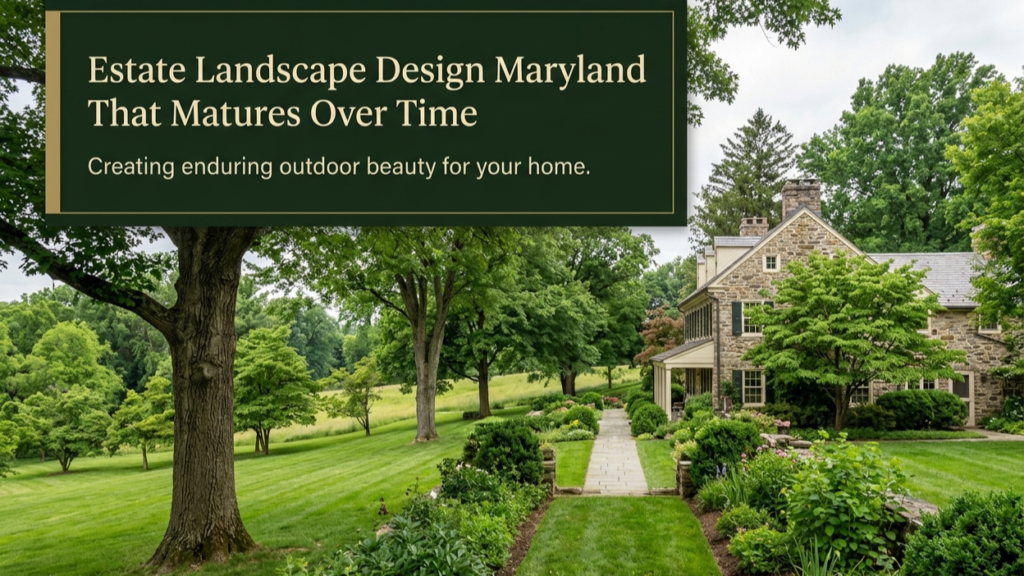
You’ve invested tens of thousands into your estate property. The landscape looked perfect on installation day—lush, balanced, exactly what you envisioned.
Five years later, it’s a different story. The foundation shrubs are blocking your windows. Those ornamental trees you loved? They’re crowding each other and dropping branches on your driveway. The perennial beds that were supposed to be “low-maintenance” need constant replanting. You’re looking at another expensive overhaul, wondering why this keeps happening.
Here’s the truth most landscape contractors won’t tell you: most landscapes are designed to look great at installation, not at maturity. They’re planned around how plants look in the nursery, not how they’ll grow over the next 20 years. There’s no thought given to how that maple will shade out your garden beds in a decade, or how those “compact” shrubs will swallow your walkway by year seven.
The result? You pay twice. Once for the installation, and again to fix the problems that were baked into the design from day one.
Long-term estate landscape design in Maryland starts with a different question: What will this look like in 20 years?
At Oakfield Landscaping, Eric designs landscapes that improve as they mature. We select plants based on their adult size, not their nursery size. We layer seasonal interest that deepens over decades. We account for Maryland’s clay soil, humidity, and freeze-thaw cycles—because what thrives in year one might struggle in year ten if you don’t plan for it.
This guide walks you through what long-term landscape planning actually looks like for estate properties in Harford and Baltimore Counties. You’ll learn the principles that make landscapes age gracefully, the mistakes that doom them to replacement cycles, and how to make sure your investment pays off for decades.
If you’re ready to have a conversation about your property’s future, not just next season, give Eric a call. He’s been designing landscapes in Harford County for years, and every project starts with walking your property and asking what you want to see in 10, 15, even 30 years.
Let’s dig in. (And if you want a broader overview of the landscape design process in Harford County, check out our complete landscape design and installation guide.)
What “Long-Term” Really Means in Estate Landscape Design
Long-term design means planning for how your landscape will look, function, and require care 10, 20, even 30 years from now—not just the year it’s installed.
Here’s what that actually looks like in practice.
Most residential landscaping is designed for immediate impact. You want privacy, so you plant arborvitae 3 feet apart. You want color, so you pack in perennials until the bed looks full. The goal is to make it look finished on day one.
Estate landscape design flips that approach. We design for how your property will look when those trees hit 30 feet, when those perennials have naturalized and spread, when the canopy has filled in and changed the light patterns across your yard.
“Maturing gracefully” means your landscape gets better over time, not more difficult to manage. The spacing that looks sparse at installation becomes perfectly balanced at year five. The young tree that seems small against your home’s facade grows into a stunning focal point that frames your entryway. The layered plantings start to interact—early bloomers giving way to summer foliage, fall color appearing in waves instead of all at once.
This is the difference between landscaping and estate landscape design. One is a project. The other is an investment that compounds.
For properties in Harford County and Baltimore County—especially larger estates with acreage, mature trees, and long sightlines—this long-term approach isn’t optional. Your landscape is visible from the road. It sets the tone for your entire property. It affects not just curb appeal but property value, privacy, and how your family uses the outdoor spaces for years to come.
Because if you’re going to invest in your property, you deserve a landscape that rewards that investment every single year.
Why Most Landscapes Don’t Age Well (And How to Avoid That)
Most landscapes fail over time because they’re designed for installation day, not for how plants grow, spread, and change over decades.
Let’s break down the most common mistakes—and what we do differently at Oakfield.
Plants Selected for Appearance, Not Mature Size
Walk through any 10-year-old subdivision in Maryland and you’ll see the same problem on repeat. Shrubs planted 2 feet from the foundation that are now 6 feet wide and covering the windows. Trees planted 15 feet apart that are tangling branches and fighting for light. Beds that looked balanced at installation but are now a chaotic mess of overgrowth.
This happens when plants are chosen based on how they look in the nursery, not how big they’ll get in your yard.
A Burkwood Viburnum might be 3 feet tall at the garden center. But give it 8 years in Maryland clay with decent moisture, and it’ll hit 8 feet tall and 6 feet wide. If you planted it 3 feet from your house, you’re now cutting it back twice a year—or ripping it out and starting over.
At Oakfield, we select plants based on their mature size first. If a shrub will grow to 8 feet wide, we space it accordingly—even if that means the bed looks a little sparse at installation. We fill in the gaps with perennials, groundcovers, or smaller accent plants that won’t compete as the main plantings mature.
Yes, it requires patience. But the payoff is a landscape that looks more intentional and balanced every year, not more crowded and overgrown.
No Plan for Seasonal Interest Across Decades
A lot of estate landscapes look stunning in May. The azaleas are blooming, the dogwoods are in flower, everything is fresh and green.
Then June hits, and it’s just… green. And it stays that way until fall, when maybe a couple of maples turn color. Winter? Forget it. Just bare branches and brown mulch.
Seasonal interest isn’t just about having something blooming at all times (though that helps). It’s about layering plants at different life stages so that your landscape has depth and movement throughout the year—and that layering deepens as plants mature.
Here’s how we think about it:
- Early spring: Bulbs (daffodils, crocuses) and early-blooming shrubs (Serviceberry, Redbud) for that first pop of color
- Late spring: Flowering trees (dogwoods, crabapples), azaleas, rhododendrons
- Summer: Perennials with strong foliage texture (Hostas, ferns), hydrangeas, ornamental grasses
- Fall: Trees selected for color (Red Maple, Sweet Gum), perennials with late blooms (asters, sedums)
- Winter: Evergreens for structure, trees with interesting bark (River Birch, Paperbark Maple), ornamental grasses that hold up through snow
When you layer these correctly, the landscape evolves over decades. That young Paperbark Maple you plant today won’t have dramatic bark for 5–7 years—but when it does, it becomes a winter focal point you’ll enjoy for 30+ years. The native perennials might take 2–3 seasons to fill in, but once they do, they return reliably and spread into natural drifts.
This is long-term planning. You’re not just designing for next spring. You’re designing for the next 20 springs.
Ignoring Maryland’s Climate and Soil Over Time
Maryland is not an easy place to garden.
We’ve got hot, humid summers that stress plants and invite fungal diseases. Cold, wet winters with freeze-thaw cycles that heave roots and crack hardscape. Clay soil that drains poorly and compacts easily. Microclimates that vary wildly even within Harford County—your property in Bel Air might have better drainage than one in Abingdon, even though they’re 15 minutes apart.
A plant that looks healthy in year one might struggle by year five if it’s not well-suited to these conditions. And once a plant starts declining, it rarely recovers. You’re looking at removal and replacement.
This is why plant selection matters so much in long-term design. We prioritize native species and well-adapted cultivars that tolerate Maryland’s extremes. Red Maple, Serviceberry, Inkberry Holly, Switchgrass—these plants evolved here. They handle the clay, the humidity, the temperature swings.
That doesn’t mean we only use natives. But when we select non-native varieties, we choose ones with a proven track record in our climate. And we test the soil first. If your property has drainage issues, we amend or grade before planting. If the pH is off, we correct it. Because even the best plants will fail in the wrong conditions.
Eric spends the first consultation walking your property and evaluating soil, drainage, sun exposure, and existing vegetation. This isn’t just to make recommendations for today—it’s to make sure your landscape thrives 10 years from now.
Poor Structural Design That Doesn’t Evolve
Even if you choose the right plants, poor layout will doom your landscape over time.
Trees planted too close to driveways that buckle the asphalt with root growth. Shrubs blocking walkways. Ornamental grasses placed in beds where they spread aggressively and choke out everything else. Gardens positioned under trees that will eventually shade them out.
Structural design is about thinking spatially—not just in two dimensions, but in time. Where will that tree’s canopy be in 15 years? How will its roots interact with your driveway, your foundation, your irrigation lines? What happens when the shrubs fill in—will you still be able to access the side of your house?
At Oakfield, we map out mature growth zones. We account for root spread, canopy diameter, and how plants will interact as they age. We position trees and large shrubs first, then layer in smaller plants around them. We plan for access, maintenance, and how the landscape will look from multiple vantage points as it matures.
This is why estate landscape design takes time. We’re not just arranging plants—we’re choreographing decades of growth.
The 5 Principles of Long-Term Estate Landscape Design
At Oakfield, every estate landscape is designed around five core principles that ensure it improves, rather than declines, over time.
These aren’t abstract ideas. They’re the practical rules that guide every plant selection, every layout decision, every conversation Eric has with clients.
1. Design for Mature Plant Sizes, Not Installation Sizes
This is the foundational principle. Everything else builds on it.
When we design a bed or border, we space plants based on how big they’ll be in 10–15 years. Not how big they are when you buy them.
Let’s say you want a privacy screen along your property line. A row of Green Giant Arborvitae sounds perfect—they’re affordable, fast-growing, and evergreen. Most contractors will plant them 3–4 feet apart for instant fullness.
But Green Giants can hit 12–15 feet wide at maturity. Planted at 3 feet apart, they’ll start crowding each other within 5 years. By year 10, they’re fighting for light and resources. You’ll see dieback, thinning foliage, and eventually you’ll need to remove every other tree.
We plant them 8–10 feet apart. Yes, it looks sparse at first. But in 7–10 years, you have a healthy, full screen with strong, well-formed trees. And we use layering to create visual interest in the meantime—underplanting with shade-tolerant perennials, adding shrubs at the base, or mixing in other evergreens with different textures.
The same principle applies to shrubs, perennials, even groundcovers. We’re patient. We space correctly. And your landscape fills in beautifully without ever becoming overcrowded.
2. Choose Specimen-Grade Plants from Specialty Growers
Big-box plants are grown for volume, not quality. They’re pruned for symmetry, pushed with fertilizer for fast growth, and sold as soon as they hit a marketable size.
Specimen-grade plants—the kind we source for estate projects—are grown for structure, health, and longevity. They’re selected for superior branching, stronger root systems, and better genetics. Many are varieties you simply won’t find at retail nurseries.
For example, instead of a standard Red Maple from a chain store, we might source an ‘October Glory’ or ‘Autumn Blaze’ cultivar from a specialty grower—selected for better fall color, stronger structure, and resistance to disease. Instead of generic Hostas, we’ll use rare varieties with unique foliage or fragrance that hold up better over decades.
These plants cost more upfront. But they establish faster, require less maintenance, and live longer. Over 20 years, the difference in quality is dramatic.
Eric has relationships with growers across Maryland and the mid-Atlantic. When we’re designing an estate landscape, we’re not limited to what’s in stock at the local garden center. We can source exactly the right plant for the right spot—and that makes all the difference.
3. Layer for Year-Round Interest Across Decades
We touched on this earlier, but it’s worth digging deeper.
Layering isn’t just about having something blooming in every season. It’s about creating depth—visual, textural, seasonal—that evolves as your landscape matures.
Here’s how we think about it:
Canopy layer (trees): These are your long-term structural elements. We select trees for mature size, shape, seasonal interest, and how they’ll interact with the rest of the landscape. A River Birch might start as a slender sapling, but in 15 years it’s a focal point with stunning exfoliating bark. A stand of Serviceberries provides early spring blooms, summer berries for birds, and fall color—and all of that improves as the trees mature.
Understory layer (shrubs and small trees): These fill in the mid-level. Oakleaf Hydrangeas for summer blooms and fall color. Inkberry Holly for evergreen structure. Redbuds for early spring flowers. These mature faster than canopy trees, giving you visual interest while the larger trees are still developing.
Perennial and groundcover layer: This is where you get season-to-season variety. Early spring bulbs (daffodils, crocuses). Summer bloomers (daylilies, coneflowers). Late-season grasses (Switchgrass, Little Bluestem). Native ferns and Hostas for texture and shade tolerance.
When these layers mature together, you get a landscape that feels intentional and alive year-round. Early spring, you’ve got bulbs and Redbud blooms. Summer, the hydrangeas and perennials take over. Fall, the maples and ornamental grasses light up. Winter, the evergreens and tree bark provide structure.
And it gets better every year. The perennials spread and naturalize. The trees develop character. The shrubs fill out and create visual weight.
4. Plan Maintenance Requirements 10–20 Years Out
Some plants get easier to care for as they mature. Others get harder.
Native perennials, once established, are nearly zero-maintenance. They return every year, spread to fill gaps, and require nothing but an annual cutback. Shrubs like Inkberry Holly maintain a nice shape with minimal pruning. Trees like Red Maple or River Birch need almost no care once they’re past the establishment phase.
But some plants are the opposite. Fast-growing ornamental grasses can spread aggressively and need division every few years. Certain shrubs require constant shearing to maintain shape. Trees with weak wood (like Bradford Pear, which we never plant) drop limbs and create ongoing cleanup.
When we design for the long term, we’re thinking about your life 10 years from now. Do you want to be out there pruning, dividing, and replanting every spring? Or do you want a landscape that largely takes care of itself?
Most of our estate clients want lower maintenance over time, not higher. So we design for that. We use plants that improve with age and require less intervention. We create naturalized areas that don’t need constant grooming. We plan beds that will look full and balanced at maturity without endless tweaking.
And we offer seasonal maintenance programs to support the landscapes we design. The first 2–3 years are critical for establishment—plants need consistent watering, mulching, and monitoring. After that, the maintenance requirements drop significantly if the design was done right.
5. Integrate Water, Lighting, and Trees as Design Layers
Estate landscapes aren’t just about plants. They’re about creating an outdoor environment—and that includes water features, lighting, and the structural elements that tie everything together.
But here’s what most contractors miss: these elements need to evolve with the landscape.
Let’s say you install a water feature—a small pond or a waterfall. If you don’t account for how nearby trees will grow and drop leaves, you’re setting yourself up for constant maintenance. If you don’t plan for how the tree canopy will shade the water, you might end up with algae problems.
Same with lighting. A path light that works beautifully today might be completely blocked by a shrub in 5 years. Uplighting for a young tree needs to be repositioned as the tree matures and the canopy spreads.
At Oakfield, we integrate these features into the long-term plan. We position water features where they’ll complement mature plantings, not compete with them. We design lighting that can adapt as the landscape grows. We plant trees with an eye toward how they’ll provide shade, privacy, and structure over decades—and how they’ll interact with everything else.
(Want to learn more about how we integrate water, lighting, and trees into estate designs? Check out our water, lighting, and tree guide for details.)
Common Mistakes to Avoid in Long-Term Landscape Planning
Even well-intentioned estate landscapes can go wrong if you skip these planning steps.
Here’s what to watch out for.
Skipping Soil Testing and Amendment
Maryland soil is challenging. Most of Harford County sits on heavy clay—poorly draining, prone to compaction, and not exactly plant-friendly out of the box.
If you skip soil testing and just start planting, you’re rolling the dice. Some plants might thrive. Others will struggle, decline, and eventually die.
Soil testing tells you pH, nutrient levels, and drainage characteristics. It lets you amend before planting—adding compost, adjusting pH, improving drainage—so your plants have the foundation they need to establish and thrive long-term.
At Oakfield, we test soil on every estate project. It’s not optional. Because even the best design will fail in bad soil.
Overplanting for Immediate Fullness
This is the single most common mistake we see when homeowners hire less experienced contractors.
They plant shrubs 2 feet apart because it looks full right away. They pack perennials into beds with no room for growth. They install trees too close together because “we’ll just remove some later.”
You never remove them later. And within 5 years, the landscape is overcrowded, unhealthy, and fighting for resources.
Proper spacing looks sparse at installation. That’s fine. Use mulch, add groundcovers, or plant annuals in the gaps if you need immediate visual interest. But give your plants room to reach their mature size.
Your landscape will thank you in 10 years.
Choosing Trendy Plants That Won’t Age Well
Every few years, a new “must-have” plant sweeps through the landscaping industry. A decade ago, it was Knockout Roses and Endless Summer Hydrangeas. Before that, Bradford Pears and burning bush.
Some of these plants have serious long-term problems. Bradford Pears have weak wood and split apart in storms. Burning bush is invasive in Maryland. Some Knockout Roses decline after 10 years and need replacement.
Trendy isn’t bad—but it needs to be vetted. At Oakfield, we stick with time-tested varieties and natives with proven track records in Maryland. We’re not chasing the latest garden center fad. We’re designing for 20 years, and that means choosing plants that will still be healthy and beautiful two decades from now.
No Plan for Tree Growth and Canopy Changes
Trees are the longest-term element of any landscape. They’re also the most impactful.
A young tree might give you full sun in your garden beds today. But in 10 years, that same tree could be casting dense shade—and all your sun-loving perennials will struggle.
Similarly, tree roots spread as the tree matures. If you plant a large tree too close to a driveway, patio, or foundation, you’re setting yourself up for expensive repairs down the line.
At Oakfield, we map out mature canopy spread and root zones before planting. We position trees where they’ll provide the shade, privacy, and structure you want—without creating problems as they grow. And we plan understory plantings that will adapt as light conditions change.
Trees are an investment. Plan them correctly, and they’re a gift that lasts generations.
Why Maryland’s Climate Requires a Long-Term Approach
Maryland’s four-season climate, clay soil, and humidity mean plants experience significant stress over time—your design has to account for that.
Let’s talk about what makes Maryland challenging.
Summers are hot and humid. We’re talking 90°F days with high moisture—perfect conditions for fungal diseases like powdery mildew and leaf spot. Plants that thrive in drier climates often struggle here.
Winters are cold and wet. We get freeze-thaw cycles that heave roots out of the ground and crack hardscape. Heavy, wet snow that breaks branches. Ice storms that damage trees.
Spring and fall are beautiful—but unpredictable. Late frosts can damage early bloomers. Heavy spring rains can cause drainage issues and root rot.
And then there’s the soil. Clay. Heavy, poorly draining, prone to compaction. It holds moisture in spring and bakes hard in summer. Roots struggle to penetrate it, and without proper amendment, many plants simply can’t establish.
This is why plant selection is so critical for long-term success in Maryland. You need species that can handle temperature extremes, moisture fluctuations, and difficult soil.
Natives are a good place to start. Red Maple, River Birch, Serviceberry, Inkberry Holly, Switchgrass—these plants evolved in Maryland’s climate. They’re adapted to the soil, the humidity, the freeze-thaw cycles. They don’t just survive—they thrive.
Non-native plants can work too, but they need to be well-vetted. We look for disease resistance, cold hardiness (zone 6b–7a in Harford County), and tolerance for clay soil. We avoid plants that are marginal for our zone, because a tough winter will knock them out.
And we amend the soil. Always. Compost, drainage improvements, pH adjustments—whatever it takes to give plants the foundation they need.
Because the reality is, Maryland is not a forgiving climate. Plants that are marginal will decline. Poor soil will catch up with you. And if you don’t plan for these challenges upfront, you’ll be replanting every 5–10 years.
Long-term landscape design in Maryland means working with the climate, not against it.
How to Get Started with Long-Term Estate Landscape Design in Harford County
If you’re ready to invest in a landscape that improves over decades, here’s how to begin.
Schedule a Consultation with Eric
The first step is a conversation.
Eric will walk your property, evaluate site conditions, and talk through your vision. What do you want your landscape to look like in 5 years? In 10? In 20? What are your priorities—privacy, low maintenance, seasonal color, outdoor living spaces?
This isn’t a high-pressure sales call. It’s a planning session. You’ll get honest feedback about what’s possible, what the challenges are, and what the timeline and investment look like.
Eric’s spent years designing landscapes in Harford County. He knows the soil, the climate, the plants that thrive here. And he’s personally involved in every project—this isn’t a company where you talk to a salesperson and never see them again.

With over 10 years of experience locally in Maryland, Oakfield Landscaping has a team of skilled professionals ready to deliver exceptional services.
Start your project
Ready to create a landscape that enhances your property and reflects your vision?
Our design process begins with an in-depth consultation:
- Walk your property and discuss your vision
- Review your functional & aesthetic preferences
- Assess existing landscape conditions
- Explain our design-installation process and timeline
- Answer your questions about our approach