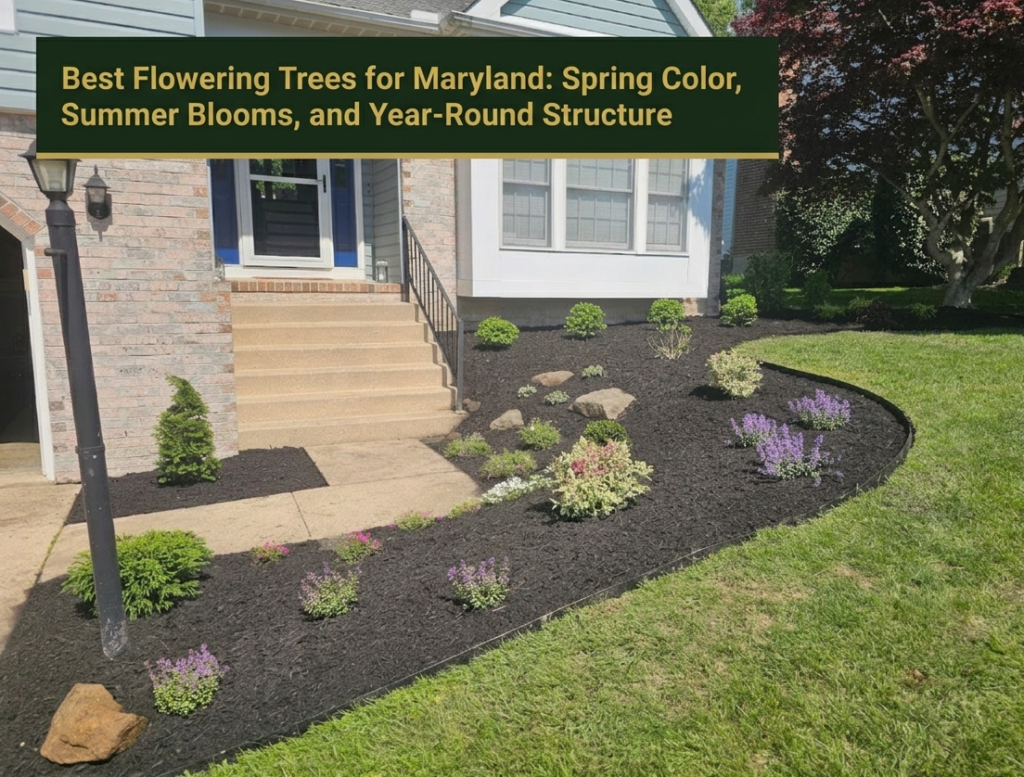
The best flowering trees for Maryland handle clay soil, humid summers, and late spring frosts without sulking. Reliable choices include eastern redbud, flowering dogwood, serviceberry, kousa dogwood, and sweetbay magnolia. Planting across bloom seasons, from March magnolias through midsummer stewartia, keeps color on the property for six months instead of two weeks.
Most homeowners in Bel Air and across Harford County plant one flowering tree, usually whatever looked good at the garden center in April, and then wonder why the yard goes quiet by June. A single ornamental cherry gives you ten days of bloom and eleven and a half months of green. That is not a flowering tree problem. It is a planning problem.
At Oakfield, Eric walks every property before recommending a single tree. Soil, sun exposure, drainage, and what is already growing nearby all factor into which species get planted and where. The list below is organized by bloom season, not by task or type, because that is how homeowners actually search for and plant these trees: by when they want color to show up next. If shade or year-round privacy is also on your list, our guide to Best Ornamental Trees for Maryland covers those separately.
We are working in USDA Zone 6b to 7a, with heavy clay soil across most of Harford County and a real chance of a hard freeze into mid-April. Every tree on this list has to survive that combination, not just look good in a catalog photo.
Earliest Bloomers: Late March to Early April
The bottom line: these trees bloom before almost anything else in the yard is awake, which means they take the brunt of Maryland’s unpredictable early spring weather. Site them where a late frost will not undo the show, and know going in that some years the bloom is shorter than others.
Okame Cherry (Prunus x incam ‘Okame’)
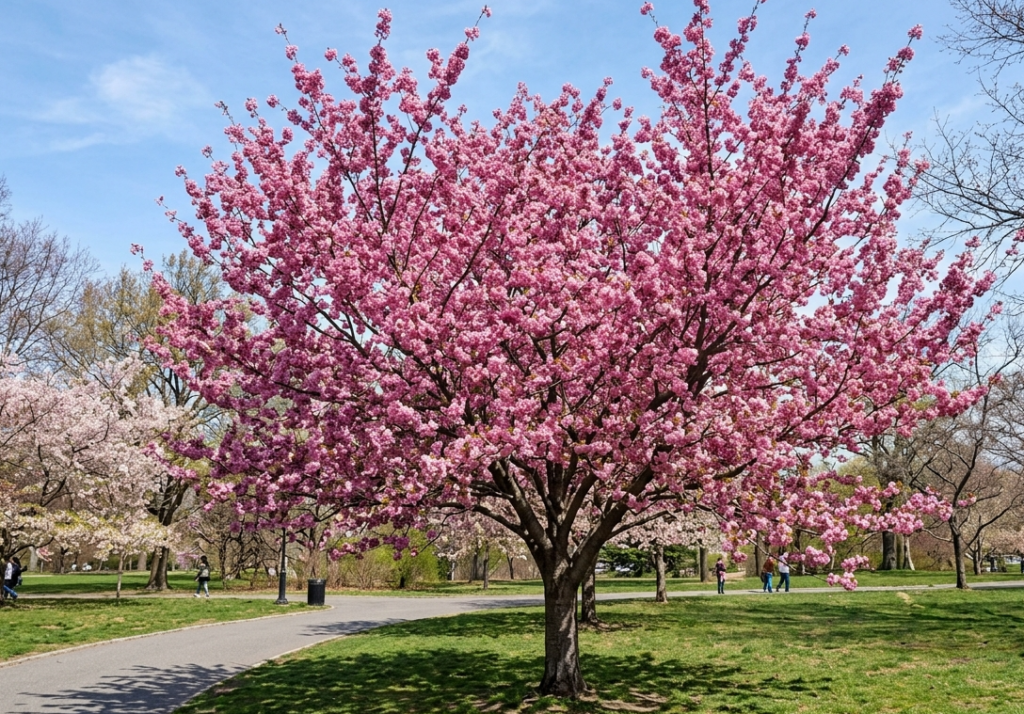
Single, carmine-pink flowers open earlier than almost any other ornamental cherry, sometimes overlapping with the last of the forsythia.
Mature size: 20 to 25 feet tall, 15 to 20 feet wide.
Site fit: full sun and well-drained soil, more cold-hardy than many ornamental cherry hybrids.
Design use: a specimen tree near an entry or along a driveway where the earliest possible color matters.
Honest caveat: the bloom window is short, often under a week, and the flowers can shatter quickly in a hard spring rain.
Cornelian Cherry Dogwood (Cornus mas)
Small clusters of yellow flowers appear directly on bare branches, often before forsythia. It is a dogwood relative rather than a true dogwood, and it is one of the species University of Maryland Extension lists as resistant to the anthracnose that troubles our native flowering dogwood.
Mature size: 15 to 25 feet tall, 15 to 20 feet wide.
Site fit: tolerates full sun to part shade and adapts to a range of soil types, including clay, once established.
Design use: plant it close to a front walk or driveway. The flowers are subtle from a distance and get lost against a lawn.
Honest caveat: it will never stop traffic the way a saucer magnolia does. This is a quiet, dependable tree, not a showpiece.
Star Magnolia (Magnolia stellata)
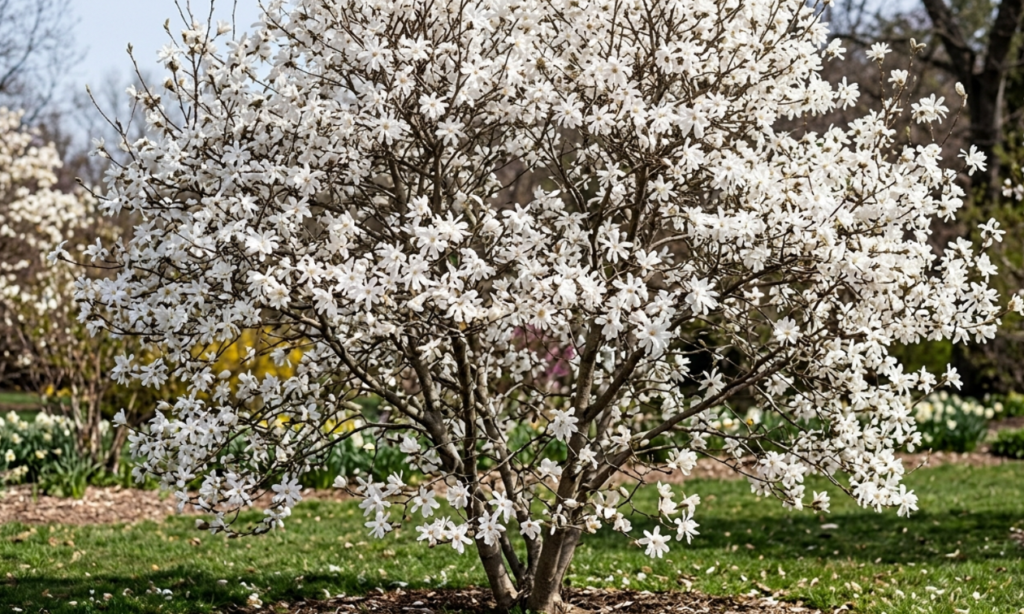
Fragrant white, strap-petaled flowers cover the bare branches before the leaves emerge, usually the first magnolia to bloom in the region.
Mature size: 15 to 20 feet tall, 10 to 15 feet wide.
Site fit: prefers moist, well-drained, slightly acidic soil and tolerates part shade to full sun.
Design use: ideal for a small front yard or a foundation planting near a porch, where the fragrance can be appreciated up close.
Honest caveat: a warm February followed by a hard freeze can brown the flowers entirely. Some years you get a full two weeks of bloom, other years almost none.
Yoshino Cherry (Prunus x yedoensis)
The same cherry planted around Washington’s Tidal Basin, with pale pink buds that open nearly white.
Mature size: 30 to 40 feet tall and wide.
Site fit: wants full sun and well-drained soil. It is less tolerant of heavy clay than most trees on this list, so amend at planting. Our mulch and topsoil calculator is a quick way to estimate how much compost a planting hole this size will need.
Design use: works as a specimen tree with room to spread, not a tree for a tight side yard.
Honest caveat: it is shorter-lived than an oak or a hornbeam, often 20 to 30 years in a typical lawn setting, and it is prone to trunk borers if stressed.
Downy Serviceberry (Amelanchier arborea)
Clusters of white flowers open before the leaves, followed by small June berries that birds strip within days. It is a Maryland native and appears on the Maryland Department of Natural Resources’ recommended tree list.
Mature size: 15 to 25 feet tall, spreading up to 35 feet.
Site fit: tolerates shade, wet soil, and clay better than most flowering trees on this list.
Design use: naturalized areas, woodland edges, or anywhere you want a low-maintenance native with wildlife value.
Honest caveat: if you were hoping to harvest the berries yourself, plan on losing that race to the cardinals and cedar waxwings most years.
Saucer Magnolia (Magnolia x soulangeana)
Large goblet-shaped flowers in pink, white, or purple-pink open before the leaves and are the showiest bloom on this early list.
Mature size: 20 to 30 feet tall and wide.
Site fit: full sun to part shade, moist and well-drained soil.
Design use: a strong specimen tree for a front lawn where it can be viewed from the street.
Honest caveat: it shares star magnolia’s late-frost vulnerability, and the spent petals turn to brown mush on a driveway or patio within a day or two of dropping.
Framework: How to Build a Bloom Succession from March to September
Most Maryland yards are planted for a single burst of color and then go visually quiet. A property with even three or four flowering trees, staggered by bloom time, keeps something happening from the first warm week of spring through late summer.
A simple sequence for a typical Harford County lot: a star magnolia or cornelian cherry dogwood near the entry for the earliest color, an eastern redbud or flowering dogwood at mid-spring for the peak show, a kousa dogwood in late May to extend the dogwood look past the native’s frost-prone window, and a crape myrtle or Japanese stewartia to carry bloom through the hottest part of summer when almost nothing else in the yard is flowering.
The sequencing matters more than any single tree choice. A yard with one spectacular saucer magnolia and nothing else gets ten days of attention and eleven months of plain green. A yard planted for succession gets a reason to look outside from March through September.
Peak Spring: Mid to Late April
The bottom line: this is when Maryland’s flowering trees put on their biggest show, and it is also when most homeowners make their only tree-buying decision of the year. These are the trees worth getting right.
Eastern Redbud (Cercis canadensis)
Magenta-pink flowers appear directly on bare branches and even on the trunk, a trait called cauliflory, before the heart-shaped leaves emerge. It is a Maryland native and one of the most widely recommended small trees in the state.
Mature size: 20 to 30 feet tall, 25 to 35 feet wide.
Site fit: understory tree in nature, so it tolerates part shade better than most flowering trees and prefers moist, well-drained soil.
Design use: works beautifully under taller oaks or pines, or as a standalone specimen in a front yard.
Honest caveat: redbuds tend toward a shorter lifespan than oaks or hornbeams and can develop canker disease on stressed or poorly drained sites.
Flowering Dogwood (Cornus florida)
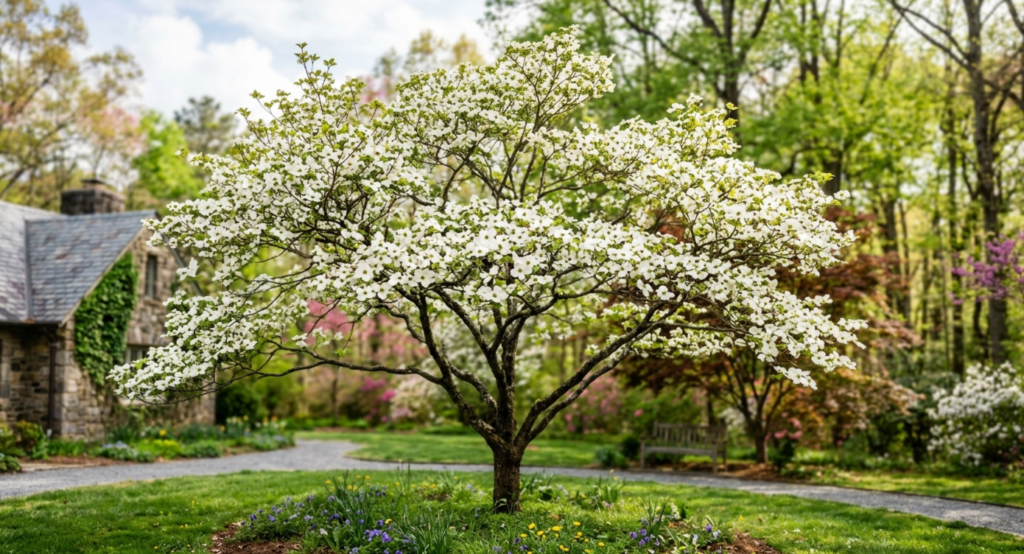
Maryland’s most iconic understory tree, with white or pink bracts opening in April, red fall foliage, and bright red winter berries that feed songbirds.
Mature size: around 20 feet tall, 15 to 20 feet wide.
Site fit: prefers well-drained soil and part shade to full sun.
Design use: a classic specimen tree, often placed at the corner of a house or as a focal point in a partially shaded bed.
Honest caveat: according to University of Maryland Extension, powdery mildew has now overtaken anthracnose as the most serious disease affecting dogwoods in the region, and no single cultivar resists every disease equally. Choose a cultivar bred for your specific site conditions rather than buying whatever is labeled disease-resistant at the garden center.
Kwanzan Cherry (Prunus serrulata ‘Kwanzan’)
Double, deep-pink pompom flowers in dense clusters, showier and blooming slightly later than Yoshino cherry.
Mature size: 25 to 30 feet tall and wide.
Site fit: full sun and well-drained soil.
Design use: a bold specimen tree for a front yard with room to spread.
Honest caveat: it is sterile, so there is no fruit for wildlife, and it is more prone to trunk borer damage than most trees on this list, especially if the trunk gets nicked by a mower or trimmer.
Red Buckeye (Aesculus pavia)
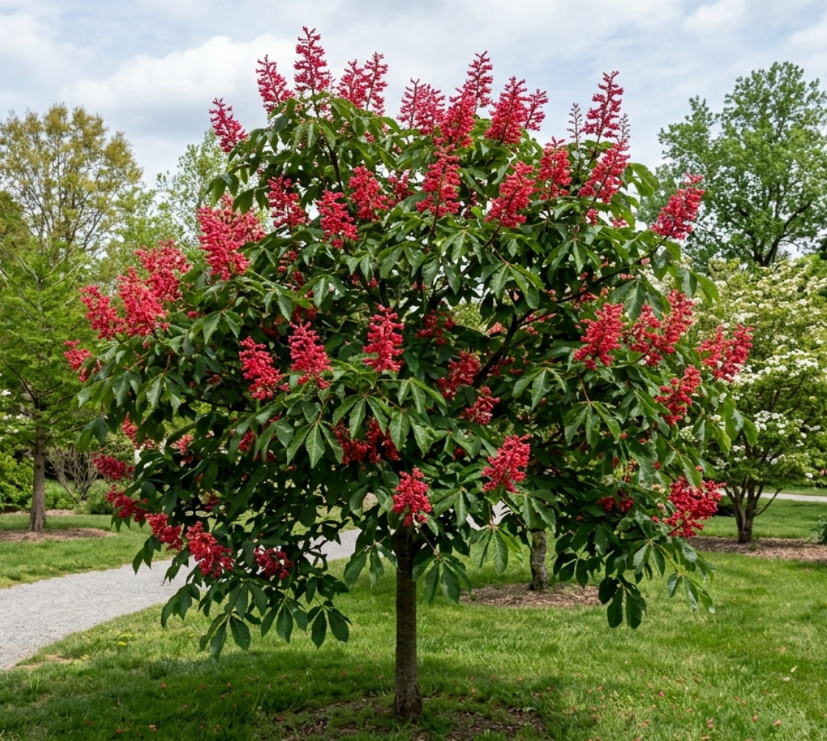
Upright red flower panicles in April draw hummingbirds before most other nectar sources are available.
Mature size: 15 to 20 feet tall and wide.
Site fit: tolerates part shade and a range of soil types, including clay.
Design use: a good understory or woodland-edge tree, or a specimen near a patio where hummingbird activity can be watched.
Honest caveat: it drops its leaves early, often looking bare by late August, well before fall color season even starts elsewhere in the yard.
Disease-Resistant Crabapple (Malus spp.)
Spring flowers in white, pink, or red cover the entire tree for two to three weeks, followed by small fruit that persists into winter and feeds birds.
Mature size: 15 to 25 feet tall and wide, depending on cultivar.
Site fit: full sun and well-drained soil, tolerant of clay and urban conditions.
Design use: front yards, along driveways, or anywhere bold spring color and winter fruit are the goal.
Honest caveat: older crabapple varieties are magnets for apple scab and fire blight. The cultivar name matters more than the species name here. Ask specifically for disease-resistant selections rather than whatever crabapple happens to be in stock.
Late Spring: May
The bottom line: May bloomers extend the flowering season past the point where most yards have already peaked, and several of these trees tolerate part shade better than the April lineup.
Carolina Silverbell (Halesia carolina)
Hanging white bell-shaped flowers line the branches in May, best appreciated from underneath the canopy.
Mature size: 25 to 35 feet tall, slightly narrower in spread.
Site fit: prefers acidic, well-drained soil and tolerates part shade.
Design use: a woodland-edge or understory tree, or a specimen where you can walk beneath it.
Honest caveat: it wants better drainage than most Harford County clay offers naturally, and it will sulk without soil amendment at planting.
Green Hawthorn (Crataegus viridis ‘Winter King’)
White spring flowers followed by red fruit that persists into winter, feeding birds when little else is available. University of Maryland Extension singles out ‘Winter King’ as the adaptable, garden-worthy selection.
Mature size: 20 to 35 feet tall and wide.
Site fit: full sun, tolerant of a range of soil conditions and urban stress.
Design use: a strong specimen or border tree, and a good replacement candidate for a removed Callery pear.
Honest caveat: it is thorny. Keep it away from walkways, driveways, and anywhere children play.
American Yellowwood (Cladrastis kentukea)
Fragrant white flowers hang in wisteria-like chains in late May, on a tree with smooth, gray, beech-like bark that adds winter interest.
Mature size: 30 to 50 feet tall and wide.
Site fit: full sun to part shade, adaptable to most well-drained soils.
Design use: a shade tree that also flowers, good for a larger property that wants both functions from one tree.
Honest caveat: it typically blooms heavily only every second or third year, so do not plant it expecting an annual show.
White Fringetree (Chionanthus virginicus)
Fleecy white flower panicles in late May, a Maryland native that also appears on the state’s recommended tree list.
Mature size: 12 to 20 feet tall and wide.
Site fit: prefers moist, fertile soil and full sun, though it tolerates some shade.
Design use: a specimen tree or grouped planting near a building foundation.
Honest caveat: research out of Wright State University found that emerald ash borer can develop in white fringetree, since it is a relative of ash. Larval survival runs lower in fringetree than in true ash, and ornamental plantings have not shown up as major reservoirs for the pest, but it is worth keeping an eye on rather than dismissing entirely.
Sweetbay Magnolia (Magnolia virginiana)
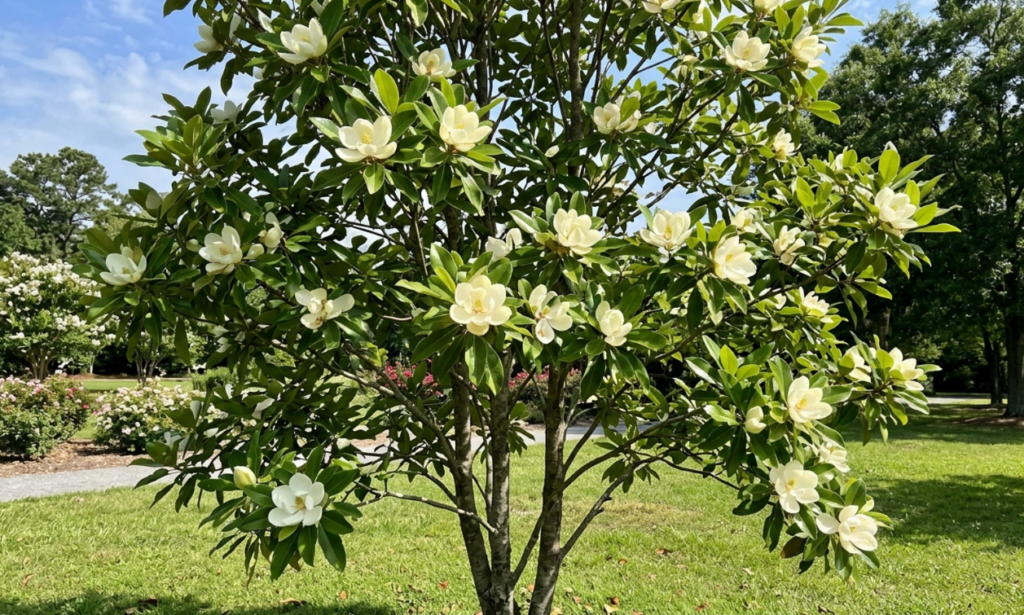
Lemon-scented cream flowers open over a long stretch from May into summer, longer than almost any other magnolia on this list. It is a Maryland native.
Mature size: 10 to 20 feet as a multi-stemmed small tree in our climate, larger further south.
Site fit: tolerates wet soil better than any other tree on this list, making it a strong choice near a low spot or rain garden.
Design use: a specimen tree in a moist area, or a naturalized planting near a water feature.
Honest caveat: it is semi-evergreen this far north, which means it looks ragged and half-bare in a harsh winter rather than fully dropping its leaves cleanly.
Framework: Native vs Non-Native Flowering Trees
Several of the best-performing flowering trees for Maryland are not native, and several natives underperform their imported equivalents in a typical suburban yard. Both facts are true, and pretending otherwise does not help anyone plant a better tree.
Kousa dogwood, a non-native from Asia, blooms later and holds up to heat and drought better than our native flowering dogwood, which is why designers reach for it on sites where anthracnose or powdery mildew have already been a problem. Crape myrtle, also non-native, gives Maryland its longest bloom window of any tree on this list, from July into September, at the cost of sitting near the edge of its cold hardiness here and needing to be monitored for crapemyrtle bark scale.
On the native side, eastern redbud, flowering dogwood, serviceberry, white fringetree, and sweetbay magnolia all carry real ecological value, feeding pollinators and birds in ways their non-native counterparts generally do not. The University of Maryland Extension’s Commercial Maryland Native Plant List catalogs roughly 675 species suited to the state’s three ecoregions, and Maryland’s Tree Solutions Now Act of 2021 set a goal of planting 5 million native trees statewide by 2031.
The honest recommendation is not native-only or non-native-only. It is choosing the tree that fits the site and being clear-eyed about what each species asks of you in return.
If wildlife value is the deciding factor, prioritize the natives on this list, since their flowers, fruit, and foliage support pollinators, birds, and other species that co-evolved with them in ways a non-native tree simply does not replicate, however attractive its bloom. If a specific disease or pest has already caused problems on your property (anthracnose on a previous dogwood, for instance) a non-native alternative bred for resistance is a reasonable trade to make. Neither choice is wrong on its own. The mistake is picking a tree because it is labeled native or non-native without asking whether it actually solves the problem you have.
Framework: Small Front Yard vs Large Property
Mature size is the single most common reason a flowering tree ends up removed within fifteen years of planting, and the same size mismatch is behind a lot of the overgrown landscapes we get called out to redesign. Matching size to the space now avoids that outcome later.
Under 20 feet: star magnolia, white fringetree, eastern redbud on the smaller end of its range, and downy serviceberry all fit tight front yards, foundation plantings, and spaces near patios without threatening a structure at maturity.
20 to 35 feet: flowering dogwood, kousa dogwood, saucer magnolia, Carolina silverbell, disease-resistant crabapple, and green hawthorn need more room but still work on a standard suburban lot with reasonable setback from the house.
35 feet and up: Yoshino cherry, Kwanzan cherry, and American yellowwood want the kind of open space a larger Harford County property offers, where a mature canopy will not crowd a driveway or scrape a roofline.
As a rule of thumb, plant at least half the tree’s mature spread away from any structure, and check for overhead utility lines before committing to anything in the 35-foot-plus category.
Underground space matters as much as what happens above ground. A tree planted six feet from a foundation might look proportionate today, but ten years of root growth can heave a walkway or crack a patio slab that was never designed to move. Drainage matters just as much before you dig; if your yard already holds water after a storm, our guide to standing water and clay soil drainage in Harford County is worth reading before you pick a planting spot. Before choosing a spot, walk the property at different times of day and note where full sun actually falls, since morning sun and afternoon sun are not interchangeable for most of the trees on this list. A Japanese maple or stewartia that gets scorched by four hours of harsh afternoon sun will never fill in the way it would on the east side of the same yard.
For homeowners planning a full front-yard redesign rather than a single specimen tree, pairing a small flowering tree with an understory shrub layer, rather than dropping it alone in a bed of mulch, is what separates a designed landscape from a yard with a tree in it.
Early Summer: Late May into June
The bottom line: these two trees pick up right as the peak spring bloomers finish, extending color into a part of the season most yards have already gone quiet.
Kousa Dogwood (Cornus kousa)
Pointed white bracts open several weeks after our native flowering dogwood, which means the bloom clears Maryland’s late-frost window entirely. University of Maryland Extension notes it blooms later and longer than Cornus florida and tolerates dry conditions better.
Mature size: 15 to 30 feet tall and wide.
Site fit: full sun to part shade, more heat and drought tolerant than the native dogwood.
Design use: front yards, small gardens, and patios where reliable bloom matters more than native provenance.
Honest caveat: it is not native, and the raspberry-like fruit that follows the flowers makes a sticky mess if it drops onto a patio or walkway.
Japanese Snowbell (Styrax japonicus)
Pendant white bell-shaped flowers hang along horizontal branches, best viewed from below or from a deck at a slightly lower elevation.
Mature size: 20 to 30 feet tall, slightly wider than tall at maturity.
Site fit: full sun to part shade, moist, well-drained, slightly acidic soil.
Design use: plant it where people naturally look upward into the canopy, near a patio, deck, or garden bench.
Honest caveat: it is shallow-rooted and struggles with drought in its first two to three years. Consistent watering during establishment is not optional with this tree.
Framework: Flowering Trees to Skip in Maryland (and What to Plant Instead)
This section discusses Maryland plant regulations for general informational purposes. It is not legal advice. Confirm current status with the Maryland Department of Agriculture before buying, planting, or removing any regulated species.
Not every popular flowering tree belongs on a current Maryland planting list, and this is the section most guides skip.
Two separate problems tend to get lumped together when people talk about “bad” flowering trees: structural weakness and invasive spread. A tree can suffer from one, the other, or both. Bradford pear is the rare case that hits both marks at once, which is part of why it became the poster child for this conversation in the first place.
Callery pear, commonly sold as Bradford pear (Pyrus calleryana), was for decades the most-planted flowering tree in Harford County subdivisions, prized for a fast growth rate and reliable white spring bloom. That popularity created its own problem: the branch structure on most Bradford pear cultivars grows in tight, narrow-angled crotches that split apart in ice storms and high wind almost as a matter of when, not if. Layered on top of that structural weakness, the species spreads aggressively into wooded areas, fields, and roadsides once cross-pollinated by another cultivar, which is the invasive concern driving the current regulation.
According to the Maryland Department of Agriculture, Callery pear was added to the state’s Prohibited Invasive Plant List effective January 15, 2026, meaning it can no longer be acquired or sold in Maryland. Existing nursery and landscaper stock has a phase-out period running to January 15, 2027 for potted plants and January 15, 2028 for in-ground plantings. If you already have a Bradford pear on your property, there is currently no requirement to remove it, but replacing it as it declines, or before its next major storm, is the better long-term move. Green hawthorn ‘Winter King’, flowering dogwood, and serviceberry all cover similar ground: white spring flowers, manageable size, and none of the storm-splitting weak branch structure that made Bradford pear notorious in the first place.
Mimosa, or silktree (Albizia julibrissin), is not yet regulated, but the Maryland Department of Agriculture has it queued for invasive species assessment in the 2026 to 2027 cycle, alongside empress tree (Paulownia tomentosa) and Norway maple (Acer platanoides). None of these are prohibited today. All three are worth thinking twice about planting now, given where the assessment process has trended for other ornamental species in recent years.
Silver maple, while not a flowering tree and not currently regulated, deserves a mention here as a cautionary example: a genuinely popular ornamental that turned out to be a poor long-term fit for suburban lots because of brittle wood and aggressive surface roots. The lesson applies across the board. Popularity at a garden center is not the same thing as a good match for your yard, twenty years out.
Summer Bloomers: July through September
The bottom line: these are the trees that keep a Maryland yard interesting through the hottest, least colorful stretch of the growing season.
Japanese Stewartia (Stewartia pseudocamellia)
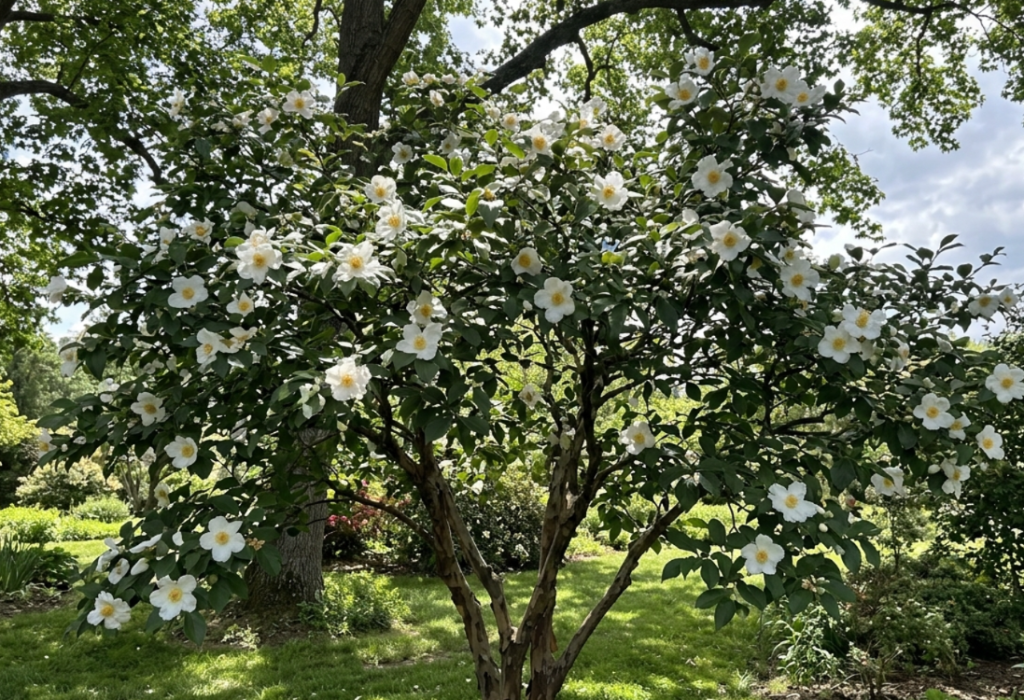
White, camellia-like flowers open in July, when almost nothing else in the yard is blooming, followed by orange to red fall color and exfoliating bark that adds interest through winter.
Mature size: 20 to 40 feet tall, 20 to 30 feet wide.
Site fit: part shade, moist, well-drained, acidic soil.
Design use: a refined specimen tree for a smaller garden where a slow, elegant grower fits the design intent.
Honest caveat: it is slow-growing and fussier about drainage than most trees on this list, and specimen-size stock is expensive. See our guide on how to find rare specimen plants in Maryland for where a tree this size actually comes from.
Sourwood (Oxydendrum arboreum)
Drooping, lily-of-the-valley-like white flower chains appear in midsummer, followed by some of the best scarlet fall color of any tree in this guide. It appears on the Maryland Department of Natural Resources’ recommended tree list.
Mature size: 25 to 30 feet tall, pyramidal in youth.
Site fit: prefers moist, well-drained, acidic soil in full sun to part shade.
Design use: a specimen tree where midsummer bloom and standout fall color both matter.
Honest caveat: it does not tolerate soil compaction or road salt, so keep it away from driveways treated in winter.
Crape Myrtle (Lagerstroemia spp.)
The longest bloom window of any tree on this list, often running from July through September in shades of white, pink, red, or purple.
Mature size: varies widely by cultivar, from 6 to 8 feet dwarf types up to 20 feet or more for tree-form varieties.
Site fit: full sun and well-drained soil.
Design use: a specimen or grouped planting wherever late-summer color is otherwise missing from the landscape.
Honest caveat: two things to know before planting. Maryland sits near the northern edge of crape myrtle’s cold hardiness range, so some winters bring dieback. And crapemyrtle bark scale, a pest first confirmed in Maryland in a Baltimore County landscape in April 2020 according to University of Maryland Extension, has since spread through the region. Budget for monitoring rather than treating this as the low-maintenance tree it is often sold as.
Seven-Son Flower (Heptacodium miconioides)
Fragrant white flowers open in late summer, and the show continues after the petals drop, when the flower calyxes turn a striking rose-red and persist for weeks.
Mature size: 15 to 20 feet tall, 10 to 15 feet wide, often grown as a multi-stemmed small tree.
Site fit: full sun to part shade, adaptable to most well-drained soils.
Design use: a late-season specimen where the post-bloom color is as valuable as the flower itself, and a strong pollinator draw when little else is blooming.
Honest caveat: it is a newer introduction to the nursery trade, so mature specimens are less common to see in person before buying, and exfoliating bark takes several years to develop.
Frequently Asked Questions
Are Bradford pears banned in Maryland?
Yes, as of January 15, 2026. Callery pear, the species sold under the Bradford pear name, is on the Maryland Department of Agriculture’s Prohibited Invasive Plant List and can no longer be sold or acquired in the state. Existing nursery stock has a phase-out period running through January 15, 2027 for potted plants and January 15, 2028 for in-ground plantings. This is not legal advice; confirm current status directly with the Maryland Department of Agriculture.
When is the best time to plant a flowering tree in Maryland?
Fall, from September through November, gives roots time to establish while the soil is still warm and the air has cooled, which reduces stress on the tree. Early spring, once the ground thaws but before leaf-out, is the second-best window. In Zone 6b to 7a with heavy clay soil, avoid planting in the heat of summer.
What is the fastest-growing flowering tree for Maryland?
Yoshino and Kwanzan cherry both establish and reach flowering size faster than most trees on this list. Neither is especially long-lived compared to a redbud or a yellowwood, so factor that trade-off into the decision.
Which flowering tree blooms the longest in Maryland?
Crape myrtle, often flowering continuously from July into September. That long bloom window comes with a caveat: Maryland sits near the edge of its cold hardiness, and crapemyrtle bark scale has spread through the region since it was first confirmed here in 2020.
Do flowering trees grow in clay soil?
Many do, but not all equally well. Serviceberry, redbud, hawthorn, and sweetbay magnolia tolerate Harford County’s heavy clay with little amendment. Stewartia, silverbell, and Japanese snowbell want better drainage and need soil amended at planting. A soil test or a check against the USDA Web Soil Survey for your specific lot will tell you which category you are working with before you plant.
What flowering trees are native to Maryland?
Eastern redbud, flowering dogwood, downy serviceberry, white fringetree, and sweetbay magnolia are all Maryland natives that appear on this list. The University of Maryland Extension’s Commercial Maryland Native Plant List catalogs roughly 675 native species suited to the state if you are looking to expand beyond trees.
Why didn’t my dogwood bloom this year?
A late spring frost after bud break is the most common cause in Zone 6b to 7a, and it affects most early bloomers on this list, not just dogwood. Powdery mildew and stress from drought or poor drainage can also suppress flowering. If the tree looks otherwise healthy, a missed bloom season is usually weather, not a sign of a dying tree.
What is the best flowering tree for a small front yard?
Star magnolia, white fringetree, and eastern redbud all stay under or near 20 to 30 feet at maturity and fit most front yard settings without threatening a foundation or overhead line. Match final choice to how much sun the spot actually gets, since some of these tolerate shade far better than others.
Choosing the right flowering tree for your Maryland property means matching bloom season, mature size, and site conditions to what your yard can actually support long-term, not just what looks good in a April nursery display. At Oakfield Landscaping, Eric visits every property in person before recommending a single species, evaluating soil, sun, and drainage so the tree you plant this spring is still thriving twenty years from now, the way our guide to landscapes that mature over decades describes.
Ready to plan a flowering tree lineup for your Bel Air or Harford County property? Our landscape design and installation team can build a bloom succession suited to your specific site. Schedule a consultation to get started.

With over 10 years of experience locally in Maryland, Oakfield Landscaping has a team of skilled professionals ready to deliver exceptional services.
Start your project
Ready to create a landscape that enhances your property and reflects your vision?
Our design process begins with an in-depth consultation:
- Walk your property and discuss your vision
- Review your functional & aesthetic preferences
- Assess existing landscape conditions
- Explain our design-installation process and timeline
- Answer your questions about our approach