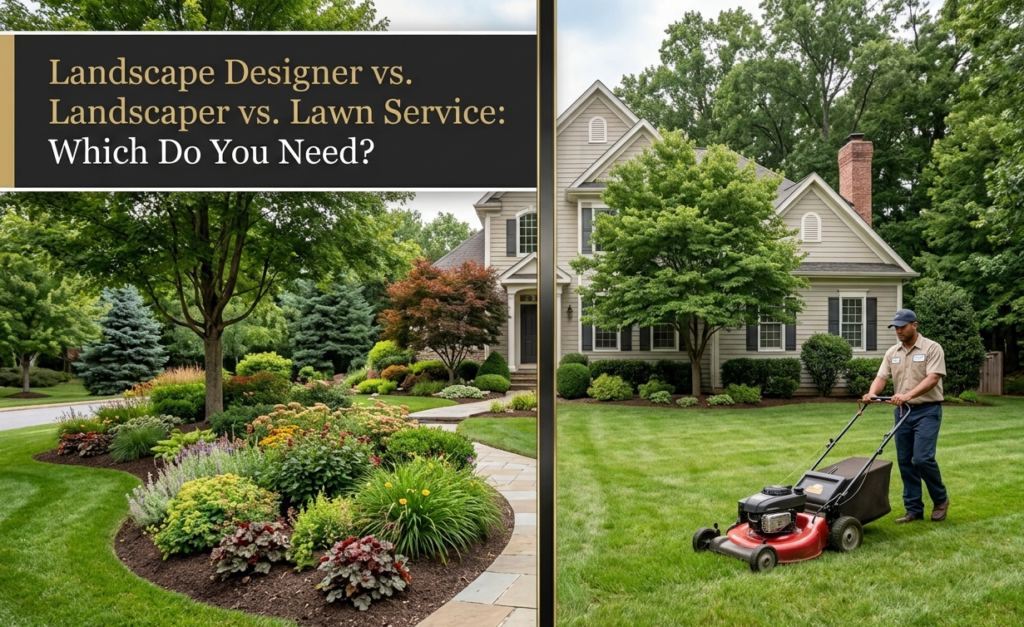
Search “landscaper near me” in Harford County and you’ll get forty results that have almost nothing in common. One is a teenager with a trailer and a mower. Another is a full design-build firm that creates and installs six-figure outdoor spaces. Both call themselves “landscapers.” Their quotes are off by a factor of fifty. And you’re left trying to figure out which one you actually need.
The confusion is built into the word. “Landscaping” covers everything from cutting grass to engineering a hillside, so the title tells you almost nothing about what a company really does. Here’s how to tell the tiers apart, and how to match the right professional to the job in front of you.
The short version: A lawn or maintenance service keeps what you already have looking good; mowing, edging, cleanups. A landscaper, or landscape contractor, installs things: plantings, beds, grading, drainage. A landscape designer creates the plan that decides what gets installed and where, and the best ones pair design with installation under one roof. Match the professional to whether you need upkeep, installation, or a plan.
The three roles at a glance
| What they do | What to look for | Hire them when | |
|---|---|---|---|
| Lawn / maintenance service | Recurring upkeep: mowing, edging, seasonal cleanups | Reliability and references | Your landscape exists and just needs regular care |
| Landscaper / landscape contractor | Installs plantings, beds, grading, drainage | Experience, insurance, a real portfolio | You know what you want built and need it done right |
| Landscape designer | Creates the plan, plant palette, and layout | Design training or APLD’s CPLD certification | You want a cohesive plan, not a guess |
| Landscape architect | Designs complex sites: heavy grading, drainage engineering, structures | State license (Board of Examiners of Landscape Architects) | Major engineering, structural, or large-scale work |
The lawn and maintenance service
This is the most basic tier, and for a lot of homeowners it’s all they need. A maintenance service mows, edges, trims, mulches, and handles spring and fall cleanups on a recurring schedule. They keep a landscape healthy and tidy; they don’t design or build one.
One simple way to place this tier: a maintenance service handles ongoing care, not construction. It’s the difference between keeping a landscape healthy and creating or rebuilding one, which is the job of the next two tiers.
If your landscape is established and you simply want it maintained, this is your match, and it’s a service we provide through our own landscape maintenance program, which is a different thing entirely from mow-and-go.
The landscaper (landscape contractor)
This is the tier most people picture. A landscape contractor installs: trees and plantings, garden beds, grading and drainage work, and the physical building of a landscape. Where a designer decides what should happen, a contractor makes it happen on the ground.
The quality gap between contractors is enormous, so this is where vetting matters most. Look for a substantial portfolio of completed local projects; real photos of their own work, not stock images; proof of current liability insurance, and references you can actually call. Maryland regulates many home-improvement contractors through the Maryland Home Improvement Commission, though whether a particular landscaping job falls under that depends on the scope of the work, so it’s reasonable to ask any contractor how they’re insured and set up before you sign.
The landscape designer
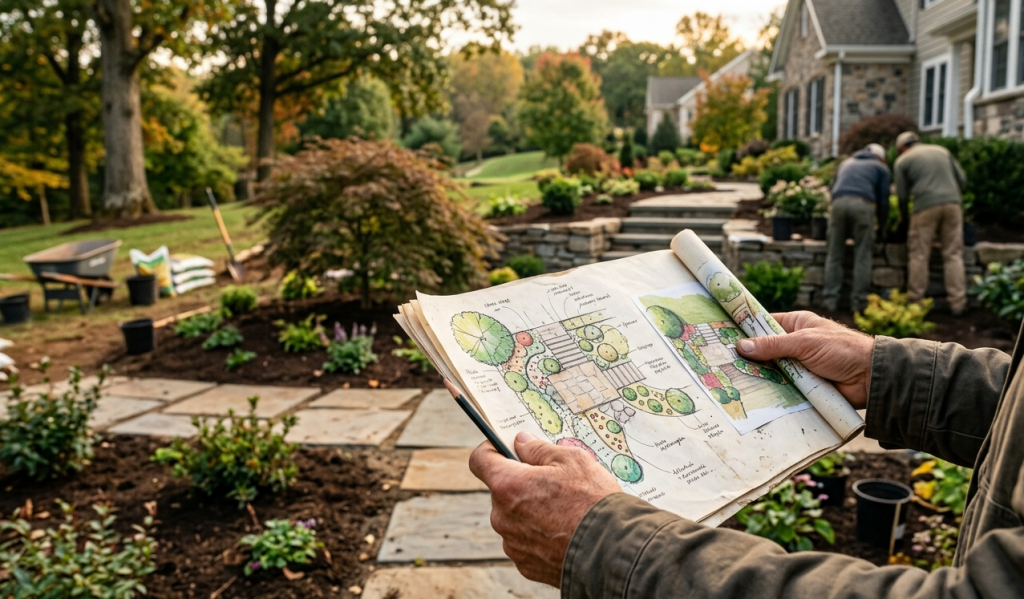
A landscaper can build what you tell them to build. A landscape designer figures out what should be built in the first place.
Designers bring formal design education and deep horticultural knowledge to the question of how a space should function and feel: what plants will actually thrive in your conditions, how the spaces flow, how it looks across all four seasons, how to solve problems like screening, slope, or drainage as part of a coherent whole. Unlike landscape architects, “landscape designer” isn’t a state-licensed title, but there is a meaningful professional credential. The Association of Professional Landscape Designers awards the CPLD (Certified Professional Landscape Designer), which it describes as the only international certification for the field, requiring at least two years of professional practice, a portfolio of installed projects reviewed by peers, and ongoing continuing education to maintain. APLD even runs a DC-Maryland-Virginia chapter with a directory of regional designers.
The value of a designer shows up most when a project is more than a single bed; when the decisions interact, and a wrong one is expensive to undo. That’s the case for hiring design before installation, which we make in detail in our piece on why design-install beats design-bid in Maryland.
The landscape architect
At the top of the technical scale is the landscape architect, and this is a true license, not a certification. Per the Maryland Board of Examiners of Landscape Architects, a landscape architect must hold a degree in landscape architecture, complete years of supervised experience, and pass the four-part national licensing exam that covers grading, drainage, and construction documentation. The American Society of Landscape Architects frames the distinction this way: architects are trained and licensed for work involving construction, grading, and stormwater engineering that carries real technical and environmental stakes.
For most residential properties, you don’t need that level of engineering. Where it earns its keep is on complex sites; significant structural grading, drainage systems that must meet engineered standards, or large estate-scale projects. A good luxury and estate landscaping firm will bring in or coordinate with a landscape architect when a project genuinely calls for one.
Design-build: where designer and contractor become one
Here’s the practical reality most homeowners arrive at: for any real project, you don’t want to hire these roles separately and hope they coordinate. You want the design and the installation to live under one roof, so the people who drew the plan are accountable for building it.
That’s the design-build model, and it’s how we work. A single team handles the design and installation; the designer’s plan and the build crew’s execution, so nothing gets lost in translation between a designer who’s moved on and an installer who’s interpreting someone else’s drawings. For homeowners across Bel Air and Harford County, it’s the difference between a landscape that was assembled and one that was designed.
A simple way to choose
Strip away the titles and it comes down to one question: what do you actually need done?
- You want your existing yard maintained on a schedule → a lawn / maintenance service.
- You know exactly what you want installed and just need skilled execution → a skilled landscape contractor.
- You want a plan: what goes where, what thrives, how it all works together — then built → a landscape designer, ideally a design-build firm.
- You have a complex, structural, or estate-scale site → a landscape architect, or a design-build firm that works with one.
Vetting whoever you hire
Whichever tier you land on, a few checks protect you: ask for proof of current liability insurance, see a real portfolio of completed local projects (not stock photos), call a reference or two, and get the full scope and price in writing before any money changes hands.
If what you’re after is a designed, installed landscape built by one accountable team, that’s exactly what we do across Harford County. Book a consultation or call (443) 794-8108, and we’ll help you figure out what your project actually needs.
This article explains the general differences between these roles in plain terms; it isn’t legal advice. Professional requirements vary by the type of work and can change, so confirm current rules with the relevant Maryland board.
Frequently asked questions
Do I need a landscape designer or a landscaper? A landscaper installs what’s already been decided; a designer decides what should be installed and why. If your project is a single, well-defined task, a landscape contractor may be enough. If the decisions interact; layout, plant selection, flow, drainage; a designer (or a design-build firm that’s both) protects you from expensive mistakes.
What’s the difference between a landscape designer and a landscape architect? Both design outdoor spaces, but a landscape architect is state-licensed and trained for technical work like structural grading and stormwater engineering, while “landscape designer” is an unlicensed title backed by voluntary certification such as the APLD’s CPLD. Architects are typically reserved for complex or large-scale sites; designers handle most residential design beautifully.
What should I look for when hiring a landscaper? Focus on proof of work and protection: a portfolio of completed local projects (their own photos, not stock), current liability insurance, references you can call, and a clear written scope and price before any deposit. For design work, ask whether the designer has formal training or certification such as the APLD’s CPLD.
Is a lawn service the same as a landscaper? No. A lawn service maintains an existing landscape (mowing, edging, cleanups). A landscaper installs and builds; plantings, beds, grading. They’re different businesses with different skills, and in Maryland, different licensing requirements.
What is a design-build landscaping company? A design-build firm handles both the design and the installation with one team, so the people who created the plan are responsible for executing it. It removes the coordination gap that happens when a separate designer and installer don’t communicate.

With over 10 years of experience locally in Maryland, Oakfield Landscaping has a team of skilled professionals ready to deliver exceptional services.
Start your project
Ready to create a landscape that enhances your property and reflects your vision?
Our design process begins with an in-depth consultation:
- Walk your property and discuss your vision
- Review your functional & aesthetic preferences
- Assess existing landscape conditions
- Explain our design-installation process and timeline
- Answer your questions about our approach