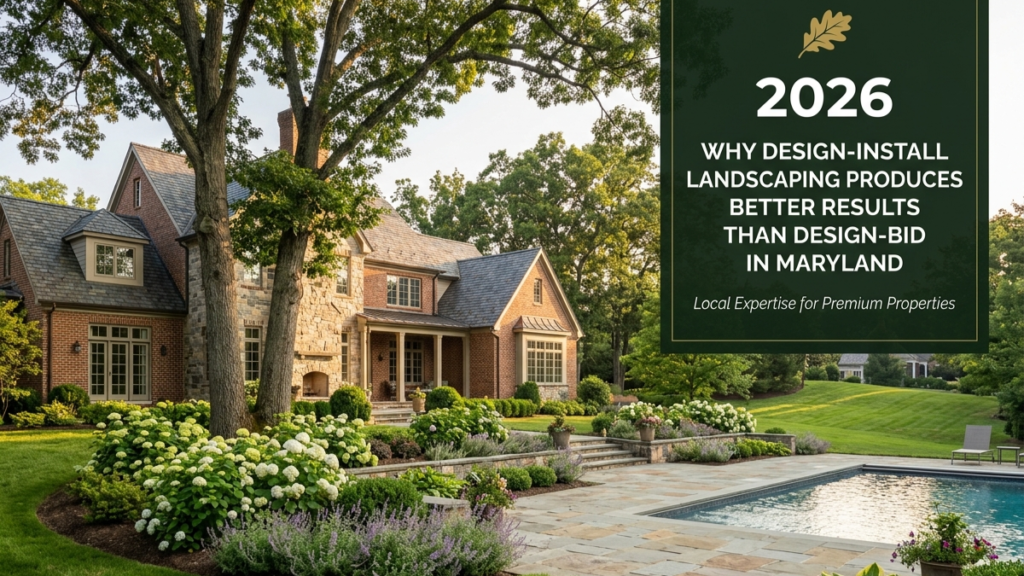
You’re planning a landscape project—maybe a front yard transformation, privacy plantings, or a backyard with mature trees and water features. You’ve heard you need to hire a designer first, then get bids from contractors. But the process feels confusing, and you’re worried about budget surprises or the design not matching what actually gets installed.
Here’s what often goes wrong: the designer creates a beautiful plan with no idea what materials actually cost. Contractors bid based on shortcuts or substitutions. You’re stuck in the middle, managing two separate companies who’ve never worked together. Timelines stretch. Costs creep up. And the final result? It doesn’t look like what you approved.
There’s a better way. Design-install landscaping (also called design-build) puts one company—one team—in charge of your project from the first sketch to the final walkthrough. No handoffs. No finger-pointing. No surprises. And in Maryland, where weather, clay soil, and growing zones demand local expertise, the design-install model produces landscapes that don’t just look good on day one—they mature and improve for decades.
What Is Design-Install Landscaping? (And Why It Matters in Maryland)
Design-install landscaping means one company handles both the design and the installation. You work with a single team from start to finish.
The traditional approach—design-bid-build—splits the work. A landscape designer creates plans. Then you solicit bids from contractors who’ve never seen your property or talked to the designer. The contractor you hire installs the design (or their version of it). You’re the middleman coordinating between two separate businesses.
Design-install eliminates that split. The same company that sketches your landscape also plants every tree, installs every water feature, and positions every shrub.
Why does this matter in Maryland specifically? Because our growing conditions don’t forgive mistakes. Clay soil doesn’t drain like the sandy loam designers learn about in textbooks. Zone 6b/7a winters kill plants that look great in a catalog but can’t handle a February freeze. Spring can be wet and cold, or dry and hot—sometimes in the same week.
A designer working alone might specify a beautiful Japanese Maple that’s impossible to source locally. Or recommend groundcovers that won’t survive Harford County summers. When the designer and installer are the same team, those disconnects never happen.
At Oakfield, Eric is involved from the first consultation through the final walkthrough. He’s designing with plants he knows will thrive because he’s the one installing them—and he’s seen how they perform in your neighbor’s yard for the past five years.
How the Design-Bid Process Usually Works (And Where It Falls Apart)
In the traditional design-bid model, the designer and contractor work separately. Homeowners end up managing two vendors, timelines slip, and budgets balloon.
Here’s how it typically plays out:
Step 1: You hire a landscape designer. They visit your property, take measurements, ask about your vision. They create a detailed plan—sometimes beautiful renderings showing exactly what your yard will look like. You pay for the design upfront.
Step 2: The designer hands you plans. Now you’re on your own to find someone to actually build it. The designer may give you a list of contractors, or you start calling around.
Step 3: You solicit bids from three to five contractors. Each one reviews the plans—most for the first time. They’ve never talked to the designer. They’ve never walked your property with the person who created the design.
Step 4: Contractors propose substitutions. The designer specified a specific cultivar of Oak. The contractor suggests a cheaper alternative. The plan calls for natural stone; the bid includes manufactured pavers. The designer chose specialty shrubs; the contractor prices out what’s available at the big-box store.
You don’t know enough about plants or materials to judge these changes. You just know the bids are all over the map.
Step 5: You pick the lowest bid. Or maybe the contractor who seems most trustworthy. You’re guessing. You hope you chose right.
Step 6: Installation begins—and reality hits. The contractor discovers drainage issues the designer didn’t account for. The Japanese Maple specified in the plan isn’t available until fall. The grading doesn’t match what the designer drew. The contractor calls you to approve changes. You call the designer to ask if the changes are okay. The designer and contractor have never met.
Step 7: The project runs long. What was supposed to take four weeks stretches into three months. Weather delays happen. Material substitutions require redesigns. The contractor and designer blame each other.
Step 8: You’re stuck in the middle. When something doesn’t look right, who do you call? The designer says they drew it correctly. The contractor says they installed it per the plans. You’re paying both, and neither takes full responsibility.
The most frustrating part? The budget. Designers often create plans without knowing real-world costs. They specify high-end materials because it looks good on paper. Contractors bid low to win the job, then hit you with change orders when they encounter problems the designer didn’t foresee.
That’s where design-bid falls apart. Nobody owns the whole project. Communication breaks down. Budgets break. And you’re left managing two businesses who’ve never worked together before.
Oakfield handles design and installation under one roof. You get a clear process, a single point of contact, and a landscape built to mature over decades.
And the result? A landscape that doesn’t just look good on installation day. It’s designed to mature, fill in, and improve over the next ten to twenty years. For larger properties or estate-scale projects, this process scales seamlessly—learn more in our complete guide to luxury and estate landscaping in Harford County.
The difference is single accountability. One company. One point of contact. One team responsible for the entire result.
5 Reasons Design-Install Landscaping Produces Better Results in Maryland
The design-install model eliminates common problems and produces landscapes that thrive in Maryland’s unique climate and soil conditions.
Here’s exactly why it works better:
1. No Budget Surprises or Change Orders
The designer knows real costs because the same company is installing the work. Pricing is transparent from the start.
When Eric designs your landscape, he’s pricing every plant, every cubic yard of soil amendment, every hour of installation. He’s not guessing. He’s not hoping a contractor can hit a number. He knows what it costs because Oakfield is doing the work.
That means no change orders mid-project. No “we didn’t account for drainage” or “that plant isn’t available so we substituted something cheaper.” If a Japanese Maple is in your design, Oakfield has already confirmed availability and cost before you approve the plan.
Compare that to design-bid: the designer specifies materials with no idea what they cost. Contractors bid based on substitutions or shortcuts to hit a price. You approve a design at a set amount, then get hit with thousands in change orders because the contractor “didn’t realize” the soil needed amending or the designer’s plant choices weren’t available.
Design-install eliminates that entirely. What you approve is what you pay.
2. Better Plant Selection for Maryland’s Climate
The designer understands what actually thrives in zone 6b/7a. No specifying plants that won’t survive Maryland winters or struggle in clay soil.
This is huge. Maryland’s growing conditions are tricky. Harford County sits in zone 6b/7a, which means cold winters but humid summers. Clay soil holds water in spring and bakes hard in August. A plant that thrives in Virginia might struggle here. Something that looks great in a Pennsylvania garden might not handle our summer heat.
Designers working separately from installation don’t always know this. They specify plants that look good in catalogs or software. They recommend varieties they learned about in school. But they don’t know which growers stock healthy specimens or which cultivars actually perform in Harford County.
Eric does. He’s been sourcing plants for Maryland landscapes for years. He knows which River Birch cultivar resists bronze birch borer. He knows which Holly varieties stay compact and which outgrow their space. He knows that Lenten Rose thrives in Bel Air’s clay soil but certain Azaleas struggle without serious amendments.
When Eric designs your landscape, he’s not pulling plant names from a list. He’s choosing varieties he’s installed in dozens of local properties—and seen perform for five, ten, fifteen years. If a plant isn’t available from a trusted grower or doesn’t have a track record in your zip code, it doesn’t go in your design.
That’s only possible when the designer and installer are the same person.
3. Faster Timelines and Smoother Communication
No back-and-forth between designer and contractor. One point of contact throughout the project. Faster decision-making when weather or site conditions require adjustments.
Design-bid projects drag on. Here’s why: every decision requires coordination between the designer and contractor—two people who often don’t communicate well.
The contractor encounters a drainage issue. They stop work and call you. You call the designer. The designer revises the plan. You forward it to the contractor. The contractor reviews it and calls you back with questions. You’re playing telephone between two professionals who should be talking directly.
This happens over and over: plant availability, grading adjustments, timing around weather, material substitutions. Every decision takes days or weeks because you’re coordinating two separate businesses.
With design-install, Eric makes the call on-site. He encounters a drainage issue? He adjusts the grading immediately based on his design intent. A plant arrives in poor condition? He contacts the grower and sources a replacement the same day. Weather forecast shows rain? He reschedules installation tasks without waiting for approvals from a separate designer.
Typical timeline for design-install at Oakfield: six to twelve weeks from consultation to completion. Design-bid? Four to six months is common—sometimes longer if the designer and contractor can’t align schedules or if change orders require redesigns.
You’re not just saving time. You’re eliminating stress. One phone number. One person managing the project. No confusion about who’s responsible for what.
4. Single Point of Accountability
If something needs adjusting, you call one company. No finger-pointing between designer and contractor. Warranty and long-term care covered by the same team.
This is the most underrated advantage of design-install. When problems arise—and they do on every project—who do you call?
In design-bid, the answer is unclear. A plant isn’t thriving? The contractor says the designer specified the wrong plant. The designer says the contractor installed it in the wrong location. You’re stuck refereeing.
Drainage issues? The contractor blames the designer’s grading plan. The designer blames the contractor’s installation. Both charge you to fix it.
With design-install, accountability is clear: Oakfield designed it and installed it. If something needs adjusting, you call Eric. No finger-pointing. No “that wasn’t in the original scope.” No coordinating between two businesses who don’t want to take responsibility.
This extends beyond installation day. A plant struggles in year one? Oakfield handles it. You want to expand the design in year two? The team that installed it is still here—they know exactly what was done and how to integrate additions seamlessly.
Your warranty and long-term care are covered by the team that built the landscape. That’s huge peace of mind.
5. Designs Built to Mature Over Decades
The designer understands how plants grow and fill in over time. Installation team executes with long-term vision in mind. Not just about curb appeal on day one—about a landscape that appreciates in value.
Most designers focus on how the landscape looks immediately after installation. Renderings show full, mature plantings. Plans are optimized for that first impression.
But landscapes aren’t static. Plants grow. Trees fill in. Shrubs expand. A design that looks perfect on day one can become crowded and overgrown in five years if spacing isn’t planned correctly.
Eric designs with maturity in mind. He’s planting Red Oak saplings today in positions where they’ll frame your home beautifully in ten years—not crowd your roofline. He’s spacing Boxwoods so they fill in naturally without needing aggressive pruning. He’s selecting slow-growing evergreens for foundation plantings instead of fast growers that outgrow their space.
This long-term thinking only happens when the designer has installation experience. A designer working on paper doesn’t see how plants perform over time. They don’t learn that certain Hydrangeas get leggy without proper siting, or that some Junipers spread wider than their tags suggest.
Eric’s been installing landscapes in Harford County long enough to see his work mature. He knows what succeeds long-term and what creates maintenance headaches. Your landscape isn’t designed for day one. It’s designed for year ten, year twenty, year thirty.
That’s the difference between a pretty plan and a landscape that appreciates in value.
What Types of Projects Benefit Most from Design-Install Landscaping?
Design-install works best for projects where design, plant expertise, and installation quality all matter—especially in Maryland’s challenging growing conditions.
Here’s where the design-install model shines:
Front yard transformations and curb appeal upgrades. Your front yard is the first thing guests see. It sets the tone for your entire property. Design-install ensures every element—mature plantings, seasonal color, tree placement, lighting—works together as one cohesive design. No contractor shortcuts. No substitutions that undermine the designer’s intent. Just a front yard that looks intentional and polished from day one.
Privacy screenings and natural borders. Getting privacy right requires understanding mature sizes, growth rates, and proper spacing. Plant evergreens too close and they’ll crowd each other. Space them too far and you’ll wait years for screening. Eric designs privacy plantings with mature size in mind, then installs them in positions that provide coverage fast without creating maintenance problems later.
Water features integrated into the landscape. A pond, stream, or fountain isn’t just a standalone feature. It needs to fit naturally into the surrounding plantings, grading, and lighting. Design-install handles the engineering and aesthetics together—no coordination headaches between a water feature contractor and a separate landscape designer.
Mature tree installation. Planting a large tree isn’t just digging a hole. It requires proper siting (accounting for overhead lines, underground utilities, future canopy spread), soil preparation for long-term health, and installation techniques that prevent settling or root girdling. When the designer and installer are the same team, trees are positioned correctly from the start—and planted using methods that ensure they thrive for decades.
Backyard renovations for outdoor living. Coordinating plantings, water features, and landscape lighting as one design creates backyards that feel intentional. Design-install eliminates the common problem where the lighting contractor, landscaper, and water feature installer never talk to each other—and the final result feels disjointed.
New build foundation landscaping. If you’ve just built a home, the landscape needs to scale with the architecture. Design-install ensures proportions are right, plantings complement your home’s style, and everything is installed correctly from the start—not patched together by multiple contractors over several years.
Low-maintenance and pollinator gardens. Plant selection and installation expertise matter here. Native plants need proper siting and soil conditions to thrive. Pollinator gardens require understanding bloom times, seasonal interest, and which varieties actually attract beneficial insects in Maryland. A designer working alone might specify plants that sound right. A design-install team installs plants they’ve tested in local conditions.
One note: Oakfield focuses on plantings, trees, water features, and lighting. We don’t handle hardscaping projects like patios, retaining walls, or anything requiring permits. Our expertise is in creating landscapes that grow and mature beautifully—not permanent structures.
Design-Install vs. Design-Bid: Which Is Right for Your Maryland Landscape Project?
If you value clear budgets, expert plant selection, and single accountability, design-install is the better choice—especially in Maryland.
Here’s a straightforward comparison:
| Design-Install (Oakfield Model) | Design-Bid-Build |
|---|---|
| One company, one point of contact | Separate designer and contractor |
| Budget set upfront, no surprises | Budget often increases after bids |
| Designer understands Maryland plants and soil | Designer may not know local conditions |
| Faster timelines (6-12 weeks typical) | Slower (4-6 months or more) |
| Single accountability for results | Finger-pointing if problems arise |
| Designs built to mature over decades | Focus often on short-term install |
| Plant selection from specialty growers | Contractor often sources from big-box stores |
| Owner (Eric) involved in every project | Designer and contractor may never meet |
Is there ever a case for design-bid? Possibly for very large commercial projects or municipal work where multiple bids are required by law. But for residential homeowners in Harford and Baltimore Counties, design-install is almost always the better option.
You’re not just hiring someone to install plants. You’re creating a landscape that will frame your home and grow more beautiful for the next twenty years. That requires expertise, accountability, and long-term thinking. Design-install delivers all three.
What to Look for in a Design-Install Landscaping Contractor in Maryland
Not all design-install contractors are the same. Here’s what to ask before hiring one.
Do they have deep local knowledge? Maryland’s clay soil, zone 6b/7a climate, and unpredictable weather require specific expertise. Ask about their experience with local growing conditions. Can they explain which plants struggle in Harford County summers? Do they know how to amend clay soil for better drainage? Have they installed landscapes that have matured successfully over five to ten years?
Do they show you examples of mature landscapes? Anyone can show fresh installations. Ask to see projects that have grown in for three to five years. That’s where you see whether plant spacing was correct, whether trees were sited properly, whether the design holds up long-term.
Are they transparent about costs upfront? Vague estimates are a red flag. A good design-install contractor provides detailed pricing before you approve the design. No surprises. No change orders unless you request changes.
Do they source specialty plants? Big-box stores stock what moves fast—not necessarily what thrives in Maryland. Ask where they source plants. Do they work with specialty growers? Can they access unique cultivars that aren’t available at retail?
Is the owner involved in your project? Some companies send salespeople to consultations, designers to create plans, and separate crews to install. You never meet the person in charge. At Oakfield, Eric is personally involved in every project from consultation through installation. That’s rare. And it matters.
Do they have a strong local reputation? Check Google reviews from homeowners in Harford and Baltimore Counties. Do past clients mention communication, budget accuracy, and long-term results? Oakfield has 60+ five-star reviews because we focus on those details.
What happens after installation? Landscapes need care—especially in the first year as plants establish. Ask whether the contractor offers maintenance programs or post-installation support. At Oakfield, we offer seasonal maintenance tailored to Maryland’s climate: spring soil amendments, summer watering guidance, fall mulching, and winter protection for sensitive plantings.
A good design-install contractor isn’t just installing plants. They’re creating a landscape that will thrive for decades—and sticking around to make sure it does. Once your landscape is installed, keeping it healthy and beautiful is easy with our seasonal maintenance programs.
Common Questions About Design-Install Landscaping in Maryland
Homeowners often have the same questions about the design-install process. Here are answers to the most common ones.
Is design-install landscaping more expensive than design-bid?
Not usually. Often costs the same or less because there are no change orders or miscommunication between designer and contractor.
Here’s why: in design-bid, you’re paying a designer upfront (often a few thousand dollars), then paying a contractor separately. The contractor’s bid doesn’t include design fees—so you’re paying twice. And when the design doesn’t match reality, you’re paying for change orders to fix disconnects between the designer’s vision and the contractor’s installation.
With design-install, design is included in the project cost. You’re paying one company for one complete project. No separate design fee. No markups from contractors who didn’t create the design and don’t feel invested in executing it correctly.
Upfront transparency means fewer surprises. You know what you’re paying before installation starts, and that number doesn’t change unless you request changes.
What if I already have a landscape design from another designer?
Oakfield can review existing designs and provide feedback, but we often recommend starting fresh to ensure design and installation are coordinated.
Here’s the issue: designs from separate designers often specify plants that aren’t available locally, ignore site-specific challenges (drainage, soil quality, sun exposure), or include spacing that doesn’t account for mature sizes. Contractors can install those plans, but the result may not match expectations.
When Oakfield starts fresh, Eric designs with installation in mind. He’s accounting for your property’s specific conditions, sourcing plants he knows are available and will thrive, and spacing everything for long-term success.
If you’ve already paid for a design, we understand the hesitation to start over. But a design that can’t be installed correctly—or creates problems down the road—isn’t a good investment. We’d rather be upfront about that than install something we know won’t succeed.
Do you offer maintenance after installation?
Yes. Oakfield offers seasonal maintenance programs tailored to Maryland’s climate.
Post-installation care is especially important in the first year as plants establish roots. We provide guidance on watering, mulching, and monitoring for stress. If you want hands-off maintenance, we offer programs that cover spring soil amendments, seasonal pruning, summer care, fall leaf management, and winter protection for sensitive plantings.
Maintenance isn’t required—but it’s the difference between a landscape that just survives and one that thrives. Most clients who invest in design-install landscaping want to protect that investment with proper care.
What areas do you serve?
Primary service area: Harford County and Baltimore County, MD—including Bel Air, Abingdon, Aberdeen, and surrounding areas.
We focus on these areas because Eric manages every project personally. That level of involvement isn’t possible if we’re driving an hour each way to job sites. Staying local means faster response times, better communication, and more accountability.
If you’re outside our primary service area but have a larger estate-scale project, reach out. We occasionally take on projects in surrounding counties if the scope justifies it.
Ready to Start Your Design-Install Landscaping Project in Maryland?
Oakfield Landscaping brings 60+ five-star reviews, deep local expertise, and a proven design-install process to every project in Harford and Baltimore Counties.
The design-install model eliminates budget surprises, communication headaches, and finger-pointing. You get single accountability, expert plant selection for Maryland’s climate, and a landscape designed to mature beautifully over decades—not just look good on installation day.
Eric’s personally involved in every project. That means you’re not talking to a salesperson during the consultation, then meeting a separate designer, then getting handed off to a crew. You work with the same person from the first conversation through the final walkthrough.
Oakfield sources specialty plants from trusted growers—not big-box stores. We design with Maryland’s clay soil, unpredictable weather, and zone 6b/7a growing conditions in mind. And we stand behind our work long after installation is complete.
Explore our luxury and estate landscaping services for larger properties.
Let’s design and install a landscape you’ll love for decades—not just on day one.

With over 10 years of experience locally in Maryland, Oakfield Landscaping has a team of skilled professionals ready to deliver exceptional services.
Start your project
Ready to create a landscape that enhances your property and reflects your vision?
Our design process begins with an in-depth consultation:
- Walk your property and discuss your vision
- Review your functional & aesthetic preferences
- Assess existing landscape conditions
- Explain our design-installation process and timeline
- Answer your questions about our approach