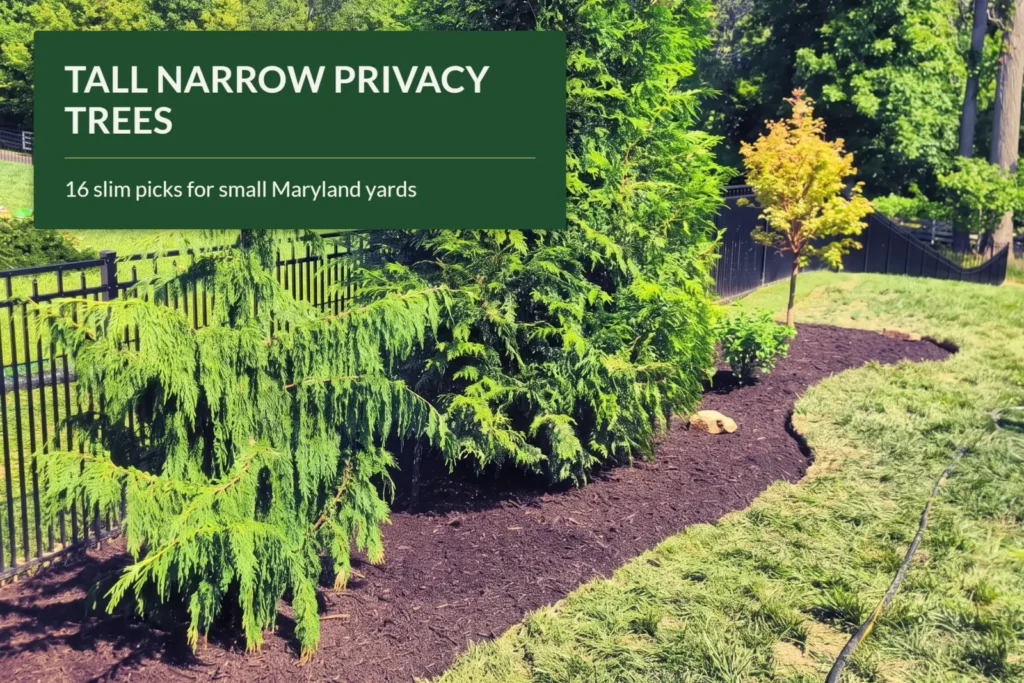
The short answer: The best tall, narrow trees for privacy in a small Maryland yard are the ones that stay slim without shearing. ‘Sky Pencil’ holly and ‘Graham Blandy’ boxwood fit a two-foot strip, ‘Kindred Spirit’ oak and ‘Slender Silhouette’ sweetgum climb past 30 feet while staying about 6 feet wide, and ‘Frans Fontaine’ hornbeam screens a patio at 15 feet across.
A small yard changes the privacy question. On an acre you can plant a row of Green Giants and let them spread 15 feet. On a quarter-acre lot, or along a side yard between two houses, that same row swallows the lawn, leans on the fence and still leaves a gap at the second-story windows. The answer is height without width: trees bred or selected for a columnar habit, so the screen goes up instead of out. Our guide to fast-growing privacy trees for Maryland covers the big screening species; this one is about the slim ones.
Maryland adds its own filter. Harford County sits mostly in Zones 6b and 7a on the 2023 USDA Plant Hardiness Zone Map, which is built from the average coldest winter night at weather stations between 1991 and 2020. Summers are hot and humid, and the heavy clay loam common around Bel Air and the rest of Harford County holds water that rots the roots of plants that want sharp drainage. USDA Agricultural Research Service Below are 16 tall, narrow trees and columnar shrubs for privacy, sorted by how wide they get, each with its size, site fit and one honest drawback.
Tall, narrow privacy trees at a glance
| Tree | Height x width | Winter | Light | Best for |
|---|---|---|---|---|
| ‘Sky Pencil’ holly | 4-10 x 1-3 ft | Evergreen | Sun to part shade | Entry, side path, container |
| ‘Graham Blandy’ boxwood | 8-9 x 2 ft | Evergreen | Sun to part shade | Formal accent pairs |
| ‘Green Arrow’ Alaska cedar | 20 x 2 ft | Evergreen | Sun to part shade | A living exclamation point |
| ‘Hicksii’ yew | 10-12 x 3-4 ft | Evergreen | Sun to shade | Shaded side yards |
| ‘Kindred Spirit’ oak | 30 x 6 ft | Deciduous | Full sun | Tall screen in clay |
| ‘Slender Silhouette’ sweetgum | 50-60 x 5-6 ft | Deciduous | Sun to part shade | Blocking second-story views |
| Columnar white pine | 40 x 8 ft | Evergreen | Sun to part shade | Native evergreen column |
| ‘Arnold’ tulip tree | 25-50 x 8-15 ft | Deciduous | Full sun | Native accent with flowers |
| ‘Adirondack’ crabapple | 12-18 x 6-10 ft | Deciduous | Full sun | Spring bloom by a patio |
| Oakland holly | 12-20 x 8-10 ft | Evergreen | Sun to part shade | Dense evergreen block |
| ‘Frans Fontaine’ hornbeam | 35 x 15 ft | Deciduous | Sun to shade | Clipped or natural screen |
| ‘Dawyck’ beech | 45 x 15 ft | Deciduous | Full sun | Estate-scale column |
| Crimson Spire oak | 40+ x 15 ft | Deciduous | Full sun | Long-lived property line |
| ‘Armstrong’ maple | 50-70 x 15 ft | Deciduous | Sun to part shade | Fast height in wet clay |
| ‘Vanessa’ Persian ironwood | 40 x 20 ft | Deciduous | Sun to part shade | Fall color, tough sites |
| ‘Princeton Sentry’ ginkgo | 60 x 25 ft | Deciduous | Full sun | Street-side and urban lots |
The narrow arborvitae and junipers people know best, ‘Emerald Green’, ‘North Pole’ and ‘DeGroot’s Spire’ arborvitae and ‘Taylor’, ‘Spartan’ and ‘Skyrocket’ juniper, are profiled side by side in our Green Giant, Leyland cypress and Emerald Green comparison, so this guide covers the hollies, yews and columnar shade trees that are often a better fit.
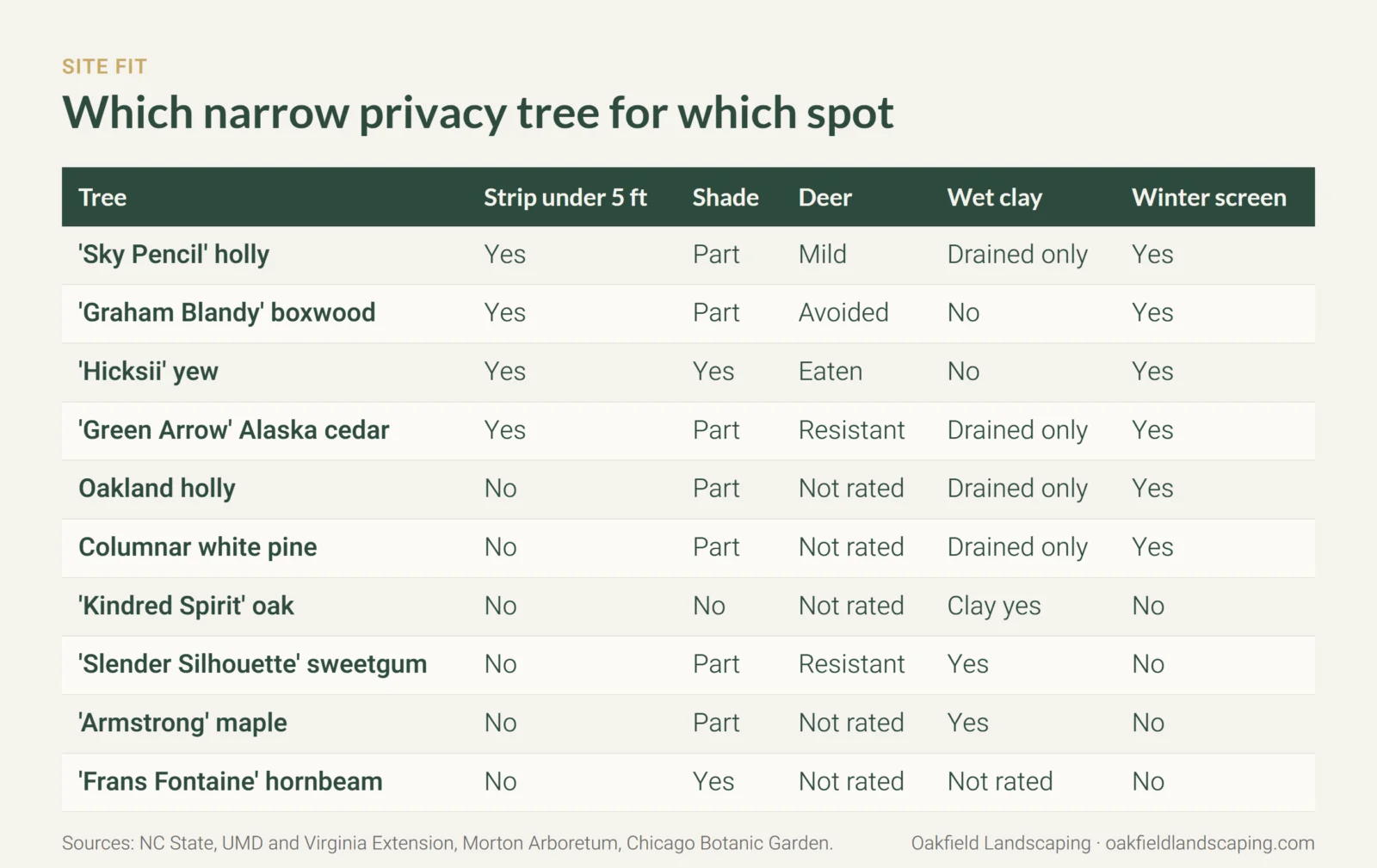
Pencil-thin: under 5 feet wide
These fit the strip between a driveway and a fence, a narrow bed beside a patio, or either side of a gate. None of them will hide a two-story house on its own, but placed well they block the sight line that matters.
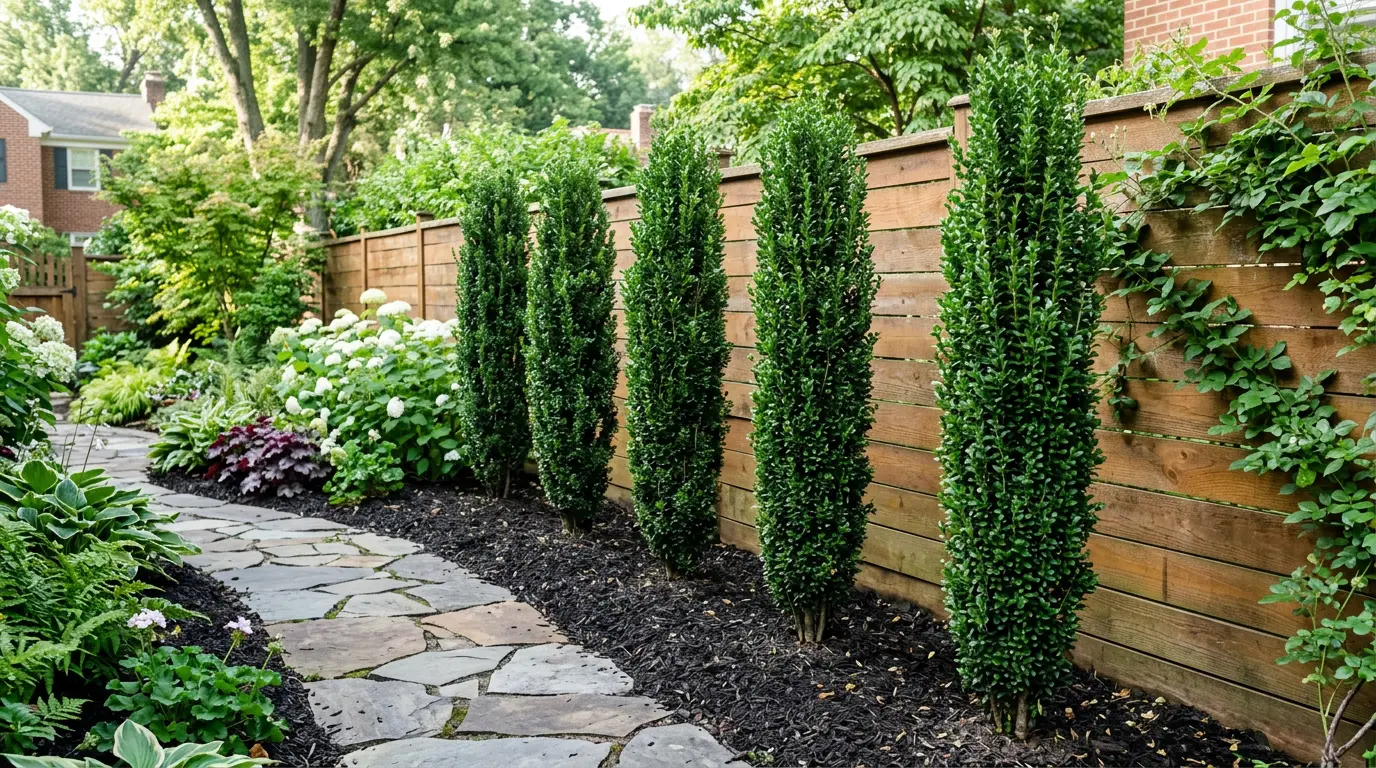
‘Sky Pencil’ holly (Ilex crenata ‘Sky Pencil’)
‘Sky Pencil’ is a Japanese holly that grows as a tight column of small evergreen leaves. Missouri Botanical Garden notes it is an introduction of the U.S. National Arboretum and that it keeps its columnar shape without pruning, with a typical 4- to 6-foot plant only 10 to 12 inches wide. Missouri Botanical Garden
NC State Extension lists it at 4 to 10 feet tall and 1 to 3 feet wide, slow-growing, in Zones 5a to 8b, for sun to part shade in acidic, well-drained soil, and says it tolerates clay and is mildly resistant to deer. Design use: a matched pair at an entry, a rhythm of columns along a side path, or a tall accent in a large container on a terrace. NC State Extension
Honest caveat: It is not banned in Maryland, but Maryland DNR lists Japanese holly among nursery plants to avoid, and the Maryland Invasive Species Council notes birds spread the berries of non-native hollies into the wild. Maryland Invasive Species Council ‘Sky Pencil’ is all female and needs a male holly nearby to set fruit, and it yellows in alkaline soil. If you would rather plant natives, our guide to native plants that thrive in Harford County has alternatives.
‘Graham Blandy’ boxwood (Buxus sempervirens ‘Graham Blandy’)
‘Graham Blandy’ is a narrow, upright boxwood, a dark green column found at the University of Virginia’s Blandy Experimental Farm. Virginia Cooperative Extension says it grows to about 8 feet tall and 2 feet wide in 15 years, in Zones 6 to 8, and that deer generally avoid boxwood. Virginia Cooperative Extension
Boxwood looks best with some afternoon shade and a soil pH between 6.5 and 7.2. Design use: formal pairs flanking a door, sentinels at the corners of a parterre, or a narrow green wall where a fence would feel too hard. Missouri Botanical Garden notes old plants can reach 15 feet with only a 2-foot spread.
Honest caveat: Boxwood blight was first confirmed in Maryland in December 2011, and University of Maryland Extension says the rainy 2018 season greatly increased its spread. University of Maryland Extension Buy from a clean source, give it air movement, and expect bronzed foliage after a hard winter in an open, windy spot.
‘Green Arrow’ Alaska cedar (Callitropsis nootkatensis ‘Green Arrow’)
‘Green Arrow’ is the most dramatic plant on this list: a narrow green spire that reads like a sculpture. Morton Arboretum describes it as a narrow, spire-shaped tree reaching 20 feet high and only 2 feet wide, cold hardy, for sun to part shade in deep, moist, well-drained soil. Morton Arboretum
Chicago Botanic Garden says it can skyrocket to 18 to 35 feet and rates it resistant to deer. Design use: a single living exclamation point at the end of a narrow bed, or two framing a view rather than blocking it. It casts almost no shade, so it works close to a house. Our guide to the best conifers for Maryland covers the broader specimen evergreens it pairs with.
Honest caveat: NC State Extension lists the species for Zones 4a to 7b and for North Carolina’s mountains only, so it is unproven in Maryland’s hotter, lower-lying spots. NC State Extension It also screens loosely; you see through it.
‘Hicksii’ yew (Taxus × media ‘Hicksii’)
‘Hicksii’ is the upright yew, a dense, dark column and one of the few evergreens here that takes real shade. University of Maryland Extension lists it at 10 to 12 feet tall and 3 to 4 feet wide, for full to part shade. University of Maryland Extension
NC State Extension adds that it is slow, drought tolerant once established and takes heavy pruning, which makes it one of the few evergreens you can keep narrower with shears. Design use: the shady side yard between two houses, or a clipped evergreen backdrop on the north side of a patio.
Honest caveat: Deer eat yew. University of Maryland Extension rates it not deer resistant and notes deer damage often shows first as thinning on the lower branches of yews. University of Maryland Extension It also rots in wet soil, and every part of the plant is poisonous, so keep it away from horses and where children graze.
Slim: 5 to 10 feet wide
This is the sweet spot for most small-yard privacy: trees that reach the second story while staying narrow enough for a 10-foot side yard or a bed along a back fence.
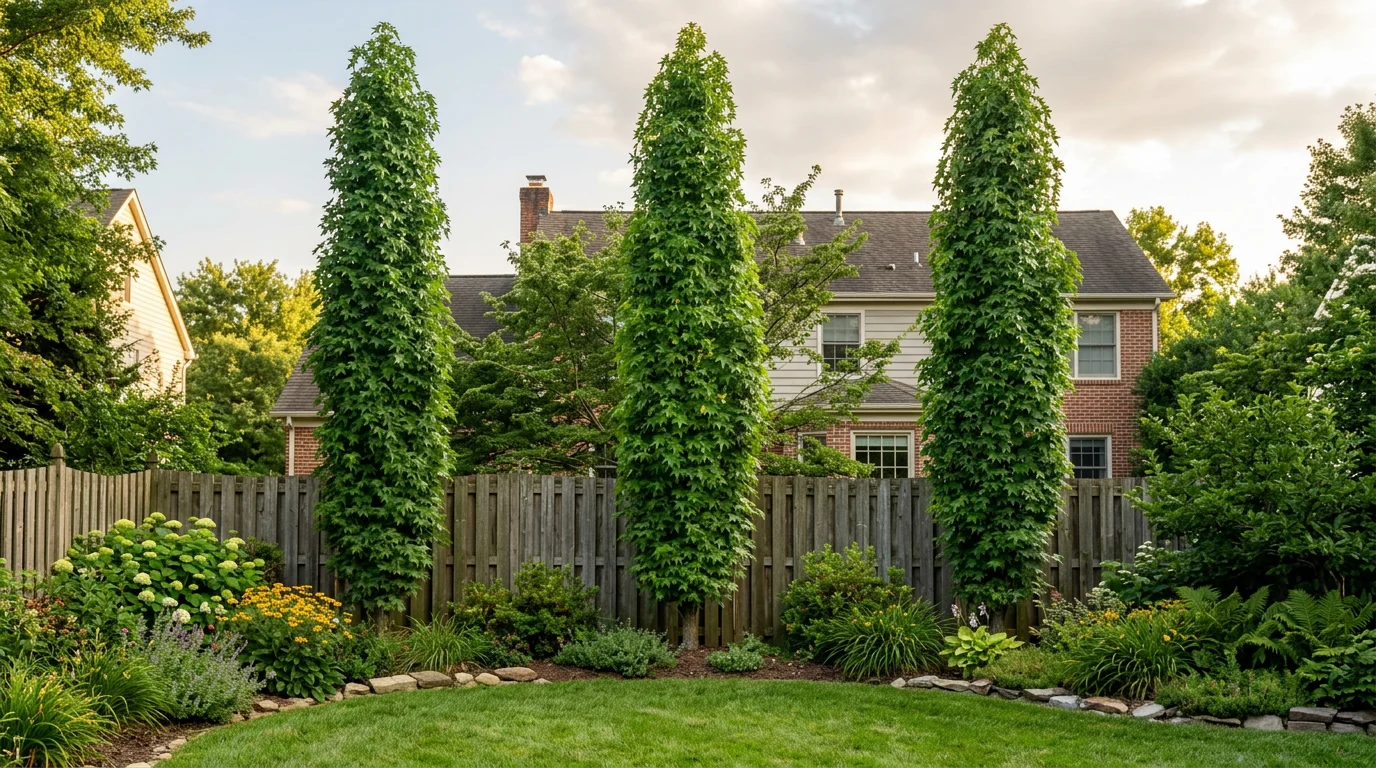
‘Kindred Spirit’ oak (Quercus × warei ‘Nadler’)
‘Kindred Spirit’ is a hybrid of swamp white oak and columnar English oak, bred for a narrow habit and for resistance to powdery mildew. NC State Extension says it grows quickly to an average of 30 feet tall and 6 feet wide, in Zones 4a to 8b. NC State Extension
It wants full sun but is not fussy about soil: once established it tolerates clay, drought and road salt. Design use: a row along a back property line where the yard is too narrow for a spreading oak, or a single tree that gives a small lot the presence of a big one.
Honest caveat: It drops acorns in fall, and NC State flags oak leaves and acorns as toxic to horses. It loses its leaves in winter, so pair it with evergreens where you need privacy in January.
‘Slender Silhouette’ sweetgum (Liquidambar styraciflua ‘Slender Silhouette’)
‘Slender Silhouette’ is the tallest, thinnest tree here, a selection of our native sweetgum. NC State Extension lists it at 50 to 60 feet tall and only 5 to 6 feet wide, growing rapidly, in Zones 5a to 9b, for sun to part shade in clay, loam or sand that ranges from dry to occasionally wet. NC State Extension
The same page rates it resistant to deer, salt and wind, with no serious pests, and notes it makes far fewer of the spiny gumballs than the species. Design use: the tree that finally blocks a neighbor’s upstairs window, planted in a staggered line along the back of a lot.
Honest caveat: In rich, ideal soil it can grow too fast and split, so NC State actually suggests leaner soil to keep it narrow and sound. It still drops some fruit, and it is bare from late fall to spring.
Columnar white pine (Pinus strobus ‘Fastigiata’)
This is the upright form of our native eastern white pine, with branches that angle upward instead of out. NC State Extension describes ‘Fastigiata’ as columnar, 40 feet tall and 8 feet wide, and lists the species as fast-growing in Zones 3a to 8b, for full sun to part shade in moist, well-drained, acidic soil. NC State Extension
Design use: a native evergreen screen where a standard white pine would spread 30 feet and shade out the yard, or a soft backdrop behind a mixed border.
Honest caveat: White pine dislikes road salt, alkaline soil and air pollution, and NC State notes it is susceptible to wind damage and to white pine blister rust, which is usually fatal. Keep it away from a salted driveway.
‘Arnold’ tulip tree (Liriodendron tulipifera ‘Arnold’)
‘Arnold’ is a columnar form of our native tulip tree. NC State Extension describes it as a narrow tree 25 feet tall and 8 feet wide, while Morton Arboretum says the upright form grows 50 feet high and 15 feet wide, so plan for the larger figure. Morton Arboretum
It wants full sun and moist, well-drained, slightly acidic soil, and NC State rates it moderately deer resistant. Design use: a native column at the corner of a lot where its height reads from the patio.
Honest caveat: NC State warns that fast growth makes it weak-wooded and prone to limb breakage in wind, ice and snow, and that aphids and scale drip honeydew and sooty mold on whatever sits beneath. NC State Extension Keep it away from parked cars and the patio table.
‘Adirondack’ crabapple (Malus sp. ‘Adirondack’)
‘Adirondack’ is the narrow crabapple, an upright vase of white spring flowers followed by small orange-red fruit. Morton Arboretum lists it at 12 to 18 feet high and 6 to 10 feet wide, with a narrow, upright form and excellent resistance to scab, fire blight, rust and mildew, the diseases that disfigure most crabapples. Morton Arboretum
Give it full sun. It is one of the few crabapples narrow enough for this list; our best flowering trees for Maryland covers the wider ones. Design use: a small flowering screen beside a patio or a pool fence, where its height is enough to block a neighbor’s deck at seated eye level.
Honest caveat: It is a flowering accent more than a full screen: bare in winter and open in habit, with fruit that drops in fall. Plant it in front of evergreens rather than alone.
Oakland holly (Ilex × ‘Magland’)
Oakland is an evergreen holly with spiny, oak-shaped leaves, discovered in 1994 as a branch sport at a Mississippi nursery, according to Missouri Botanical Garden. NC State Extension lists it at 12 to 20 feet tall and 8 to 10 feet wide, slow-growing, in Zones 6a to 9b, for sun to part shade in moist, well-drained soil. NC State Extension
Its flowers are perfect, so a single plant sets red-orange berries without a pollinator. Design use: a dense evergreen block where a Nellie Stevens holly would be too wide, or the evergreen anchor in a mixed screen.
Honest caveat: It is pyramidal rather than truly columnar, and at 8 to 10 feet wide it is the bulkiest evergreen here. NC State advises shelter from cold northern winter winds, which matters on open, exposed lots in northern Harford County.
Narrow shade trees: 10 to 25 feet wide
These are full-sized trees in a narrow form. They need a deeper back yard than the first two groups, the kind found on the acre lots around Fallston, but they bring height, fall color and decades of presence. For full-crowned trees on bigger lots, see our best shade trees for Maryland.
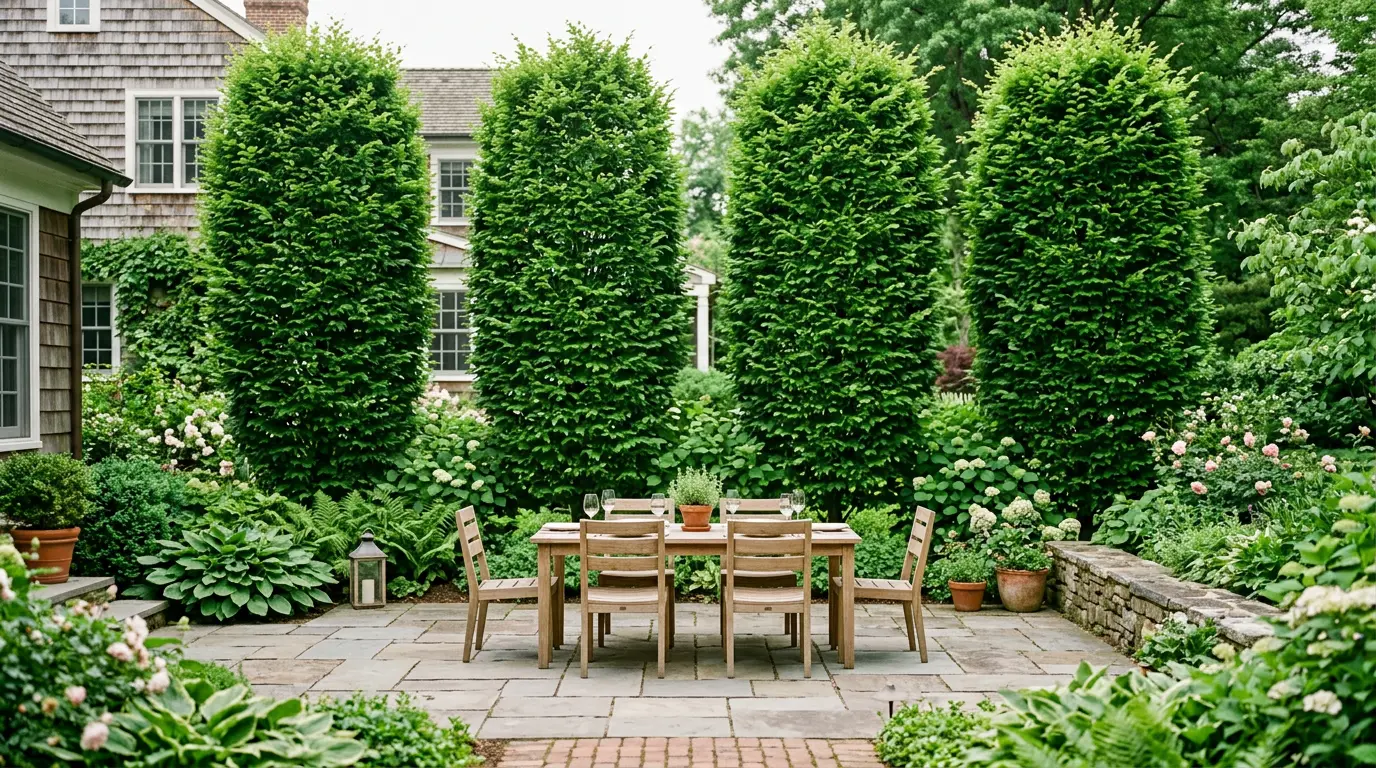
‘Frans Fontaine’ hornbeam (Carpinus betulus ‘Frans Fontaine’)
‘Frans Fontaine’ is the columnar European hornbeam, a dense tree that can be left natural or clipped into a tall hedge on stilts. Morton Arboretum says it grows 35 feet high and 15 feet wide and holds its narrow, fastigiate form longer than the older ‘Fastigiata’, which widens with age. Morton Arboretum
The species grows in full sun to full shade in Zones 4 to 8, which makes it one of the most adaptable screening trees for a yard with mixed light. Design use: a pleached screen above a fence line, or a formal row beside a terrace.
Honest caveat: It is deciduous, and Cornell’s woody plant database notes hornbeam may suffer ice damage. Cornell University At 15 feet wide it needs a real bed, not a strip.
‘Dawyck’ European beech (Fagus sylvatica ‘Dawyck’)
‘Dawyck’ is the columnar beech, grown from a tree found in Scotland, a classic estate beech on a narrow frame. Morton Arboretum puts the upright form at 45 feet high and 15 feet wide, and UConn notes old trees can reach 80 feet while staying about 15 feet wide. Morton Arboretum
It wants full sun and well-drained soil. Design use: a pair framing a long view on a larger property, or a single column at the corner of a house where a spreading beech would never fit.
Honest caveat: Beech leaf disease, caused by a nematode, was confirmed in Maryland in September 2023, and University of Maryland Extension says all beech species are susceptible. University of Maryland Extension Beech also struggles in wet, compacted clay and in drought. It is a considered choice now, not a default.
Crimson Spire oak (Quercus robur × alba ‘Crimschmidt’)
Crimson Spire is a hybrid of English oak and our native white oak, selected for a narrow form and red fall color. Morton Arboretum lists it at more than 40 feet tall and only about 15 feet wide, in Zones 4 to 7, for full sun in moist, well-drained soil, and says it handles wetter sites than white oak and resists powdery mildew. Morton Arboretum
Design use: a long-lived row down a property line, the kind of planting that still looks right in 50 years, and one that holds up to Maryland clay.
Honest caveat: It is intolerant of salt, so keep it back from the road and driveway, and like all oaks it should only be pruned when dormant because of oak wilt.
‘Armstrong’ Freeman maple (Acer × freemanii ‘Armstrong’)
‘Armstrong’ is an upright hybrid of red and silver maple, often sold as a red maple. Morton Arboretum describes it as a narrow tree 50 to 70 feet high and 15 to 20 feet wide, and NC State Extension says it grows rapidly and tolerates heavy clay and occasionally wet soil. NC State Extension
Design use: fast height for a wet, heavy lot, the low back corner where most screening trees would rot.
Honest caveat: Its fall color is weak. NC State calls it poor and Missouri Botanical Garden more often an inferior yellowish orange, so choose it for form and toughness, not autumn show. It is also bare all winter.
‘Vanessa’ Persian ironwood (Parrotia persica ‘Vanessa’)
‘Vanessa’ is an upright selection of Persian ironwood, a tough tree with mottled bark and red fall color. Penn State Extension says it matures at 40 feet tall with a 20-foot spread, is hardy in Zones 4 to 8, and tolerates clay soil as long as it drains well, along with heat and drought once established. Penn State Extension
Design use: a screen that earns its keep in every season, with leaves in summer, color in fall and bark worth looking at in winter.
Honest caveat: It is the widest tree here bar one, at 20 feet across, so it needs a deep yard, and it screens only while in leaf.
‘Princeton Sentry’ ginkgo (Ginkgo biloba ‘Princeton Sentry’)
‘Princeton Sentry’ is a fruitless male ginkgo with an upright form that tapers to a point. UConn lists it at 60 feet tall but only 25 feet wide, hardy to Zone 3, and stresses that only male ginkgos should be planted, because female trees drop foul-smelling fruit. UConn Plant Database
Morton Arboretum calls ginkgo hardy and pest-resistant. Design use: near the driveway or the street, where its upright form keeps clear of the walk.
Honest caveat: UConn notes it can be slow to establish after planting, so it is a long game, and at 25 feet wide it is only narrow next to a regular ginkgo.
Evergreen or deciduous: when a bare tree still works
Most of the slimmest shade trees lose their leaves. That is fine if the view you want to hide is the neighbor’s deck in July, and a problem if it is their kitchen window in January. Ask when you actually use the space. A pool and patio are summer rooms, so a column of ‘Kindred Spirit’ oak or ‘Slender Silhouette’ sweetgum covers the season that matters. A view from your own family room needs evergreens.
The strongest small-yard screens use both. University of Maryland Extension recommends a mix of different plants rather than one row of a single type, because a mixed screen is more resilient to drought, flooding, pests and disease, and it suggests layering larger plants behind medium ones. University of Maryland Extension In practice that might be a back line of Crimson Spire oak with ‘Sky Pencil’ holly and ‘Hicksii’ yew stepping in front of it. Our post on privacy screening plants that work year-round goes deeper on evergreen layers.
How far apart to plant narrow privacy trees along a fence line
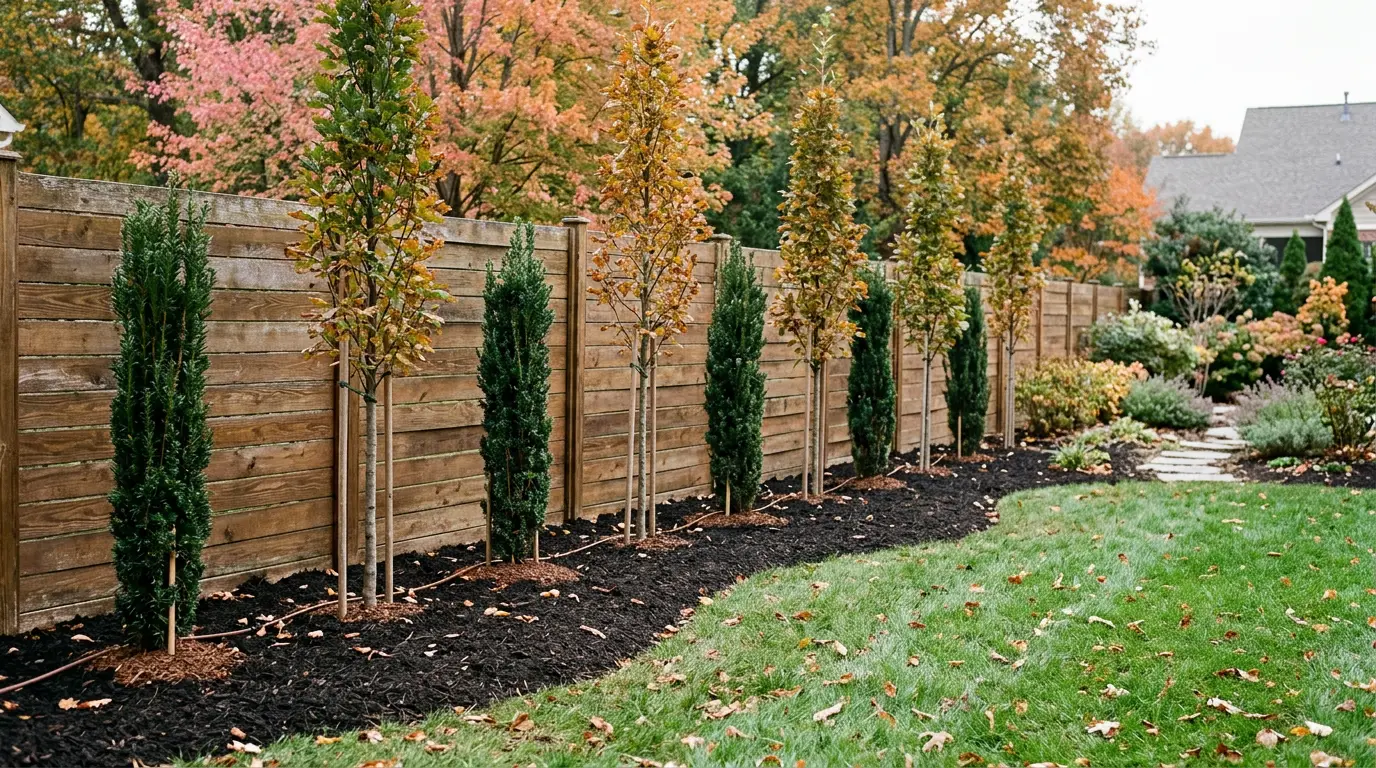
Spacing is where most fence-line screens go wrong, and narrow trees make it easier to get right because their mature width is predictable. Clemson Cooperative Extension says spacing should follow each plant’s mature height and width and warns against planting too close together. Clemson Cooperative Extension As a starting point, set narrow trees about their mature width apart, center to center, so they just touch when grown: 2 to 3 feet for ‘Sky Pencil’, about 6 feet for ‘Kindred Spirit’, about 15 feet for ‘Frans Fontaine’. Plant a little closer only if you accept thinning one out later.
A staggered line closes gaps faster than a single row. Clemson describes offsetting two or three rows so each plant fills the space between the ones in front of it. Even in a narrow bed, a zigzag of two lines a few feet apart reads as a solid screen sooner than a straight row.
Distance from the fence matters too. University of Maryland Extension advises planting a tree at least half its mature canopy width from a building foundation, and at least 15 feet for small trees. University of Maryland Extension The same half-the-width logic works along a fence: a 6-foot-wide oak goes about 3 feet off the fence, so it grows beside it rather than through it. This isn’t legal advice. Check your deed, any HOA rules and county setbacks before planting on or near a shared property line.
Tall, narrow trees to avoid in Maryland
Some of the most-sold columnar trees are poor choices here. These come up constantly in searches for tall, skinny privacy trees.
Italian cypress (Cupressus sempervirens). It is the classic Mediterranean pencil tree, 40 to 70 feet tall and 3 to 6 feet wide, but NC State Extension rates it for Zones 7a to 10b and notes root rot in poorly drained sites. NC State Extension Zone 7a is its cold limit, which leaves much of Harford County at or past its edge, in clay that stays wet all winter.
Lombardy poplar (Populus nigra ‘Italica’). It grows fast and narrow, but NC State Extension calls it short-lived and notes that Cytospora canker, worst in hot, humid climates, is often fatal. Its shallow, suckering roots also lift paving.
Callery pear, including ‘Chanticleer’ (Pyrus calleryana). ‘Chanticleer’ is sold as a narrow flowering pear, but Callery pear is now on the Maryland Prohibited Invasive Plant List, effective January 15, 2026, with nurseries phasing out potted stock by January 15, 2027 and in-ground stock by January 15, 2028, according to the Maryland Department of Agriculture. Maryland Department of Agriculture University of Maryland Extension adds that storm breakage is common because of its narrow branch angles.
Norway maple, including columnar forms (Acer platanoides). It is not prohibited, but Maryland DNR lists it among plants to avoid, NC State notes its cultivars freely self-seed, and the Maryland Department of Agriculture has it on the list of species to assess next.
Planting narrow trees in Maryland clay, and keeping them narrow in snow
Clay is the reason narrow trees fail in Harford County more often than cold. University of Maryland Extension says the planting hole should be no deeper than the root ball and at least twice as wide, with the root flare at soil level, and warns that adding organic matter to the hole slows establishment because roots stay in the enriched soil instead of growing out into the surrounding clay. University of Maryland Extension On a wet site, the better fix is raising the whole bed, or choosing a tree that tolerates wet clay, like ‘Armstrong’ maple or ‘Slender Silhouette’ sweetgum.
Snow is the other risk for upright evergreens. Clemson Cooperative Extension describes heavy snow and ice splaying columnar evergreens open, and recommends choosing plants with a single main stem, since multiple leaders split apart in storms. Clemson Cooperative Extension Before a big storm, loosely spiral jute twine up the plant to hold the branches in, and take it off before spring growth starts.
Planning a narrow privacy screen?
The right narrow tree depends on how wide the space really is, which way it faces, how wet the clay stays and which view you are trying to hide, and Eric checks all of that on site before anything is ordered. Our landscape design and installation work fits each tree to the spot it will thrive in, from a pair of ‘Sky Pencil’ holly at a gate to a staggered row of columnar oaks along a back property line. If you are weighing options for your yard, schedule a consultation and we will walk it with you.
Tall, narrow privacy tree FAQs
What is the fastest-growing tall, skinny tree for privacy?
Among trees that stay genuinely narrow, ‘Slender Silhouette’ sweetgum and ‘Kindred Spirit’ oak are both rated rapid growers by NC State Extension, and ‘Armstrong’ maple and columnar white pine are fast as well. Of those, only the pine is evergreen. In Harford County clay, the sweetgum and the maple are the two that also tolerate wet ground.
What is the most low-maintenance tall, narrow tree?
‘Sky Pencil’ holly and ‘Kindred Spirit’ oak need the least care. Missouri Botanical Garden notes ‘Sky Pencil’ keeps its columnar shape without pruning, and ‘Kindred Spirit’ was bred to resist powdery mildew and tolerates clay and drought once established. ‘Slender Silhouette’ sweetgum has no serious pests. In Maryland, avoid boxwood and beech if you want a hands-off screen, since both face serious diseases here.
Will Italian cypress grow in Maryland?
Not reliably. NC State Extension rates Italian cypress for Zones 7a to 10b, so most of Harford County, in Zones 6b and 7a, is at or beyond its cold limit. It also rots in poorly drained soil. For the same pencil shape, ‘Sky Pencil’ holly, ‘Green Arrow’ Alaska cedar or a narrow arborvitae will last longer in Maryland clay.
Do columnar trees stay narrow on their own?
Mostly, because the narrow habit is genetic, but many widen with age. Morton Arboretum notes ‘Frans Fontaine’ hornbeam keeps its narrow form longer than the older ‘Fastigiata’, which spreads, and NC State warns ‘Slender Silhouette’ sweetgum can grow too fast and split in rich soil. Plan for the published mature width and let snow-prone evergreens be tied in during storms.
What is the best narrow evergreen for screening a small yard?
For a narrow strip in sun, ‘Sky Pencil’ holly; in shade, ‘Hicksii’ yew, if you can protect it from deer; and for more height, columnar white pine or Oakland holly. Mixing two or three of them, as University of Maryland Extension recommends, protects the screen if one species fails. On wet Maryland clay, check drainage first, since yew and white pine both decline in standing water.