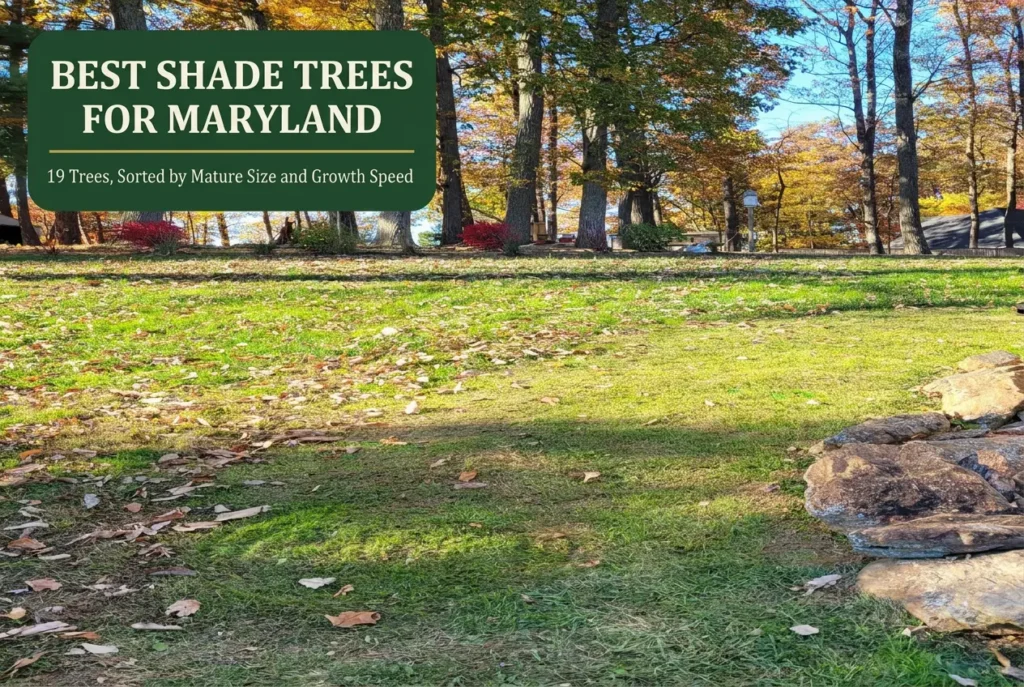
The short answer: The best shade trees for Maryland are the ones that match your lot size, your soil and your patience. Willow oak, red maple and river birch give fast shade on heavy clay; white oak, swamp white oak and black gum give slower, longer-lived shade; American hornbeam and hop hornbeam fit small yards where a 70-foot canopy would swallow the house.
Harford County is good shade-tree country. Most of it sits in Zone 6b to 7a on the 2023 USDA Plant Hardiness Zone Map, and the native canopy that grew here before the subdivisions did, oaks, tulip poplar, red maple, black gum and hornbeam, still outperforms most imports on the heavy clay loam we dig into around Bel Air. The payoff is real. According to University of Maryland Extension, Baltimore neighborhoods without tree cover have measured summer temperatures as much as 10 to 16 degrees hotter than leafy ones, and a shade tree on the west side of a house delivers the largest cooling benefit, followed by the east side. University of Maryland Extension
This guide profiles 19 shade trees that perform in Maryland, sorted by mature size, with growth speed, clay tolerance, design use and one honest drawback for each. Short decision sections follow on fast versus long-lived shade, backyard versus front yard, roots in small yards, natives, and planting in clay.
Maryland shade trees at a glance
| Tree | Mature height | Growth rate | Clay soil | Wet spots | Best for |
|---|---|---|---|---|---|
| Willow oak (Quercus phellos) | 40 to 75 ft | Fast | Good | Tolerates | Fast, graceful shade on large lots |
| Northern red oak (Quercus rubra) | 50 to 75 ft | Moderate to fast | Fair | No | Classic lawn oak on well-drained ground |
| White oak (Quercus alba) | 80 to 100 ft | Slow | Good | No | The heirloom tree for an estate |
| Swamp white oak (Quercus bicolor) | 50 to 60 ft | Medium | Good | Yes | Oak shade in a wet, compacted corner |
| Tulip poplar (Liriodendron tulipifera) | 80 to 120 ft | Fast | Fair | No | Tall, fast shade at the edge of acreage |
| American linden (Tilia americana) | 60 to 80 ft | Medium | Good | No | Dense shade and bee-friendly bloom |
| Bald cypress (Taxodium distichum) | 50 to 70 ft | Medium | Good | Yes | Fine texture beside a pond or low spot |
| American elm (Ulmus americana) | 60 to 80 ft | Fast | Good | Tolerates | The vase-shaped street tree, resistant cultivars only |
| Hackberry (Celtis occidentalis) | 40 to 60 ft | Fast | Good | Tolerates | Tough shade for wind, grime and dry banks |
| Red maple (Acer rubrum) | 40 to 70 ft | Fast | Good | Yes | Fast shade with the best fall color |
| Black gum (Nyssa sylvatica) | 30 to 50 ft | Slow to medium | Good | Yes | Moderate shade, scarlet fall, wildlife |
| Thornless honeylocust (Gleditsia triacanthos var. inermis) | 40 to 45 ft | Fast | Good | Occasional | Light shade that lets grass grow |
| River birch (Betula nigra) | 40 to 70 ft | Fast | Good | Yes | Fast shade in a wet corner, peeling bark |
| Kentucky coffeetree (Gymnocladus dioicus) | 60 to 80 ft | Slow to moderate | Good | Occasional | Drought-tough, bold winter silhouette |
| Sweetgum ‘Rotundiloba’ (Liquidambar styraciflua) | 60 to 80 ft | Fast | Good | Yes | Fast shade and mixed fall color, no gumballs |
| Yellowwood (Cladrastis kentukea) | 30 to 45 ft | Slow | Fair | No | Wide, low canopy with fragrant bloom |
| American hornbeam (Carpinus caroliniana) | 20 to 30 ft | Slow | Good | Yes | Small-yard shade, even in part shade |
| Hop hornbeam (Ostrya virginiana) | 20 to 40 ft | Slow | Good | No | Small, drought-tough lawn tree |
| Sourwood (Oxydendrum arboreum) | 20 to 30 ft | Slow | Fair | No | Small tree with summer bloom and crimson fall |
Large shade trees for Maryland (60 feet and up)
These are the trees that shade a whole side of a house, and eventually a whole lawn. They belong on the half-acre and larger lots out toward Fallston, Forest Hill and Jarrettsville, planted where the mature crown has somewhere to go.
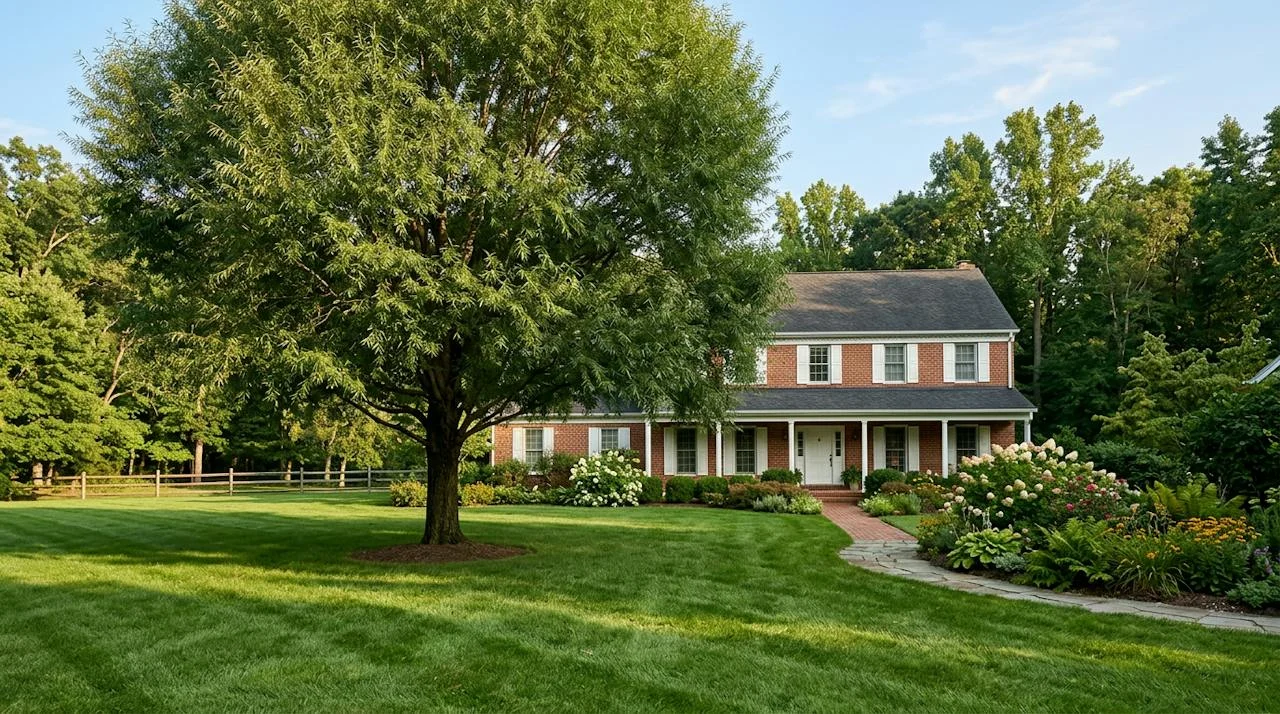
Willow oak (Quercus phellos)
Willow oak is the shade tree Maryland nurseries sell most for a reason. It grows fast, 40 to 75 feet tall and 25 to 50 feet wide at maturity, with narrow, willow-like leaves that cast a light, dappled shade and rake up easily. The NC State Extension Plant Toolbox lists its growth rate as rapid and notes that it transplants well because of a fibrous root system. NC State Extension
It is adaptable to clay, tolerates wet soil and occasional standing water, and takes full sun to light shade, which covers most Harford County lots. The Maryland DNR recommended tree list calls it a good shade tree that grows in wet soil. In a design we use it as the single big tree on a large lawn, or in a loose row along a property line where it reads as a grove within ten years. Maryland DNR
Honest caveat: It gets big, and it is susceptible to wind damage and to iron chlorosis on high-pH soil. Give it 30 feet from the house and skip it on the limed-up strip next to a concrete driveway.
Northern red oak (Quercus rubra)
Northern red oak is the classic lawn oak of the Maryland piedmont: round-topped, symmetrical, 50 to 75 feet tall and about as wide, with large leaves that turn brownish-red to scarlet in October. NC State Extension rates it moderate to fast-growing and easily transplanted, and the Maryland DNR list notes it is one of the faster oaks with acorns valued by wildlife. NC State Extension
It wants full sun and well-drained, acidic soil, which means it does its best work on the sloping, drier parts of a property rather than the low corner that holds water. Once established it tolerates drought, dry soil and air pollution. Design use: the anchor tree in a front lawn, set off from the house so the full crown reads from the street.
Honest caveat: It is susceptible to oak wilt and can yellow with chlorosis when the soil is not acidic enough. On the limestone-influenced soils in parts of northern Harford County, test pH before you commit.
White oak (Quercus alba)
White oak is Maryland’s state tree and the one people mean when they say “a tree my grandchildren will sit under.” It generally tops out at 80 to 100 feet with a spread of 50 to 80 feet, grows slowly, and lives for centuries. NC State Extension describes it as a long-lived tree for coarse, deep, moist, well-drained, slightly acidic soil, and lists it as clay-tolerant. NC State Extension
Its wildlife value is unmatched, from the dozens of butterfly and moth species it hosts to the turkeys and jays that work its acorns, and the Maryland DNR list calls it the classic oak form, best for large areas. Design use: an estate tree, planted young and sited for the view 40 years out, the kind of planting we talk through in landscapes designed to mature over decades.
Honest caveat: The deep taproot makes it hard to transplant, so buy it small and plant it once. It is also sensitive to soil compaction, which rules out the lawn a construction crew just drove over.
Swamp white oak (Quercus bicolor)
Swamp white oak is the oak for the ground where other oaks sulk. It grows 50 to 60 feet tall and about as wide at a medium rate, with two-toned leaves that are dark green above and silvery beneath. NC State Extension says it prefers moist to wet acidic soil with a high mineral content but adapts to drier sites, and tags it as tolerant of spring flooding and clay. NC State Extension
The Maryland DNR list adds that it tolerates salt, drought and compaction and transplants more readily than most white oaks, which makes it the oak we reach for on a new-construction lot with a damp low corner. If a yard already shows standing water after storms, this is the big tree that will not mind.
Honest caveat: It is highly susceptible to oak wilt and can show chlorosis when soil pH runs high. It also hybridizes readily, so fall color varies from tree to tree.
Tulip poplar (Liriodendron tulipifera)
Tulip poplar is the tallest native hardwood in the eastern forest, and it grows fast: 80 to 120 feet tall and 30 to 60 feet wide on a long, straight trunk, with tulip-shaped yellow and orange flowers in May that most people never notice because they open high in the crown. NC State Extension rates its growth as rapid and its fall color a clean golden yellow. NC State Extension
It wants full sun and moist, well-drained soil and adapts to a wide pH range. The Maryland DNR list recommends it for broad boulevards and parks, which is the honest way to say it needs acreage. Design use: the back edge of a large property, where it screens the horizon and casts afternoon shade across a meadow or a pool deck from 60 feet away.
Honest caveat: Fast growth means weak wood, so limbs break in ice and wind, aphids drip honeydew on anything parked beneath it, and its shallow roots limit what will grow inside the drip line. NC State Extension does not recommend it for small residential lots or as a street tree.
American linden (Tilia americana)
American linden, or basswood, is the dense-shade tree: a broad, heart-leaved canopy 60 to 80 feet tall and 30 to 60 feet wide at a medium growth rate, with fragrant, pale yellow flowers in June that NC State Extension says bees visit in abundance. The Maryland DNR list calls it a fine shade tree that transplants readily. NC State Extension
It is tolerant of clay and adaptable to drier, rocky ground, though it prefers moist, fertile soil. Design use: a single specimen on a large lawn, or the cooling tree on the west side of a house with a patio under it. The cultivar ‘Redmond’ stays a more manageable 40 to 60 feet.
Honest caveat: Japanese beetles and linden aphids find it, so expect some chewed leaves and a sticky patio table in July. It is also sensitive to heat and compaction.
Bald cypress (Taxodium distichum)
Bald cypress is a deciduous conifer, which surprises people: feathery, soft green needles that turn cinnamon orange in fall and drop. It grows 50 to 70 feet tall and 20 to 30 feet wide at a medium rate, in full sun to part shade. NC State Extension notes it tolerates a wide range of soil conditions, standing water included, and lists it as clay-tolerant. NC State Extension
Its narrow, pyramidal shape makes it one of the few large shade trees that fits a long, narrow side yard, and it is the obvious choice beside a pond or a rain garden. The Maryland DNR list points out that the famous “knees” form only in or near water, so a lawn-planted cypress stays knee-free.
Honest caveat: It is a conifer, so the shade is lighter and more upright than an oak’s, and chlorosis shows up quickly on alkaline soil. It is one of several deciduous conifers that do well in Maryland, alongside dawn redwood. Bagworms can find it in a bad year.
American elm (Ulmus americana)
The vase-shaped American elm that once arched over every Maryland main street is back, through cultivars that resist Dutch elm disease. It grows rapidly to 60 to 80 feet tall and 30 to 60 feet wide, adapts to both wet and dry sites and to clay, loam and sand. NC State Extension lists ‘Valley Forge’ as having the best Dutch elm disease resistance, ‘Princeton’ as highly resistant, and ‘Jefferson’ as a disease-resistant 50-foot form. NC State Extension
The Maryland DNR list describes it as fast to medium growing, suited to lawns and cities, and tolerant of pH and salt. Design use: the arching tree over a driveway or a long walk, where the vase shape lets you walk and park beneath it without constant limbing-up.
Honest caveat: Plant only a named resistant cultivar, never a seedling elm, and accept that resistance is still being evaluated. Elm leaf beetles and other insects still visit even the resistant trees.
Hackberry (Celtis occidentalis)
Hackberry is the tough one. It grows rapidly to 40 to 60 feet tall and wide, with a broad crown in age and a warty, corky bark that is handsome in winter. NC State Extension says it tolerates wind, urban conditions and a wide range of soils, clay and shallow rocky ground included, across acid, neutral and alkaline pH. NC State Extension
It hosts the Hackberry Emperor, Question Mark and Mourning Cloak butterflies, and its small fruits feed birds through winter. Design use: the exposed, windy bank along a road frontage where a maple would scorch.
Honest caveat: It is not a beauty. Witches’ broom and nipple galls disfigure the twigs and leaves without hurting the tree, the fall color is an undistinguished yellow, and the fruit is messy over a patio.
Medium shade trees for Maryland (35 to 60 feet)
Medium trees shade a patio or a south-facing wall without owning the lot. They are the right scale for the quarter-acre to half-acre lots of Bel Air and Abingdon, and several tolerate the wet, compacted clay new subdivisions leave behind.
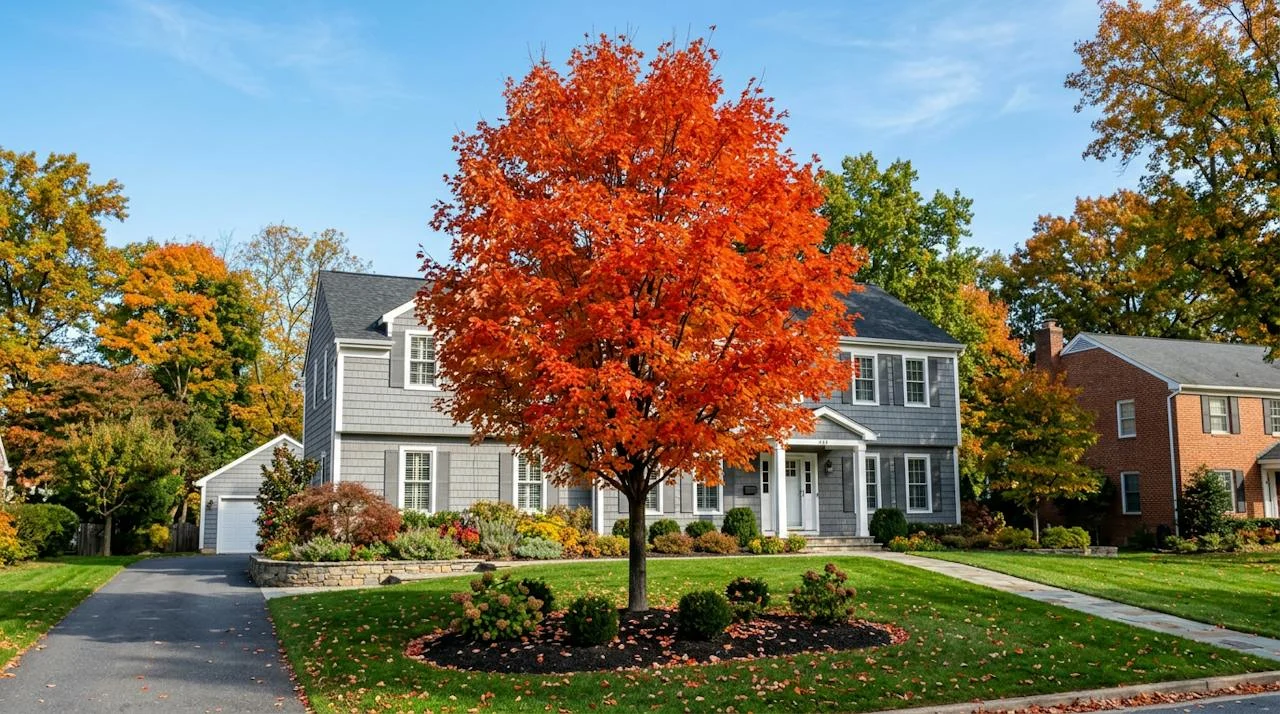
Red maple (Acer rubrum)
Red maple is the most-planted shade tree in the eastern United States and the most-searched one too. It grows rapidly to 40 to 70 feet tall and 30 to 50 feet wide, flowers red before the leaves in March, and turns brilliant red, orange and yellow in fall. NC State Extension names ‘October Glory’ for exceptional fall color, ‘Red Sunset’ as a good shade tree with early orange-scarlet color, and ‘Brandywine’ as a seedless male with consistent color. NC State Extension
It prefers moist, slightly acidic soil and tolerates clay, occasional flooding and occasional drought, which is why the Maryland DNR list calls it a good shade tree and University of Maryland Extension names it among the trees expected to adapt well to a warming Chesapeake region. Design use: the first tree we plant on a bare new lot, because it delivers real shade in eight to ten years.
Honest caveat: It makes a dense mat of surface roots that outcompete lawn and perennials under it and can buckle a nearby walk, and it develops manganese chlorosis on alkaline soil. Keep it 15 feet off the driveway.
Black gum (Nyssa sylvatica)
Black gum, or black tupelo, has the most reliable scarlet fall color of any Maryland native, on a tree that typically reaches 30 to 50 feet in a landscape with a neat pyramidal to rounded crown. NC State Extension describes its growth as slow to medium, about 12 to 15 feet in ten years, in full sun on moist, acidic soil. NC State Extension
It tolerates poorly drained clay and standing water, and its early-fall fruit is one of the most important foods for migrating songbirds. The Maryland DNR list praises its spectacular fall color and calls it a good street tree. The cultivar ‘Wildfire’ flushes bronze-red; ‘Green Gable’ is upright with red fall color. Design use: the medium tree beside a patio where you want color, wildlife and a canopy that never gets out of scale.
Honest caveat: The long taproot makes it difficult to transplant, so buy it in a container, site it once, and expect to wait for the shade. It is also intolerant of alkaline soil.
Thornless honeylocust (Gleditsia triacanthos var. inermis)
Honeylocust casts a different kind of shade: a broad, flat-topped crown of tiny leaflets that lets enough light through for turf to grow underneath, which is why NC State Extension notes grass thrives under it and the Maryland DNR list calls it an excellent lawn tree. Thornless cultivars such as ‘Skyline’ reach 40 to 45 feet and are nearly seedless; ‘Imperial’ stays 30 to 40 feet. NC State Extension
It grows rapidly, tolerates clay, and is highly salt, wind and drought tolerant once established. Design use: the tree over a lawn you still want to be a lawn, or beside a pool where big leaves would be a chore.
Honest caveat: Buy only a named thornless, seedless cultivar. The wild species carries three-inch spines and 12-to-18-inch pods, and even the cultivars draw webworms and borers, so it is not a plant-and-forget tree.
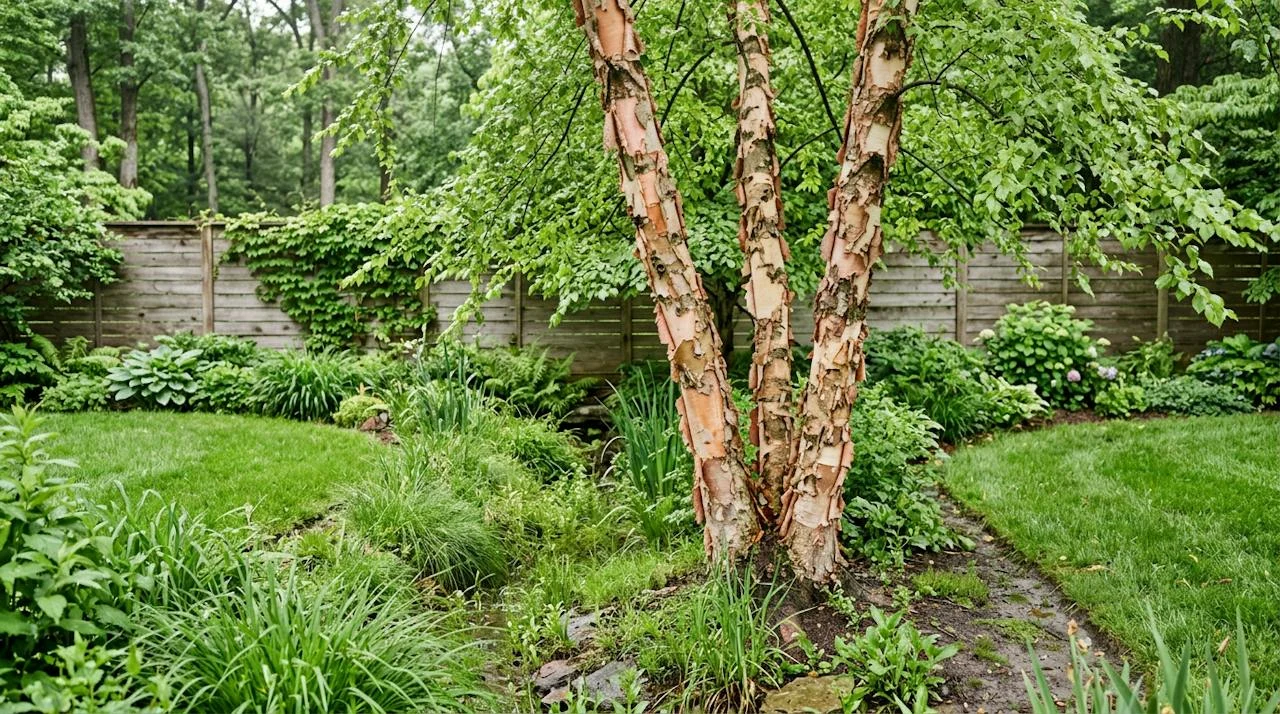
River birch (Betula nigra)
River birch is the fast shade tree for a wet corner, and the only birch that handles Maryland summers. It grows rapidly to 40 to 70 feet tall and 40 to 60 feet wide, usually as a multi-stemmed clump, with salmon and cream bark that peels in papery curls year-round. NC State Extension recommends the cultivar Heritage (‘Cully’) for its superior bark and names it resistant to the bronze birch borer that kills white-barked birches here. NC State Extension
It prefers wet sites and tolerates clay. Design use: the tree in the low spot by the downspout outfall, or a three-stem clump lit from below as the focal point of a back yard.
Honest caveat: It sheds interior leaves in summer drought, drops twigs constantly, and clogs gutters if planted near the house. NC State Extension suggests it for the less manicured parts of a landscape.
Kentucky coffeetree (Gymnocladus dioicus)
Kentucky coffeetree is the shade tree for a dry, exposed, difficult site. It reaches 60 to 80 feet tall and 40 to 55 feet wide with an open, irregular crown, grows fast when young and slows with age, and leafs out late in spring with pinkish-bronze new growth. NC State Extension calls it a good, dependable city tree, drought tolerant, salt and pollution resistant, on clay, loam or sand across any pH. NC State Extension
Its huge compound leaves cast a light shade, and the coarse branching gives it one of the best winter silhouettes of any lawn tree. The male cultivar ‘Espresso’ is fruitless and vase-shaped. Design use: a large lawn or a parking court where nothing else thrives.
Honest caveat: Female trees drop leathery 10-inch pods that persist through winter, the seeds are poisonous to people and pets, and the wood is weak. Choose ‘Espresso’ and keep it away from the play area.
Sweetgum ‘Rotundiloba’ (Liquidambar styraciflua)
Sweetgum is a fast, star-leaved native that grows 60 to 100 feet tall and 40 to 50 feet wide, with fall color that NC State Extension describes as a brilliant mixture of yellows, oranges, purples and reds. The reason most Maryland homeowners refuse to plant it is the spiky gumballs that litter the lawn from December to April. The cultivar ‘Rotundiloba’ produces no gumballs and keeps the fall color. NC State Extension
It tolerates clay and wet ground and grows in full sun to part shade, in neutral to acidic soil. Design use: a fast, colorful canopy on a wet, heavy site where you want the show of a maple with a different leaf.
Honest caveat: The root system is shallow, so plant it in spring (roots take three to four months to recover) and keep it off the driveway. Iron chlorosis appears on alkaline soil, and the straight species is a mistake over any lawn you walk barefoot.
Yellowwood (Cladrastis kentukea)
Yellowwood is the medium shade tree with a secret: in late spring, every two or three years, it hangs foot-long panicles of fragrant white pea-like flowers that stop traffic. It grows slowly to 30 to 45 feet tall and 40 to 45 feet wide, a low, broad dome that shades a terrace without towering over the house. NC State Extension says it tolerates high pH and dry soil and turns gold to orange in fall. NC State Extension
It wants full sun to part shade and well-drained ground. Design use: the specimen tree in a formal front lawn or beside a patio, where its smooth gray bark and wide crown earn the slow start.
Honest caveat: Its limbs break easily in wind and snow and it often needs corrective pruning for weak branch forks. Prune only in summer, because it bleeds badly otherwise, and University of Maryland Extension lists it among the fleshy-rooted trees to plant in spring, not fall.
Small shade trees for Maryland (under 35 feet)
Small shade trees shade a patio, a bedroom window or a townhouse yard without ever threatening the roof, and two of the three below are understory natives that tolerate the part-shade a house or a fence already casts. For small trees grown mainly for bloom, see our guide to flowering trees for Maryland; these three are chosen for canopy first.
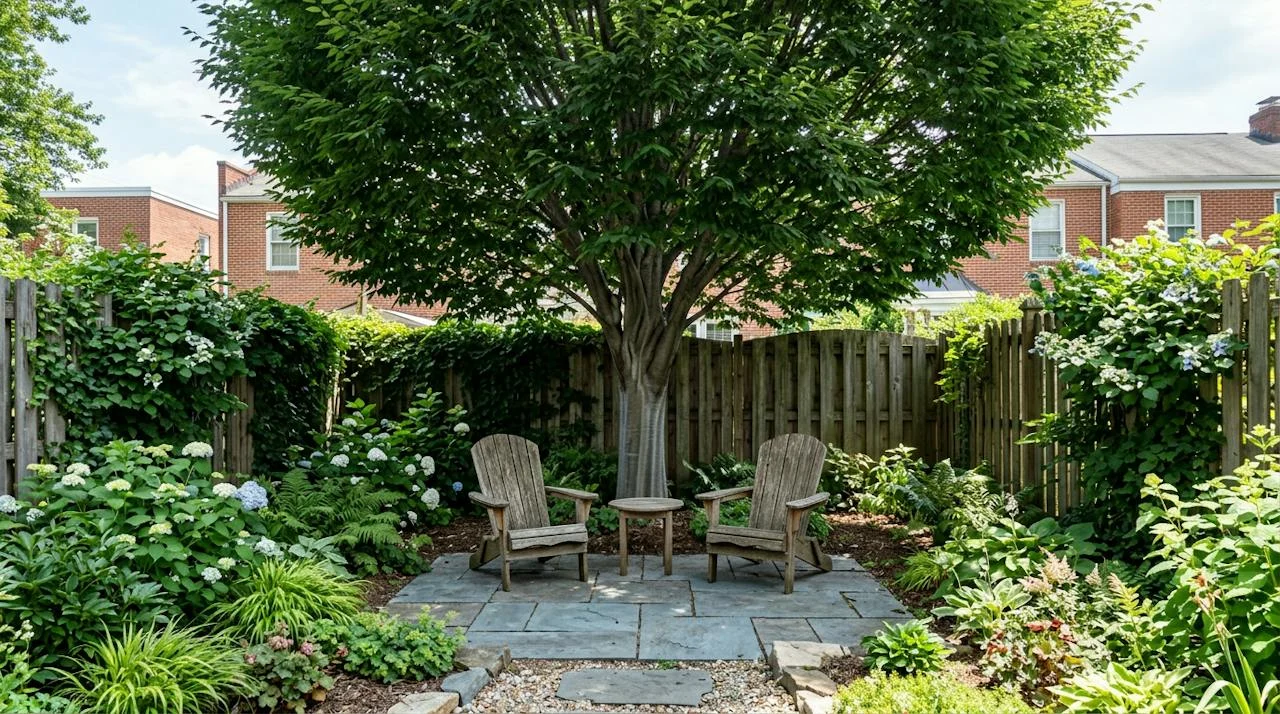
American hornbeam (Carpinus caroliniana)
American hornbeam, or musclewood, is the small shade tree for a Maryland yard that already has some shade. It grows slowly to 20 to 30 feet tall and 20 to 35 feet wide, with smooth, fluted gray bark that looks like flexed muscle and orange-red fall color. NC State Extension lists it for deep shade and partial shade, as tolerant of wet soil and clay, and as a street tree suited to urban conditions. NC State Extension
University of Maryland Extension names it among the natives for urban and small sites, and the columnar cultivar ‘J.N. Upright’ (Firespire) stays 20 feet tall and 10 feet wide for a side yard. Design use: the canopy over a townhouse patio, or the understory tree beneath a big oak where a second big tree would be a mistake.
Honest caveat: It is especially sensitive to drought, heat and soil compaction, and it is difficult to transplant, so plant it small in spring and water it for two full summers.
Hop hornbeam (Ostrya virginiana)
Hop hornbeam, or ironwood, is the dry-site cousin of American hornbeam: 20 to 40 feet tall and 15 to 30 feet wide, slow-growing, with shaggy, shredding bark for winter interest and papery hop-like seed clusters in summer. NC State Extension says it tolerates drought and heavy clay soils, grows in full sun to deep shade, and suits a lawn, a driveway or a street. NC State Extension
Design use: a small lawn tree on the dry, sunny slope of a lot where a river birch would scorch, or the tree in a parking-strip bed.
Honest caveat: It is slow, reaching only 10 to 15 feet in 15 years, the fall color is a plain yellow, and it does not tolerate salt or compaction.
Sourwood (Oxydendrum arboreum)
Sourwood is a small native tree that earns its spot on bloom and fall color: fragrant white, urn-shaped flowers on drooping panicles in June and July that bees turn into prized honey, then crimson fall foliage. It grows slowly to 20 to 30 feet tall and 10 to 15 feet wide in full sun to part shade. NC State Extension notes it prefers acidic, moist, well-drained soil and tolerates shade and dry soil. NC State Extension
Design use: a narrow, upright accent at the corner of a patio or along a woodland edge, where its light shade and summer bloom carry the garden between the spring and fall shows.
Honest caveat: It is intolerant of pollution and urban conditions, needs acidic soil, and dislikes being moved, so plant it young and leave it alone. On heavy, poorly drained clay it will sulk.
Fast shade or long-lived shade? How to decide
Every shade tree trades speed for strength. The fast growers in this guide, willow oak, red maple, river birch, tulip poplar, sweetgum and American elm, put on real canopy in eight to ten years, and that speed is exactly why their wood is weaker, their roots shallower and their lifespans shorter. NC State Extension says it plainly for tulip poplar: fast growth makes the wood weak, so limbs break in wind, ice and snow. The slow growers, white oak, black gum, hop hornbeam and Kentucky coffeetree, ask for patience and pay it back with a tree that outlives the house.
Our rule on a new property is to plant both. Put a fast tree where you need shade on the patio or the west wall now, and plant the oak or the black gum where it will matter in 30 years. The fast tree can come out when the slow one catches up, and nobody will have waited a decade in the sun. The same thinking applies to fast-growing privacy trees, where the quick screen and the permanent screen are rarely the same plant.
Best shade trees for a backyard versus a front yard
Backyard shade is about use: you want a canopy over the patio, the play area or the pool by late afternoon, which means a tree on the west or southwest side with a broad, low crown. Red maple, honeylocust, river birch, yellowwood and American hornbeam all shade a terrace at human scale, and honeylocust is the one that still lets grass grow under it. University of Maryland Extension’s placement guidance is specific: shade trees on the west side of a house give the greatest cooling benefit, followed by the east, and a tree on the south side should sit at least 2.5 times its expected mature height away from the house. University of Maryland Extension
Front-yard shade is about presence from the street and about distance from the driveway, the walk and the utilities. Northern red oak, willow oak, swamp white oak, American elm and black gum all read well as a single specimen on a lawn. Keep large trees at least 20 feet from a driveway and small trees at least 10 feet, keep small trees at least 15 feet from the foundation or half their mature canopy width, and under power lines choose a tree that tops out at 25 feet or less, which in this list means a hornbeam or a sourwood.
Small yards, roots and the trees to skip
The question we hear most on quarter-acre lots is which shade trees have non-invasive roots. The honest answer is that every tree’s roots spread well beyond its canopy, but some are far worse neighbors to pavement and septic fields. Red maple makes a dense mat of surface roots, sweetgum and tulip poplar are shallow-rooted, and silver maple’s roots, according to NC State Extension, disturb driveways and sidewalks and invade septic systems and drains, which is why we never plant it. The better-behaved choices for tight quarters are American hornbeam, hop hornbeam, black gum, yellowwood and bald cypress, kept 15 to 20 feet from anything hard. On the acre lots around Fallston, most of which run on septic, we map the drain field before we site any tree at all. NC State Extension
Three common Maryland shade trees belong on the skip list. Silver maple, for the roots and the weak wood above. Sugar maple, which NC State Extension describes as intolerant of high heat, compacted soil and road salt, struggles in a Harford County lawn in August unless you choose a heat-tolerant cultivar such as ‘Bonfire’. And Callery pear, including the ‘Bradford’ everyone planted in the 1990s, is now a prohibited invasive species under Maryland law; University of Maryland Extension advises not planting it and replacing existing specimens when possible. Pin oak deserves a warning rather than a ban: it is one of the fastest oaks and the most widely planted, but its lower limbs angle sharply down and it yellows badly with chlorosis on alkaline soil. University of Maryland Extension NC State Extension
Native shade trees and why they win in Maryland
Seventeen of the 19 trees above are native to the eastern United States, and that is not an accident. University of Maryland Extension points to the USDA Forest Service Tree Atlas, which rates oaks, red maple, blackgum and loblolly pine as the species expected to stay best adapted to the lower Chesapeake as summers warm, and reminds gardeners that oaks, maples, birches and elms host the butterflies and moths that feed the birds. The same page names Norway maple and mimosa as invasives not to plant. Our own guide to native plants that thrive in Harford County covers the shrubs and perennials that belong under these canopies.
Non-native does not mean bad; Japanese zelkova and male ginkgo are well-behaved street trees. But when two trees fit a site equally well, the native one feeds more of the yard, and the Maryland DNR’s Marylanders Plant Trees program offers a rebate on native trees from its recommended list. The rebate amount and the eligible list change, so confirm both on the DNR page before you buy.
Planting a shade tree in Harford County clay
Most shade-tree failures we are called to diagnose were planted wrong, not chosen wrong. University of Maryland Extension’s planting guidance, updated in September 2026, is the standard we follow: plant in fall, in winter when the ground is not frozen, or in early spring, and avoid summer; dig the hole no deeper than the root ball and at least twice as wide, with sloping sides; set the root flare at soil level; and cut circling roots on container trees with four one-inch cuts down the root ball. Do not add compost to the hole, because on clay it traps water around the roots. If the whole area is compacted, work two to three inches of compost into the top six inches out to the future drip line instead. University of Maryland Extension
Timing matters by species. The same guidance lists willow oak, tulip poplar, yellowwood, dogwoods and magnolias as fleshy-rooted trees that should go in during spring, while the oaks and maples take fall planting well. Skip fertilizer for the first one to three years, stake only if the tree cannot stand on its own and remove the stakes after a year, and mulch out to the drip line with the bark exposed. Then water: University of Maryland Extension says to check the soil daily for the first two weeks and at least weekly for two years, and to water deeply whenever the top six inches are dry, which takes one to two inches of water. A newly planted tree that misses its second summer is the one we replace. University of Maryland Extension
Planning a shade tree planting?
Choosing the tree is the easy half. Siting it for the afternoon sun, the septic field, the view from the kitchen and the size it will be in 2056 is the part that takes a walk around the property. Our landscape design and installation work starts with that walk, and the same crew that plans the tree plants it. Schedule a consultation and bring your questions about shade.
Shade tree FAQs
What is the fastest growing shade tree for Maryland?
Willow oak, red maple, river birch and tulip poplar are the fastest shade trees that also hold up in Maryland. NC State Extension rates all four as rapid growers, and willow oak and red maple deliver usable shade in eight to ten years on Harford County clay. Tulip poplar is faster still but needs acreage and breaks in ice, so it belongs on large properties rather than a Bel Air lot.
What is the best shade tree for a small backyard?
American hornbeam is the best shade tree for a small Maryland backyard: 20 to 30 feet tall, tolerant of part shade, wet soil and clay, with smooth gray bark and orange-red fall color. Hop hornbeam suits a drier, sunnier small yard and black gum fits a slightly larger one. All three stay below the roofline and keep their roots out of the patio.
How far from the house should a shade tree be planted?
University of Maryland Extension recommends setting a tree on the south side of a house at least 2.5 times its expected mature height away, keeping small trees at least 15 feet from the foundation or half their mature canopy width, and keeping large trees at least 20 feet from a driveway. In practice we give a 60-foot oak 30 feet or more from the house and a hornbeam 15.
When is the best time to plant a shade tree in Maryland?
Fall is best for most oaks, maples and other shade trees, followed by winter when the ground is not frozen and early spring; University of Maryland Extension advises against summer planting. Willow oak, tulip poplar and yellowwood are exceptions with fleshy roots that establish better in spring. In Harford County, mid-September through October gives roots weeks of warm soil before the first frost.
Which shade trees have non-invasive roots?
No tree has truly non-invasive roots, but American hornbeam, hop hornbeam, black gum, yellowwood and bald cypress are the best-behaved shade trees near walks, foundations and septic fields. Avoid silver maple, which NC State Extension says invades drains and lifts pavement, and give red maple and sweetgum, both shallow-rooted, at least 15 feet from anything hard in Maryland clay.
How long does it take a shade tree to provide shade?
A fast grower such as red maple or willow oak planted at 2 inches of trunk caliper usually casts enough shade for a patio in eight to ten years in Maryland, while a white oak or black gum takes 15 to 20 years to do the same job. Planting in fall, watering for two full summers and keeping mulch off the trunk shortens the wait more than any fertilizer does.
Which tree gives the most shade?
American linden, northern red oak, red maple and sweetgum cast the densest shade of the trees in this guide, because their broad leaves overlap into a nearly solid canopy. Willow oak, honeylocust, Kentucky coffeetree and bald cypress cast a lighter, dappled shade that keeps a Maryland lawn alive underneath, which is the better choice over turf you want to keep.