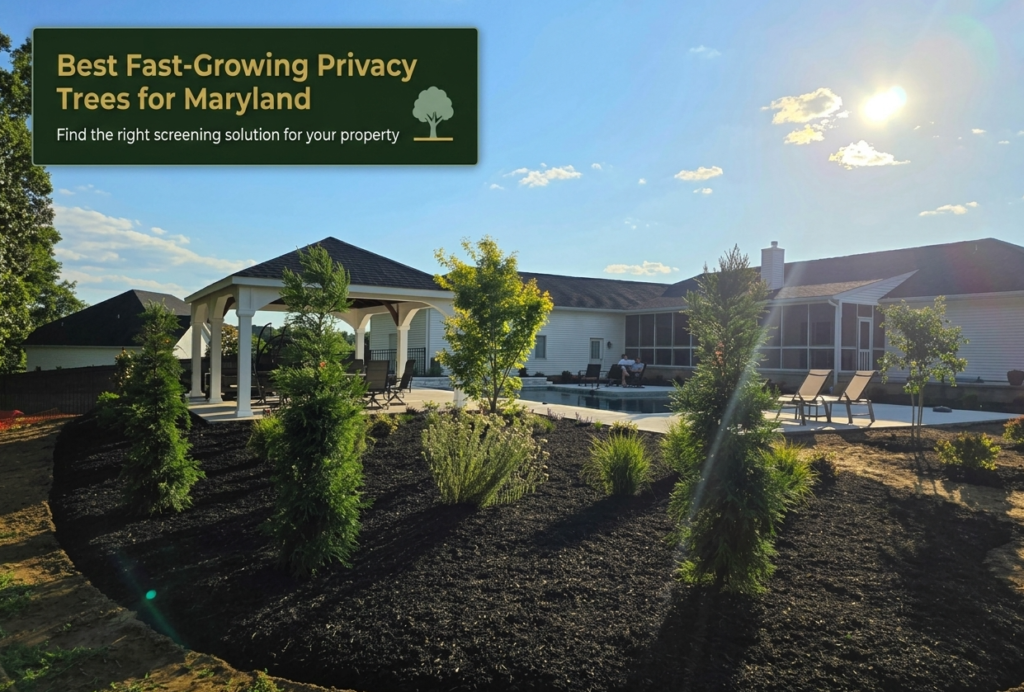
The fastest privacy trees for Maryland are Thuja ‘Green Giant’, Nellie R. Stevens holly, Japanese cedar and Leyland cypress, all of which can add two to three feet a year while young. Green Giant is the safest choice for Zone 6b to 7a clay: it handles heavy soil, resists deer and bagworms, and has no serious disease problems.
That answer covers most yards. The rest of this guide covers the twenty trees worth considering, grouped by how fast they actually fill in, plus the four you should skip.
One thing to get straight before you shop. Nursery tags and mail-order sites advertise growth rates measured on young, irrigated, well-fed plants in their best years. Real screens slow down. The U.S. National Arboretum, which introduced Thuja ‘Green Giant’ to the American nursery trade, puts the tree at roughly 30 feet at 30 years and about 60 feet at maturity. Average that out and you get closer to a foot a year across the tree’s life, not the three to five feet the marketing copy promises. Both numbers are honest. They describe different phases.
The speeds below describe the establishment years, roughly years two through ten, which is the window you actually care about when you are trying to block a view.
Quick comparison: speed versus mature size
| Tree | Typical young growth | Mature height | Mature width | Evergreen | Deer pressure |
|---|---|---|---|---|---|
| Thuja ‘Green Giant’ | 2 to 3 ft/yr | 50 to 60 ft | 12 to 20 ft | Yes | Low |
| Nellie R. Stevens Holly | 2 to 3 ft/yr | 15 to 30 ft | 8 to 25 ft | Yes | Low to moderate |
| Japanese Cedar ‘Yoshino’ | 2 to 3 ft/yr | 30 to 50 ft | 15 to 25 ft | Yes | Low |
| Leyland Cypress | 3 to 4 ft/yr | 50 to 70 ft | 15 to 25 ft | Yes | Low |
| Eastern White Pine | 2 to 3 ft/yr | 50 to 80 ft | 20 to 40 ft | Yes | Moderate |
| Schip Laurel | 2 ft/yr | 10 to 18 ft | 6 to 10 ft | Yes | Low |
| Dawn Redwood | 3 to 4 ft/yr | 70 to 100 ft | 25 to 35 ft | No | Low |
| Norway Spruce | 1 to 2 ft/yr | 40 to 60 ft | 25 to 30 ft | Yes | Low |
| Serbian Spruce | 1 ft/yr | 40 to 50 ft | 15 to 20 ft | Yes | Low |
| Eastern Red Cedar | 1 to 2 ft/yr | 30 to 40 ft | 10 to 20 ft | Yes | Low |
| Arizona Cypress | 2 ft/yr | 30 to 40 ft | 15 to 20 ft | Yes | Low |
| Foster Holly | 1 to 2 ft/yr | 20 to 25 ft | 10 to 12 ft | Yes | Low to moderate |
| Southern Magnolia ‘Bracken’s Brown Beauty’ | 1 ft/yr | 30 to 35 ft | 15 to 20 ft | Yes | Low |
| Emerald Green Arborvitae | 1 ft/yr | 12 to 15 ft | 3 to 4 ft | Yes | Severe |
| American Holly | under 1 ft/yr | 15 to 30 ft | 10 to 20 ft | Yes | Rarely browsed |
| Concolor Fir | under 1 ft/yr | 40 to 50 ft | 15 to 25 ft | Yes | Low |
| Eastern Hemlock | under 1 ft/yr | 40 to 70 ft | 25 to 35 ft | Yes | Moderate |
Growth figures describe establishment-phase performance on a well-prepared site with irrigation. Confirm mature dimensions for the specific cultivar you buy, since named selections vary widely within a species.
Fastest: two to three feet a year while young
Thuja ‘Green Giant’ (Thuja standishii x plicata)
This is the default recommendation for Maryland privacy, and it earns the spot. A cross between western red cedar and Japanese arborvitae, it was sent from a Danish nursery to the U.S. National Arboretum in 1967 and released to the trade after decades of trials. It carries the Pennsylvania Horticultural Society’s Gold Medal Plant Award.
Mature size runs to about 60 feet tall with a 12 to 20 foot spread, though most homeowners keep it in the 25 to 35 foot range by planting it where that height is welcome and simply letting it be.
Site fit for Maryland is the reason it wins. According to the U.S. National Arboretum, the tree grows in soils ranging from sandy loams to heavy clays, which is exactly the range you find across Harford County’s Piedmont. It also has no serious pest or disease problems, and the Arboretum names it specifically as a substitute for Leyland cypress.
Design use: a single row on 6 to 8 foot centers for a solid wall, or 10 to 12 foot centers if you want individual pyramids with air between them. Staggered double rows read as a woodland edge rather than a fence.
The honest caveat: it gets genuinely large. Planted five feet off a property line by an owner picturing a 15 foot hedge, it becomes a 20 foot wide problem in twenty years. Give it room or choose something narrower.
Nellie R. Stevens Holly (Ilex x ‘Nellie R. Stevens’)
A broadleaf alternative when you want glossy dark green rather than feathery conifer texture, plus heavy red fruit through winter. It is a hybrid of English holly and Chinese holly, and it is a Maryland plant by origin: NC State Extension credits its selection to Nellie R. Stevens of Oxford, Maryland, in the early 1900s. Few screening plants have a better local pedigree.
Per the North Carolina Extension Gardener Plant Toolbox, it matures quickly to 15 to 30 feet tall and 8 to 25 feet wide and is a heavy producer of bright red berries.
Site fit: the same source notes it tolerates a range of soils including heavy clay but does poorly on wet sites, and that it handles drought and heat better than most hollies. That combination suits the upland clay loams common across northern Harford County. It also fruits reasonably well without a male pollinator nearby, which most hollies will not do.
Design use: excellent as a formal clipped hedge, as a mixed-screen anchor, or as a security planting where the spiny foliage does real work along a fence line.
The honest caveat: the leaves are sharp, so keep it away from walkways and play areas. It also gets wide at the base, so plan for the 15 to 20 feet it will eventually occupy rather than the four foot pot it arrives in.
Japanese Cedar (Cryptomeria japonica ‘Yoshino’)
The upgrade pick when a row of arborvitae would look generic. Foliage is soft, feathery and blue-green in summer, often taking bronze tones in winter.
The species reaches 50 to 70 feet tall and 20 to 30 feet wide according to NC State Extension, while the ‘Yoshino’ selection stays narrower and columnar at roughly 30 to 50 feet. NC State also lists the species as deer resistant.
Site fit: this one wants consistent moisture and drainage at the same time, which is the hardest combination to deliver on Maryland clay. It performs beautifully on amended, mounded beds and sulks in a low spot that stays wet in March. Check your drainage honestly before committing, and if standing water is part of the picture, read our guide to fixing yards that hold water on heavy clay first.
Design use: we specify it on projects where the screen has to look designed rather than functional. It reads as a specimen conifer that happens to be planted in a line.
The honest caveat: winter bronzing bothers some clients. If you want unbroken dark green in February, choose Green Giant or a holly instead.
Leyland Cypress (x Cuprocyparis leylandii)
The fastest common screening conifer at three to four feet a year, and the one we most often recommend against.
Mature size is 50 to 70 feet tall and 15 to 25 feet wide, though many Maryland Leylands never get there because they fail first.
Site fit is the problem. University of Maryland Extension reports that winter cold injury on Leyland cypress opens the door to Seiridium and Botryosphaeria cankers and Cercospora needle blight, and that the only cure for those cankers is pruning out the infected wood. UME also notes that if more than a third of the tree is damaged, replacement is usually the answer. Their recommendation is direct: diversify an evergreen border with several species rather than planting one.
Design use: if you already have healthy Leylands, keep them watered through drought and monitor them. There is no reason to remove a screen that is performing.
The honest caveat: planting a new single-species Leyland row in 2026 means accepting that a canker outbreak can take out several trees at once and leave gaps you cannot fill by pruning, because these conifers do not regenerate foliage from bare interior wood. The U.S. National Arboretum recommends Green Giant as the substitute, and so do we.
Eastern White Pine (Pinus strobus)
The fast native option, and the one that handles part shade better than most screening conifers. Soft, blue-green needles in bundles of five, with an open, informal habit.
Mature size is large: 50 to 80 feet tall and 20 to 40 feet wide, so this is a tree for acreage rather than a quarter-acre lot.
Site fit: it wants acidic, well-drained soil, which much of the Maryland Piedmont provides. It is notably intolerant of road salt and of compacted, waterlogged ground, so keep it away from driveways and drainage swales.
Design use: excellent for a naturalistic buffer at the back of a large property, particularly where you want the screen to read as existing woodland rather than as a planted line.
The honest caveat: white pine is brittle. Ice storms take limbs, and the tree sheds its lower branches as it matures, so a row that screens perfectly at fifteen years can be looking at you from underneath at thirty. Underplant it early with a lower layer.
Schip Laurel (Prunus laurocerasus ‘Schipkaensis’)
The shade solution. Where a conifer would thin out under a canopy, skip laurel holds dense glossy foliage in surprisingly low light.
Expect 10 to 18 feet tall and 6 to 10 feet wide, which makes it a screen for windows and patios rather than for second-story views.
Site fit: University of Maryland Extension lists cherry laurels as cold-hardy in USDA zones 6 to 8 and best in moist, well-drained soil with good organic content, noting they tolerate full sun through full shade. UME also observes that most cherry laurel problems trace back to site conditions that stress the plant, which then invites pests like peachtree borer.
Design use: layered in front of taller conifers, along a shaded side yard, or as a clipped evergreen hedge at eye level.
The honest caveat: it is planted everywhere in the mid-Atlantic, which means bird-dispersed seedlings show up in nearby woodlots. It is not currently regulated in Maryland, but if your property borders a stream buffer or forest, a native holly is the more responsible pick.
Dawn Redwood (Metasequoia glyptostroboides)
The fastest tree on this list, and the one most people rule out once they understand it. A deciduous conifer with fine, ferny foliage, russet fall color and handsome fluted bark.
Mature size is 70 to 100 feet tall and 25 to 35 feet wide. It is a forest tree.
Site fit: unusually tolerant of wet, heavy ground, which makes it one of the few fast screening trees that will thrive in the low, poorly drained corner of a Harford County lot where nothing else survives.
Design use: a high canopy screen that blocks a neighboring rooftop or a distant view rather than a ground-level sightline. Effective in groups of three or five on estate properties.
The honest caveat: it drops every needle in November and stands bare until April, which is precisely when you can see through to the neighbors. Use it as a canopy layer over an evergreen understory, never as the whole screen.
Steady: one to two feet a year
Norway Spruce (Picea abies)
The workhorse spruce for the mid-Atlantic and a far better bet here than Colorado blue spruce. Dark green needles, gracefully drooping branchlets, and a dense pyramidal form that holds to the ground for decades.
Mature size is 40 to 60 feet tall and 25 to 30 feet wide.
Site fit: it tolerates clay better than most spruces and handles Maryland’s humid summers without the needle cast problems that disfigure blue spruce here. Full sun, and it appreciates a deep mulch ring rather than turf to the trunk.
Design use: a windbreak on exposed ground, or the dark backdrop layer at the rear of a mixed screen where you want depth behind lighter foliage.
The honest caveat: it is wide. Anything closer than 15 foot centers gives you a solid screen for fifteen years and a row of one-sided, thinning trees after that.
Serbian Spruce (Picea omorika)
The narrow spruce, and one of the most elegant screening conifers available. Two-toned needles show green above and silver below, so the tree flickers in wind.
Mature size is 40 to 50 feet tall but only 15 to 20 feet wide, which is a genuinely useful ratio.
Site fit: it handles heat and humidity better than most spruces, tolerates a range of soil pH, and needs drainage. On flat clay, plant it high with the root flare above grade.
Design use: where you need real height in a narrow easement or side yard. Also excellent as a repeated vertical accent within a mixed screen.
The honest caveat: growth is slow at roughly a foot a year, so buy it big or plan for patience. It also resents being crowded, and interior branches shade out fast in a tight row.
Eastern Red Cedar (Juniperus virginiana)
Maryland’s native screening conifer, and the toughest tree on this list. You already see it colonizing every unmowed fence line in Harford County, which tells you what you need to know about its adaptability.
NC State Extension puts it at 30 to 40 feet tall and 10 to 20 feet wide in good conditions, tolerating a wide variety of soils.
Site fit: full sun, essentially any drainage, tolerant of drought, wind, poor soil and salt. It supports native wildlife and its berry-like cones feed cedar waxwings through winter. If you are building a screen with ecological function, start here and pair it with the species in our guide to native plants that thrive in Harford County.
Design use: informal buffers, meadow edges, and any exposed site that has killed something else.
The honest caveat: it is an alternate host for cedar-apple rust, so avoid it within a few hundred feet of apples, crabapples or hawthorns. Wild-type plants also vary enormously in form, so buy a named upright cultivar if you want uniformity in a row.
Arizona Cypress (Hesperocyparis arizonica ‘Carolina Sapphire’)
The blue one. Soft silver-blue foliage with a citrus scent when crushed, and a loose, informal texture unlike anything else on this list.
Mature size is 30 to 40 feet tall and 15 to 20 feet wide.
Site fit: this is where Maryland gardeners get into trouble. Arizona cypress evolved in the dry Southwest and demands sharp drainage. It performs on a sunny slope or a raised berm and dies on flat, compacted clay that stays wet in spring.
Design use: a color accent within a mixed evergreen screen, or a full screen on a well-drained sunny bank.
The honest caveat: it is the least reliable tree here for our conditions. Check your soil with the USDA Web Soil Survey before you commit to a row of them, and expect to lose one occasionally even on a good site.
Foster Holly (Ilex x attenuata ‘Fosteri’)
The narrow holly. Fine-textured, small dark leaves on a tight upright cone, with heavy red fruit.
Mature size is 20 to 25 feet tall and only 10 to 12 feet wide.
Site fit: acidic, well-drained soil in full sun to part shade. Like most hollies it will not tolerate standing water, but it handles the clay loams of the Piedmont well once established.
Design use: the holly to choose when Nellie Stevens is too wide. It fits a 12 foot planting bed along a driveway or between houses without constant shearing.
The honest caveat: the fine texture that makes it elegant also makes it less opaque than Nellie Stevens in the first few years. Plant on 6 foot centers rather than 8 if you want a screen quickly.
Southern Magnolia (Magnolia grandiflora ‘Bracken’s Brown Beauty’)
Broadleaf evergreen with large glossy leaves, felted cinnamon undersides, and huge fragrant summer flowers. ‘Bracken’s Brown Beauty’ is the cultivar to specify in Maryland because it is meaningfully hardier and denser than the species.
Mature size is 30 to 35 feet tall and 15 to 20 feet wide, considerably more compact than a wild southern magnolia.
Site fit: the 2023 revision of the USDA hardiness map pushed most of central and northern Maryland into Zone 7a, which brings this species comfortably into range for the first time in many gardeners’ memory. Give it a sheltered spot away from harsh northwest winter wind.
Design use: a formal, high-value screen along a front property line where you want the planting to read as an architectural feature.
The honest caveat: it grows about a foot a year, so it is a fifteen-year investment. It also drops leathery leaves year-round, which is a maintenance conversation worth having up front.
Emerald Green Arborvitae (Thuja occidentalis ‘Smaragd’)
The small-space arborvitae, at 12 to 15 feet tall and only 3 to 4 feet wide. It is the right plant for a narrow side yard and the wrong plant almost everywhere else in Harford County.
Site fit: moist, well-drained soil in full sun. It is a cultivar of American arborvitae, which is native to the region and adapted to our climate.
Design use: tight urban side yards, courtyard screens, and formal repeated verticals in a designed bed.
The honest caveat, and it is a significant one: deer. Rutgers Cooperative Extension’s deer resistance ratings place American arborvitae in the most heavily browsed of its four categories, and NC State Extension states plainly that deer browsing on American arborvitae can be a serious problem. On most Harford County properties, deer will strip this plant to bare stems up to about six feet, which is exactly the height you were trying to screen. Plant it only inside a fenced yard or commit to year-round repellent.
Slow but permanent: under a foot a year
American Holly (Ilex opaca)
Maryland’s native evergreen holly and the state tree of Delaware next door. Matte dark green spiny leaves, red fruit on female plants, and an irregular pyramidal form that ages into real character.
Mature size is 15 to 30 feet tall and 10 to 20 feet wide.
Site fit: acidic, well-drained soil, sun to considerable shade. It is one of the few evergreens that will screen reliably under an existing tree canopy, which is a common need on wooded Harford County lots.
Design use: woodland edges, shade screens, and native plantings where wildlife value matters. Birds strip the fruit through winter. It is also the best deer bet on this list: Rutgers rates American holly in its highest category, rarely damaged.
The honest caveat: it is slow, often under a foot a year, and it is dioecious, so you need a male within a few hundred feet for the females to fruit. Buy it at the largest size your budget and access allow. Our notes on sourcing specimen-size plant material explain why that matters more for slow growers than fast ones.
Concolor Fir (Abies concolor)
The best true fir for Maryland, with long soft blue-gray needles and a formal conical silhouette. It looks like a Colorado blue spruce that will actually survive here.
Mature size is 40 to 50 feet tall and 15 to 25 feet wide.
Site fit: it needs excellent drainage and cool root conditions. It tolerates our heat better than most firs and shrugs off cold, but it will not accept wet feet or heavy compaction.
Design use: a specimen-quality screen on a well-drained slope, or a single vertical accent where a whole row would be excessive.
The honest caveat: slow, expensive, and unforgiving of a poorly drained planting hole. This is a tree to plant three of, beautifully, rather than fifteen of, cheaply.
Eastern Hemlock (Tsuga canadensis)
Included because clients ask about it, and because the answer takes explaining. It is a graceful native evergreen, the best shade-tolerant screening conifer in the eastern forest, and currently a difficult plant to recommend.
Mature size is 40 to 70 feet tall and 25 to 35 feet wide.
Site fit: cool, moist, shaded north-facing slopes. It struggles in full sun on hot Piedmont clay.
Design use: shaded ravines and stream buffers on large wooded properties, where nothing else provides an evergreen layer.
The honest caveat: hemlock woolly adelgid has devastated the species across the mid-Atlantic. Planting hemlock now means committing to an ongoing treatment program with a licensed applicator for the life of the tree. If you are not prepared for that, plant American holly instead.
Four fast trees to skip
Naming what does not work saves more money than naming what does.
Hybrid Poplar (Populus x canadensis). Sold as the fastest screen available at six to eight feet a year, and it delivers. It also has weak wood, aggressive roots that find drain lines, a lifespan under twenty years, and it is deciduous. You get a bare screen and a removal bill in the same decade.
Willow Hybrid (Salix x matsudana x alba). Marketed heavily online as a fast-growing living fence. Same problems as hybrid poplar with worse disease pressure and even more invasive roots. Not a landscape tree.
Colorado Blue Spruce (Picea pungens). Beautiful in Denver. In Maryland’s humid summers it is chronically disfigured by Rhizosphaera needle cast and Cytospora canker, which strip the lower branches first. A blue spruce screen typically looks worst at the exact height you planted it to cover. Plant concolor fir or Serbian spruce instead.
Running Bamboo (Phyllostachys species). It is fast, it is evergreen, and it will cross your property line underground and become your neighbor’s legal problem and then your legal one. Clumping bamboo is a different plant and a reasonable choice in the right spot, but the running types belong in containers or nowhere.
How to choose: four questions that decide the planting
1. How fast do you actually need it, and how many trees does that take?
Growth rate is the wrong first question. Spacing is the right one, because spacing determines how long you wait and what the screen looks like in year twenty.
The arithmetic is straightforward. Take the mature width of your chosen tree and plant at roughly 60 to 75 percent of it for a solid screen. Green Giant at a 15 foot mature spread goes on 8 to 10 foot centers. Emerald Green at 4 feet goes on 3 foot centers. Nellie Stevens at 15 feet goes on 8 to 10 foot centers.
The temptation is always to tighten that spacing for faster coverage. Resist it. Clemson Extension’s guidance on mixed screens makes the point that plants installed too close crowd each other, shade out interior branches, compete for water and create the humid, still conditions that fungal disease needs. The screen that closes in three years instead of five thins out permanently at fifteen.
If you need coverage sooner than a small plant provides, buy larger stock rather than crowding small stock. A row of 10 to 12 foot balled-and-burlapped Green Giants installed on correct centers gives you a real screen the day it goes in and stays healthy for forty years.
2. Native or non-native?
Both are defensible, and the answer depends on where the screen sits.
If the planting borders woods, a stream buffer or open field, lean native. Eastern red cedar and American holly deliver evergreen screening with genuine habitat value, and neither will seed into the adjacent woodlot as an unwelcome guest.
If the screen sits between two suburban houses and its only job is blocking a sightline, the non-natives on this list are appropriate. Thuja ‘Green Giant’ is sterile in practical terms and non-invasive. Cryptomeria and the hybrid hollies stay put.
What matters more than origin in either case is not planting a monoculture. University of Maryland Extension’s advice after the Leyland cypress failures was to diversify an evergreen border with a mix of species rather than a single one, and that is the single most valuable structural decision you can make. A row of one species is one pest event away from a gap. A screen of four species absorbs the loss.
One regulatory note: Maryland’s invasive plant law changed on June 1, 2024 under Senate Bill 915, and the Maryland Department of Agriculture has been updating its invasive plant lists and requirements since. None of the trees recommended above appear on the state’s restricted lists as of this writing, but check the current MDA list before any large installation.
3. Will deer and bagworms find it?
In Harford County, assume yes to both and plan accordingly.
On deer, Rutgers Cooperative Extension maintains the standard rating list for the region, sorting landscape plants from rarely damaged through frequently severely damaged. Green Giant, Cryptomeria, Norway spruce and the hollies sit in the more resistant tiers. American arborvitae sits at the bottom. Rutgers is explicit that no plant is deer proof and that local pressure and winter severity change the outcome.
On bagworms, University of Maryland Extension identifies arborvitae, cedar, juniper and pine as the most frequently damaged hosts, notes that eggs typically hatch sometime in May in central Maryland, and warns that heavily infested conifers can be killed outright. Each female lays several hundred eggs inside her bag, so an untreated population compounds fast. The damaged foliage does not regrow.
The practical takeaway for both problems is the same as the disease takeaway: mix your species, keep the plants unstressed and watered through drought, and inspect the screen each June rather than each September.
4. Can it grow where you are putting it?
Two site checks are worth doing before you buy anything.
Drainage first. Dig a hole a foot deep where the screen will go, fill it with water, let it drain, then fill it again. If the second filling has not drained within a day, you have a wet site, and most of the trees on this list will fail there. The USDA Web Soil Survey will tell you what soil map units cover your parcel. Much of the northern Harford County Piedmont sits on well-drained loams over a clay loam subsoil, such as the Glenelg series, but low areas and heavily graded new-construction lots behave very differently from what the map suggests.
Hardiness second. The USDA revised its Plant Hardiness Zone Map in 2023 using 1991 to 2020 temperature data from more than 13,000 stations, and much of Maryland shifted a half zone warmer. Most of central and northern Maryland now maps to Zone 7a, with Zone 6b persisting at higher elevations to the west. Look up your own ZIP code on the USDA tool rather than relying on a zone printed on an older plant tag.
Planting, installation and long-term care
A privacy screen is one of the few landscape investments where installation quality determines the outcome more than plant selection does.
Plant high on clay. The root flare should sit an inch or two above finished grade so water moves away from the trunk rather than collecting against it. Widen the planting hole to two or three times the root ball diameter and rough up the sides, since a smooth-walled hole in clay behaves like a pot.
Water deeply and infrequently through the first two full growing seasons. Newly planted evergreens on Maryland clay are lost far more often to a saturated root zone than to drought, so a slow soak once or twice a week beats a daily sprinkle.
Mulch a continuous bed rather than individual rings, two to three inches deep, pulled back from the trunks. A continuous bed eliminates mower and string trimmer damage and reduces root competition from turf.
Skip the fertilizer at planting. Roots establish first. Feeding a stressed new transplant pushes top growth the root system cannot support.
For a broader look at how a screen fits into an overall plan, including how it interacts with lighting and water features, see our guide to integrated landscape design across water, lighting and trees. On acreage, the scale considerations are different again, and we cover those in planning privacy on large Harford County properties.
Property lines, rights-of-way and permits
Two legal points come up on nearly every privacy screen project in Maryland.
Overhanging growth. Maryland follows what is known as the Massachusetts Rule, which the state’s highest court adopted in Melnick v. C.S.X. Corp., 312 Md. 511 (1988). Under it, a neighbor whose property is affected by your tree is generally limited to self-help. According to the University of Maryland’s Agricultural Law Education Initiative, that means a neighbor may trim branches, vines and roots back to the property line but may not enter your land to do it. Practically, this means a screen planted tight to a boundary can be cut flat on one side, legally, by someone who does not like it.
Roadside plantings. The Maryland Roadside Tree Law, first enacted in 1914, requires a permit from the Maryland DNR Forest Service before a tree is planted, pruned or removed within a public road right-of-way. The DNR Roadside Tree Program covers who needs a permit and how to apply. The right-of-way frequently extends further onto a front lawn than owners expect, so verify the boundary before planting a front-yard screen. Harford County’s own landscaping provisions also reference corner clearance and sightline requirements, and local HOA covenants may add restrictions of their own.
This is general information, not legal advice. Confirm right-of-way boundaries, setbacks and permit requirements with Harford County Planning and Zoning and the Maryland DNR Forest Service, and consult an attorney for any boundary dispute.
Frequently asked questions
How much do privacy trees cost in Maryland?
Cost is driven far more by installed size than by species. A screen built from three to four foot container stock is a fraction of the cost of the same screen built from ten to twelve foot balled-and-burlapped trees, and the difference buys you roughly five to seven years of waiting. Site access, soil preparation, irrigation and warranty coverage all move the number.
For Zone 6b to 7a properties in Harford County, the practical question is usually how many years of privacy you are buying rather than how many trees.
How long does it take a privacy screen to actually block the view?
With correctly spaced Thuja ‘Green Giant’ installed at six to seven feet, most homeowners get meaningful screening in two to three growing seasons and a solid wall in four to five. Slower species like American holly or concolor fir take eight to twelve years from the same starting size.
Buying larger stock is the only reliable way to compress that timeline. Crowding smaller plants closes the gap faster and then thins out permanently, because interior branches shaded out on Maryland clay do not regrow.
When is the best time to plant privacy trees in Maryland?
Fall, roughly mid-September through late November, is the best window. Soil is still warm enough for root growth while cool air reduces water stress on the foliage, so the tree spends the season establishing roots rather than supporting new top growth. Early spring is the second-best option.
Avoid midsummer installation of large evergreens in Harford County unless irrigation is in place. Summer-planted balled-and-burlapped conifers on clay carry a meaningfully higher failure rate.
How close to the property line can I plant a privacy tree in Maryland?
Maryland has no statewide setback for planting trees near a boundary, but your neighbor has the legal right to trim any growth crossing the line back to that line. Practical guidance is to set the row inward by at least half the tree’s mature width so it never encroaches.
Harford County zoning, subdivision plats and HOA covenants may impose their own requirements, and a public road right-of-way triggers a Maryland DNR Forest Service permit. Confirm all three before planting, and treat this as general information rather than legal advice.
What should I plant instead of Leyland cypress in Maryland?
Thuja ‘Green Giant’ is the direct substitute, and the U.S. National Arboretum recommends it specifically for that purpose. It matches Leyland’s speed and form while avoiding the canker and needle blight problems University of Maryland Extension documents on Leylands after winter injury.
Better still, plant a mix. UME’s own guidance after widespread Leyland failures was to diversify an evergreen border across several species rather than repeat a single one down the property line.
What is the fastest-growing evergreen that stays under 15 feet tall?
Schip laurel is the fastest true dwarf screen, adding about two feet a year and topping out near 10 to 18 feet with dense foliage that holds up in shade. Emerald Green arborvitae reaches a similar height in a much narrower three to four foot footprint but grows at roughly half the speed.
On unfenced Harford County properties, choose the laurel. Rutgers rates American arborvitae among the most heavily browsed landscape plants, and deer routinely strip Emerald Green to bare stems at screening height.
Get a privacy plan for your property
Choosing the right species is the easy half. Setting the line, reading the drainage, sizing the stock to your timeline and staging the planting so it looks intentional in year one and year twenty is the part that determines whether the screen works.
Oakfield Landscaping designs and installs privacy plantings across Harford and Baltimore counties. See our landscape design and installation services, or learn more about working with us as your Harford County landscapers and for landscaping in Bel Air, MD.
Still deciding between plant types rather than species? Our companion guide covers privacy screening plants that work year-round in Maryland, including shrubs and mixed-layer approaches.

With over 10 years of experience locally in Maryland, Oakfield Landscaping has a team of skilled professionals ready to deliver exceptional services.
Start your project
Ready to create a landscape that enhances your property and reflects your vision?
Our design process begins with an in-depth consultation:
- Walk your property and discuss your vision
- Review your functional & aesthetic preferences
- Assess existing landscape conditions
- Explain our design-installation process and timeline
- Answer your questions about our approach