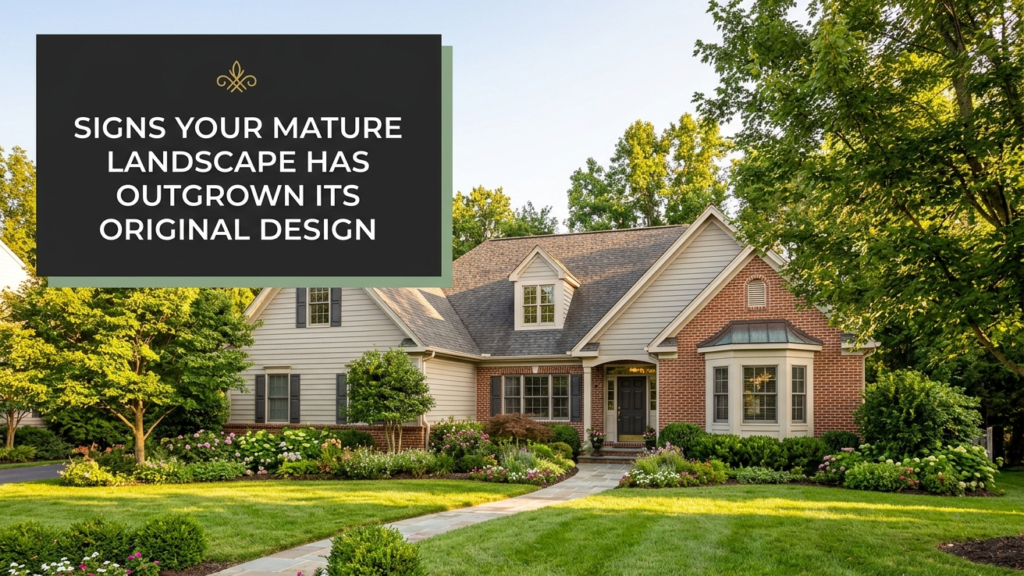
You planted everything 10-15 years ago. Back then, your landscape looked perfect—balanced, proportional, welcoming. But now your “dwarf” shrubs are blocking windows. Your privacy trees have grown into each other, creating a wall of brown, dead branches. And your front yard feels dark and crowded instead of open and inviting.
You’re pruning more often, but nothing helps. Your curb appeal is disappearing. Neighbors who moved in after you have better-looking yards. You’re embarrassed when guests pull up.
Here’s the truth: your landscape hasn’t failed—it’s just matured beyond its original design. Most landscapes are designed to look good at installation, not 10 years later. The plants that were “perfectly sized” when they went in the ground have done exactly what plants do—they’ve grown. And if they weren’t selected with that growth in mind, you end up with an overgrown mess.
The good news? With the right approach to overgrown landscape redesign, you can restore balance, reclaim your curb appeal, and create a yard that works for the next 20 years.
In this guide, we’ll walk through the telltale signs your Maryland landscape has outgrown its design, what causes landscapes to fail over time, and what your realistic options are—including when to renovate versus when to just keep maintaining.
The Reality of Landscape Maturity in Maryland
Let’s start with something most homeowners don’t realize: landscapes are living, growing systems. They change over time. And in Maryland’s Zone 6b/7a climate, plants often grow faster than people expect—especially when they get adequate water and good soil conditions.
A landscape that was designed to look “full and mature” in five years often looks completely overgrown by year 10 or 12. That’s not your fault. It’s just how plants work.
Most foundation plantings are designed to look good at installation. Designers and installers want everything to look full right away, so they space plants based on current size, not the size they’ll be in a decade. That “compact” burning bush that was 2 feet wide when planted? It can easily hit 8-10 feet if left unpruned.
Maryland’s long growing season (late March through October) means rapid growth for most common shrubs and trees. We get adequate rainfall, humid summers, and relatively mild winters. Plants thrive here—sometimes too well.
Common overgrowth culprits in Harford County landscapes include:
- Arborvitae (especially ‘Green Giant’)—sold as narrow privacy screens but can reach 12-15 feet wide
- Yews—grow slowly at first, then accelerate
- Burning bush—aggressive growers that sucker and spread
- Forsythia—beautiful for two weeks in spring, then a sprawling maintenance nightmare
- Bradford pears—weak branch structure and they outgrow residential lots
- Japanese maples—stunning trees, but often planted in spots with too little space
Here’s the key distinction: there’s a difference between a landscape that needs maintenance and one that needs redesign. Maintenance keeps a well-designed landscape healthy and attractive. Redesign fixes a landscape where the fundamental planning was flawed or the plants have simply outgrown their purpose.
If you’re constantly pruning, and your landscape still looks overgrown, you don’t have a maintenance problem. You have a design problem.
7 Signs Your Harford County Landscape Has Outgrown Its Design
Let’s get specific. Here are the clear signals that your landscape needs more than just pruning—it needs professional renovation.
1. Shrubs Are Blocking Windows, Walkways, or Sightlines
This is the most obvious sign. You look out your living room window and see… shrubs. Not a view of your yard, not the street—just dense green foliage pressed against the glass.
Or you’re walking to your front door and have to turn sideways to avoid brushing against overgrown junipers. Or you’re backing out of your driveway and can’t see around the corner plantings that have grown into 6-foot mounds.
Foundation plantings that now cover half your windows aren’t just an aesthetic problem—they’re blocking natural light, making your home feel darker inside, and hiding your home’s architectural features. Shrubs encroaching on walkways force people to walk on the lawn, creating worn paths through your grass. Corner plantings that block sightlines are a safety issue.
If you’re pruning these plants every 6-8 weeks just to keep them “manageable,” that’s the clearest sign you have the wrong plant in the wrong spot. You’re fighting the plant’s natural growth habit. You’ll never win that fight.
This is especially common with plants sold as “dwarf” or “compact” varieties that turn out to be neither. That “dwarf” Alberta spruce? It can reach 10-12 feet. Those “compact” hollies? Try 6-8 feet wide at maturity.
In Maryland, we see this constantly with yews and boxwoods planted too close to foundations, and arborvitae planted in front of picture windows. These were fine choices 15 years ago when they were small. Now they’re blocking light, views, and access.
2. Your Privacy Screen Has Become a Wall of Dead Branches
Privacy plantings are one of the most common landscaping requests. And one of the most commonly botched.
Here’s what we see all the time in Harford County: a row of arborvitae or Leyland cypress planted 3-4 feet apart “for instant privacy.” For the first few years, it looks great. Then the trees start touching. Then they start growing into each other. Then the lower branches start dying off because they’re not getting enough light or air circulation.
Five years later, you’ve got a solid wall of green up top and a wall of brown, skeletal branches at eye level. The dead interior is visible from the street or your neighbor’s yard. It looks terrible.
Here’s the problem: once evergreens lose their lower branches, they don’t grow back. Those branches are gone permanently. You can prune the tops, but you can’t fix the dead interior.
This happens because the trees were planted based on their size at installation, not their mature width. ‘Green Giant’ arborvitae should be spaced 8-10 feet apart minimum if you want healthy, full trees long-term. Planted 3 feet apart, they’ll look good for five years, then decline.
What we do differently at Oakfield: we space privacy trees based on their mature width, use layered plantings (trees backed by shrubs) for multi-season privacy, and select disease-resistant varieties that hold their foliage low even at maturity. It takes a bit longer to achieve “full” privacy, but you get screening that lasts 20+ years without major problems.
3. Mature Trees Are Crowding Out Everything Else
Let’s say you planted a red maple in your front yard 15-20 years ago. At the time, it was a wispy sapling that cast almost no shade. The landscape bed around it was planted with sun-loving perennials—daylilies, coneflowers, maybe some knockout roses.
Fast forward to today. That maple is now 30 feet tall with a broad canopy. Your front yard, which used to get 6-8 hours of sun, now gets 2-3 hours of filtered light. Those sun-loving perennials? They’re struggling or dead. Your grass is thin and patchy under the tree canopy. You’ve got surface roots making it hard to mow or plant anything new.
This is a classic example of a landscape that wasn’t designed with maturity in mind. As trees grow, they fundamentally change the “microclimate” of your landscape. What was full sun becomes part shade. What was part shade becomes deep shade. And the plantings that worked in Year 3 completely fail in Year 15.
We see this constantly in Maryland—hostas and azaleas planted in what’s now deep shade, hydrangeas that no longer bloom because they’re not getting enough light, and lawns struggling under mature oaks or maples.
The solution isn’t removing the tree (unless it’s diseased or hazardous). The solution is redesigning the landscape to work with the conditions the mature tree has created. That means replacing struggling sun plants with shade-tolerant natives, adding mulched beds under canopies where grass won’t grow, and selecting plants that thrive in the drier soil conditions near established root systems.
4. Your Front Yard Feels Dark, Crowded, or Uninviting
This one’s harder to quantify, but you know it when you see it. Your home used to feel open and welcoming. Now it feels like it’s being swallowed by the landscape.
Your front yard feels cramped. The entryway or front porch is dark because overgrown evergreens are blocking light. You can’t see house numbers or architectural details from the street—everything’s obscured by plants. The landscape that once framed your home nicely now dominates it.
This is a loss of curb appeal. And curb appeal matters—not just for resale value, but for how you feel about your home every single day.
If you feel a little embarrassed when guests pull up, your landscape has outgrown its purpose. Landscapes should enhance your home’s appearance, not hide it. They should make you proud, not self-conscious.
We see this particularly with older homes where the original landscape used lots of evergreens (yews, arborvitae, spreading junipers). These were low-maintenance choices that looked fine when small. But as they’ve matured, they’ve created this enclosed, dark feeling that makes homes look dated and smaller than they actually are.
The fix usually involves selective removal—taking out the largest or most overgrown plants—and replacing them with right-sized options that provide structure without overwhelming the space. Sometimes just removing one or two overgrown evergreens can completely transform how open and inviting your front yard feels.
5. You’re Spending More Time Pruning and Still Losing Ground
Here’s the scenario: you’re out pruning every 4-6 weeks during the growing season. You’re cutting back shrubs, trimming hedges, trying to keep everything “in bounds.” But no matter how often you prune, the plants rebound aggressively. Two weeks after pruning, they look overgrown again.
You’re spending more on maintenance—either your own time or paying a crew—but the landscape never actually looks good. You’re constantly fighting to keep plants contained. It’s exhausting.
This is the clearest sign you need redesign, not more maintenance. You’re fighting the plant’s natural growth habit and mature size. Some plants (forsythia, burning bush, privet, certain spireas) are aggressive growers that respond to pruning by growing even faster. Others (arborvitae, Leyland cypress) simply get too large for their space and no amount of pruning makes them appropriate.
Contrast this with a properly designed landscape: a well-designed landscape uses right-sized plants that need minimal pruning—maybe once or twice per season to shape or remove dead wood. The plants fit their space at maturity. You’re not constantly battling them.
When we design landscapes at Oakfield, we select plants based on their mature size and growth rate. If you have a 4-foot-wide space, we’re not planting something that wants to be 8 feet wide. We’re choosing a plant that naturally stays 3-4 feet and looks good with minimal intervention.
If you’re pruning more than four times a year and still frustrated, you have the wrong plants. Period.
6. Plantings Look Outdated Compared to Neighboring Homes
Landscape design trends evolve. What was standard practice 20 years ago looks dated today.
If your landscape was installed in the 1990s or early 2000s, chances are it features:
- Rows of evenly-spaced boxwoods or yews
- Burning bush (now considered invasive in Maryland)
- Bradford pears (weak trees that split in storms)
- Mulch volcanoes around tree trunks
- Mostly evergreens, minimal perennials or ornamental grasses
Meanwhile, newer homes in your neighborhood have layered native plantings, ornamental grasses swaying in the breeze, pollinator gardens with black-eyed Susans and coneflowers, and naturalistic designs that look less formal and more integrated with the surrounding environment.
Your yard stands out—but not in a good way. It looks like a time capsule from 2002.
This isn’t about keeping up with the Joneses. It’s about recognizing that landscape practices have improved. We understand native plants better now. We design for pollinators and beneficial insects. We use layered plantings that provide year-round interest instead of landscapes that look good for six weeks and boring the rest of the year.
At Oakfield, our contemporary designs use native and adapted plants that support local ecosystems, naturalistic layouts that feel less rigid and formal, and plantings selected for multi-season interest (spring blooms, summer foliage, fall color, winter structure). These landscapes look better, require less maintenance, and support healthier yard ecosystems.
7. You’ve Lost Access to Parts of Your Yard
This is the functional issue that often gets overlooked: overgrown landscapes limit how you can actually use your property.
Maybe you can’t walk around the side of your house anymore because shrubs have completely blocked the path. Your backyard feels disconnected from your front yard because overgrown screening plants have created an impenetrable barrier. You can’t access your hose bib without crawling through bushes. The HVAC unit is surrounded by plants, making service calls difficult.
Or maybe you have garden beds that were beautiful 10 years ago, but now they’ve been completely overtaken by aggressive spreaders or self-seeding plants. Those paths that used to wind through your yard? They’ve disappeared under encroaching groundcovers or spreading ornamental grasses.
A landscape should enhance how you use your property, not limit it. You should be able to access utilities easily. You should be able to walk around your home. You should be able to maintain everything without needing a machete.
When landscapes become so overgrown that they restrict access or make routine maintenance difficult, it’s time for renovation. We need to reestablish clear circulation paths, provide adequate access to utilities and building systems, and create functional spaces you can actually use and enjoy.
What Causes Landscapes to Outgrow Their Original Design?
Understanding why this happens helps prevent it from happening again. Here are the main culprits:
Poor plant selection. This is the big one. Many landscapes are planted with whatever’s available at big box stores, not what’s actually appropriate for the site. Plants are chosen based on how they look in a 3-gallon pot, not how they’ll perform at maturity. “It looks nice” becomes the selection criteria instead of “it fits the space and thrives in our conditions.”
Inadequate spacing. Designers and installers are under pressure to create landscapes that look “full” immediately. So they space plants based on current size, not mature spread. Those shrubs planted 2 feet apart? They should have been 5 feet apart. But 5 feet apart looks sparse at installation, so nobody wants to do it. Five years later, everything’s overcrowded.
Lack of long-term planning. Most landscape designs are created to look good in Year 1, not Year 10. There’s no consideration of how plants will grow, how trees will cast shade, how conditions will change. The design is static, but landscapes are dynamic living systems.
Changed conditions. Even well-designed landscapes can outgrow their purpose if site conditions change dramatically. That sunny border becomes shady as trees mature. New construction next door changes drainage patterns. Soil compaction from years of foot traffic kills plantings. The landscape that worked initially no longer works because the environment has changed.
Designer/installer disconnect. In many cases, the person who designs the landscape isn’t the person who installs it, and neither is the person who maintains it. This creates a telephone game where the original intent gets lost. Designers create plans that look good on paper but are impractical to install or maintain. Installers make substitutions based on availability. And maintenance crews have no idea what the original vision was.
At Oakfield, we handle both design and installation. That means we’re accountable for long-term results. We don’t hand off a pretty rendering to a crew that has to make it work—we build what we design, and we design based on what we know will thrive here in Harford County. If something’s not going to work in Maryland’s clay soils and temperature swings, we don’t design it.
Your Options When Your Maryland Landscape Is Overgrown
So your landscape has outgrown its design. Now what? You have three basic options, and which one makes sense depends on the severity of the overgrowth and your goals.
Option 1: Aggressive Pruning and Maintenance
This is the “kick the can down the road” option. It can work in certain situations, but it’s not a permanent fix.
When this approach works:
- The overgrowth is minor (plants 10-20% oversized for their space)
- You love the current plant palette and don’t want to change it
- Budget constraints require delaying a full renovation
- Plants are species that respond well to rejuvenation pruning
Limitations to understand:
This is temporary. You’ll be back in the same spot in 1-2 years. You’re treating the symptom, not fixing the cause.
Some plants don’t respond well to heavy pruning. Evergreens (arborvitae, yews, Leyland cypress) won’t regrow from old wood. Cut them back hard and you’re left with bare, brown branches that never fill back in. Other plants (forsythia, burning bush) respond to hard pruning by growing back even more aggressively.
And aggressive pruning doesn’t address the fundamental design flaw—you still have plants that are too large for their space. You’re just constantly fighting to keep them contained.
If you go this route, be realistic: you’re choosing higher ongoing maintenance costs to avoid upfront renovation costs. Sometimes that’s the right choice (if you’re planning to sell soon, for example). But don’t expect it to actually solve the problem long-term.
Option 2: Selective Removal and Replanting
This is the middle ground—more than maintenance, less than full renovation.
When this approach works:
- Some plants are thriving and well-suited to their spots
- Others are clearly failing or overgrown
- The foundation of the design is sound, but specific plant choices were wrong
- You want to preserve mature trees or specimen plants you love
What this involves:
We evaluate your existing landscape and identify what’s worth saving. Healthy, well-sited plants stay. Problem plants (overgrown shrubs, diseased trees, aggressive spreaders) get removed.
We replace the removed plants with right-sized, climate-appropriate species. We adjust spacing based on what remains. We redesign the layout to work with your best existing features.
This approach costs less than full renovation because we’re working with some existing plants. But it requires careful planning—the new plantings need to complement what stays, both aesthetically and in terms of growth rates and mature sizes.
At Oakfield, this is often what we recommend for properties where the bones of the landscape are good but 30-40% of the plantings are problems. We can preserve the mature shade trees you love, keep the healthy foundation plantings, and replace everything that’s overgrown or struggling. You get a refreshed landscape without starting from scratch.
Option 3: Full Landscape Renovation
This is the comprehensive approach—removing most or all of the existing landscape and redesigning from the ground up.
When this is the right call:
- You’re experiencing multiple signs from our list above
- The original design is 15+ years old
- Plants are blocking windows, walkways, and views
- You’re constantly pruning and still frustrated
- You want a complete refresh and are ready to invest in it
What full renovation involves:
Site evaluation and design planning. We walk your property, evaluate existing conditions (drainage, sun/shade, soil quality), identify what (if anything) is worth preserving, and discuss your goals, style preferences, and budget.
Removal phase. We remove overgrown, diseased, or poorly sited plants. Sometimes this means clearing large sections of the landscape. It can feel dramatic—your yard looks worse before it looks better—but it’s necessary to create the space for a proper redesign.
Redesign based on current conditions. We design based on how your property is now, not how it was 15 years ago. That means accounting for mature shade, current drainage patterns, your actual use patterns (do you use the backyard? do you need privacy from neighbors?), and existing features we’re working around (mature trees, hardscape you want to keep, utility locations).
New plant palette selected for long-term success. Every plant is chosen based on its mature size, growth habit, and suitability for Maryland’s climate. We use native and adapted species that thrive in our zone. We design for four-season interest. And we space everything to look good at maturity, not just at installation.
Phased installation if needed. Larger renovations can be phased if budget requires it. Maybe we do the front yard this year and the backyard next year. Phasing allows you to spread costs over multiple seasons while still getting the complete vision installed eventually.
If you want to learn more about the complete renovation process, check out our detailed guide: The Complete Guide to Landscape Renovation in Harford County.
Maryland-specific plant knowledge. We’re not using generic plant palettes that could work anywhere in the Mid-Atlantic. We’re selecting plants that specifically thrive in Harford County’s conditions:
- Clay soils that drain slowly
- Temperature swings (90°F summers, occasional sub-zero winter nights)
- High humidity in summer
- Moderate deer pressure in many neighborhoods
- Disease pressure on certain species (boxwood blight, fire blight, hemlock woolly adelgid)
We use native and adapted species that have evolved to handle these conditions. We source specialty varieties not found at big-box stores—plants selected for disease resistance, compact growth habits, or exceptional performance in our climate zone.
And we understand microclimates. The north side of your house is a completely different environment than the south side. We design accordingly.
Designing for maturity, not just installation. This is the key difference between our work and landscapes that fail after 10 years.
We design landscapes that look good on Day 1 and even better in Year 10. Every plant is selected based on its mature size, growth habit, and how it will interact with neighboring plants as your landscape matures.
If you have a 6-foot-wide space between your walkway and house, we’re not planting something that wants to be 10 feet wide. We’re choosing a plant that naturally stays 4-5 feet and looks good with minimal pruning.
We space plants based on their mature spread, not their current size. Yes, this means your landscape looks a bit sparse at installation. But two years later, it looks perfect. And 10 years later, it still looks perfect instead of overgrown.
Transparent process with clear expectations. You’ll know what to expect every step of the way:
- Initial consultation and site evaluation—we walk your property together, discuss your frustrations and goals, and explain your realistic options
- Design planning with clear budget and timeline—no surprises, no scope creep
- Personal involvement from Eric on every project—you work with someone who knows your property and your vision
- Detailed proposals that explain what we’re doing and why—you understand the thinking behind every plant choice and design decision
Why Harford County Homeowners Choose Oakfield for Landscape Renovation
We’ve been doing this work in Harford and Baltimore Counties for years. Here’s what homeowners tell us matters most:
Local expertise you can verify. We have 60+ five-star Google reviews from homeowners right here in Bel Air, Abingdon, Aberdeen, and surrounding areas. You can read what your neighbors say about working with us.
We’re based in Bel Air. We know these properties. We understand the soil conditions, the microclimates, what grows well in what neighborhoods.
Personal involvement on every project. Eric is personally involved in every project from consultation through completion. You’re not handed off to a project manager who’s never seen your property. You work with someone who knows your landscape and your vision.
Design-build model means single point of accountability. We design it, we build it, we’re responsible for the results. If something’s not working, there’s no finger-pointing between designer and installer. We own the entire process.
Specialty plant sourcing. We’re not limited to what’s available at big box stores. We work with specialty nurseries to source specific varieties selected for performance in Maryland’s climate. You get better plants, more unique options, and varieties bred for disease resistance and compact growth.
Post-installation maintenance available. We offer ongoing maintenance services for the landscapes we install. That means we can handle seasonal tasks (mulching, pruning, leaf management) and ensure your landscape continues to thrive long-term.
Frequently Asked Questions
Can I just prune my overgrown shrubs back hard instead of replacing them?
It depends on the plant. Some shrubs (certain hollies, boxwoods, deciduous plants like spirea) respond well to rejuvenation pruning. You can cut them back to 12-18 inches and they’ll regrow from the base over the next growing season.
But many common evergreens don’t respond well to hard pruning. Arborvitae, yews, and Leyland cypress won’t regrow from old wood. If you cut them back to bare branches, you’re left with dead-looking plants that never fill back in.
And here’s the bigger issue: if your shrubs are blocking windows or walkways, they’re likely the wrong plant for the space. Even if they respond well to hard pruning, you’re just setting yourself up to do it again in two years. The better long-term solution is replacing them with right-sized plants.
During our consultation, we can evaluate your specific plants and tell you honestly whether rejuvenation pruning is a realistic option or whether replacement makes more sense.
How do I know if I need landscape renovation or just better maintenance?
Here’s the simple test: if you’re pruning every 4-6 weeks and still frustrated, that’s a design problem. If plants are blocking windows, walkways, or views, that’s a design problem. If your landscape looked perfect 10 years ago but has become increasingly problematic despite regular maintenance, that’s a design problem.
Maintenance keeps a well-designed landscape healthy and attractive. It includes seasonal tasks like mulching, occasional pruning to shape plants, leaf management, and addressing issues as they arise.
Renovation fixes a landscape that was poorly planned or has outgrown its original purpose. It addresses fundamental problems like wrong-sized plants, poor spacing, outdated design, or changed site conditions.
If you’re spending more money on maintenance each year and your landscape still doesn’t look good, you’re treating symptoms instead of fixing the cause. That’s when renovation makes sense.
What happens to my mature trees during a landscape renovation?
Healthy, well-sited mature trees are assets—we design around them. Trees provide shade, structure, and established character that new landscapes can’t replicate.
During our site evaluation, we assess tree health, look for structural issues, and evaluate whether each tree is well-suited to its location. For trees we’re keeping, we’ll recommend structural pruning if needed (removing dead wood, correcting poor branch structure, raising the canopy).
Then we design new plantings that work with the shade and root structure those trees create. That might mean shade-tolerant perennials under the canopy, mulched beds where grass won’t grow, or plants selected to thrive in the drier conditions near established root systems.
If a tree is diseased, structurally hazardous, or poorly located (blocking sightlines, too close to the house, invasive species), we’ll discuss options. Sometimes removal is the right call. But our default is always to preserve healthy mature trees and design around them.
Will my new landscape require less maintenance than my current overgrown one?
Yes—if designed correctly. And that’s exactly how we design.
Right-sized plants need minimal pruning. If we specify a plant for a 5-foot-wide space, we’re choosing something that naturally stays 4-5 feet wide at maturity. You might prune it once a year to shape it or remove dead wood, but you’re not fighting aggressive growth every month.
Native and adapted plants thrive in Maryland’s climate without constant intervention. They’re evolved to handle our soils, temperature swings, and precipitation patterns. You’re not constantly feeding, watering, or treating problems.
Low-maintenance doesn’t mean no maintenance. You’ll still need seasonal care:
- Annual mulching to suppress weeds and conserve moisture
- Occasional pruning to maintain shape and remove dead material
- Leaf management in fall
- Monitoring for pest or disease issues
But you won’t be pruning every few weeks. You won’t be replacing struggling plants. And you won’t be spending every weekend trying to keep your landscape contained.
The maintenance becomes manageable and enjoyable instead of constant and frustrating.
Ready to Reclaim Your Harford County Landscape?
Let’s review what we’ve covered:
Overgrown landscapes aren’t a maintenance failure—they’re a natural result of plant maturity and poor initial planning. Most landscapes are designed to look good at installation, not 10-15 years later. As plants mature beyond their expected size, they create problems that maintenance alone can’t fix.
The signs it’s time for redesign are clear: shrubs blocking windows and walkways, dead privacy screens, mature trees crowding out other plantings, constant pruning that never gets ahead of growth, loss of curb appeal, and limited access to parts of your yard.
Renovation restores balance and creates a landscape designed for the next 10-20 years. It addresses the root causes instead of just treating symptoms. And when done right, it results in a landscape that requires less maintenance, looks better, and makes you proud of your property again.
If your Harford County landscape has outgrown its original design, Oakfield Landscaping can help. We’ll evaluate your property, explain your realistic options, and create a renovation plan that brings back your curb appeal and works with how your landscape has matured.
We design landscapes that look good today and even better in 10 years. Every plant is selected based on its mature size and how it performs in Maryland’s climate. You get transparent pricing, personal involvement from Eric on every project, and a design-build process that holds us accountable for long-term results.
Call (443) 794-8108 or email eric@oakfieldlandscaping.com to schedule your consultation. We serve Bel Air, Abingdon, Aberdeen, and surrounding areas in Harford and Baltimore Counties.
Your landscape should make you proud, not embarrassed. Let’s make that happen.

With over 10 years of experience locally in Maryland, Oakfield Landscaping has a team of skilled professionals ready to deliver exceptional services.
Start your project
Ready to create a landscape that enhances your property and reflects your vision?
Our design process begins with an in-depth consultation:
- Walk your property and discuss your vision
- Review your functional & aesthetic preferences
- Assess existing landscape conditions
- Explain our design-installation process and timeline
- Answer your questions about our approach