You’re looking out your back windows and seeing straight into your neighbor’s yard. Or maybe traffic on Route 24 means noise and headlights at all hours. Perhaps you just spent the weekend getting quotes for a privacy fence, and the $8,000+ price tag has you wondering if there’s a better option.
Here’s where it gets frustrating. You start researching plants for privacy online, and every website tells you something different. Leyland Cypress is the miracle solution on one site, a disease-prone disaster on another. You find “fast-growing privacy trees” that look perfect until you realize they’re only hardy to Zone 7—and Bel Air definitely gets colder than that. Now you’re worried about spending thousands on plants that won’t survive a Maryland winter or will take a decade to actually block anything.
That’s exactly why we put together this guide specifically for Harford and Baltimore County homeowners. Eric Vogt and the Oakfield team have designed and installed privacy screenings across the region for 60+ five-star clients. This isn’t a generic plant list copied from a national nursery catalog. We’re focusing only on plants that perform year-round in our climate zones (6b-7a), provide actual screening—not token coverage—and match different property needs. Whether you need fast growth, low maintenance, or something attractive enough for your front yard, you’ll find real options that work here in Maryland.
What Makes a Good Privacy Screening Plant for Maryland?
The bottom line: Not every plant labeled “privacy screening” actually works in Maryland’s climate or provides year-round coverage. Here’s what separates the winners from the disappointments.
First, let’s talk evergreen versus deciduous. Deciduous plants drop their leaves every fall. That means from November through April, you’re looking at bare branches. If your goal is year-round privacy—blocking views of neighbors, roads, or commercial properties even in January—you need evergreen plants that keep their foliage through winter.
Hardiness zones matter more than most homeowners realize. Harford and Baltimore Counties sit in zones 6b to 7a. That means our coldest winter temperatures typically hit -5°F to 5°F. A plant rated for Zone 8 might look great at the nursery in April, but it won’t survive when we get a real cold snap. Stick with plants rated for at least Zone 6.
Growth rate sounds straightforward, but there’s a tradeoff most people don’t expect. Fast-growing plants (3+ feet per year) give you privacy sooner, but they often have shorter lifespans and weaker wood structure. They also need more frequent pruning to stay under control. Moderate growers (1-2 feet per year) take longer to fill in, but they typically live longer and need less maintenance once established.
Density matters as much as height. Some plants grow tall quickly but stay thin and sparse. You can see right through them even at mature size. Look for plants with dense branching from ground level to the top. This is especially important if you’re trying to block sightlines from a second-story window or a neighbor’s deck.
Disease resistance is the factor that catches people off guard. Leyland Cypress became hugely popular in the 1990s because it grows ridiculously fast. But in Maryland’s humidity, it’s prone to canker diseases. We’ve seen entire privacy hedges decline and die within 10-15 years. You’ll learn more about specific disease-resistant alternatives below.
The Best Evergreen Privacy Screening Plants for Maryland
The bottom line: These plants keep their foliage year-round, which means privacy even in January. Here are the top performers we install in Harford and Baltimore Counties.
Thuja Green Giant (Thuja standishii x plicata)
This is the plant that replaced Leyland Cypress as the go-to for fast privacy screening—and for good reason.
Thuja Green Giant grows 3-5 feet per year once established. It reaches 30-40 feet tall and 12-18 feet wide at maturity, though you can keep it smaller with annual pruning. It’s hardy in zones 5-8, which means it handles our worst winters without damage.
Best use: When you need screening fast. New construction where the builder stripped all the trees. Properties with significant road noise or adjacent commercial buildings. Anywhere you want results in 3-5 years instead of 10.
What makes it better than Leyland Cypress? It’s significantly more disease-resistant. It handles Maryland’s clay soil without complaint. Deer mostly leave it alone. And it maintains dense foliage from the ground up without developing the gappy, sparse look that plagues older Leyland hedges.
The texture is soft and feathery, not harsh or prickly. It responds well to pruning if you need to control height or width. Most of our clients who choose Thuja are looking at it 5 years later saying they wish they’d planted it sooner.
Emerald Green Arborvitae (Thuja occidentalis ‘Emerald’)
Think of this as Thuja Green Giant’s more refined cousin—slower growing but more elegant.
Emerald Green grows 6-12 inches per year. It reaches 12-15 feet tall and only 3-4 feet wide at maturity. Hardy in zones 3-8, so winter hardiness is never a concern in Maryland.
Best use: Narrow spaces where you can’t give up 15 feet of yard width. Formal hedges where aesthetics matter as much as function. Front yard screening where you want polished curb appeal, not just a wall of green.
This plant stays naturally narrow and pyramidal. You can prune it, but most homeowners don’t need to. The growth rate is slower than Thuja Green Giant, so plan on 5-8 years to reach effective screening height if you start with 5-foot plants.
The foliage is brighter green than most arborvitae, and it holds that color through winter instead of turning brownish. If you’ve seen arborvitae that look half-dead in February, those are usually different varieties. Emerald Green stays vibrant year-round.
American Holly (Ilex opaca)
This is Maryland’s native holly, and it’s tougher than people expect.
American Holly grows slowly to moderately—plan on 12-18 inches per year. Mature size ranges from 15-30 feet tall and 10-15 feet wide, depending on growing conditions. Hardy in zones 5-9.
Best use: Wildlife-friendly screening where you want birds and berries. Properties where you’re willing to wait for a screening that will outlive you. Native plant landscapes. Spots where you want winter interest beyond just solid green.
The glossy, spined leaves look sharp, and they are—they provide excellent screening because they’re dense and layered. Female plants produce red berries in winter (you need a male holly within 50 feet for pollination). Those berries feed birds when not much else is available.
American Holly is incredibly long-lived. These trees can live 100+ years. They tolerate shade better than most evergreens, so they work in spots where Thuja would struggle. The main downside is patience—if you need privacy next year, this isn’t your plant. But if you’re thinking 20 years down the road, it’s one of the best choices.
Skip Laurel (Prunus laurocerasus ‘Schipkaensis’)
Skip Laurel is the broadleaf evergreen that grows faster than people expect.
This plant puts on 2 feet per year in good conditions. It reaches 10-15 feet tall and 6-8 feet wide at maturity. Hardy in zones 5-9, so it handles Maryland winters without damage.
Best use: Dense screening quickly. Properties with partial shade where needled evergreens won’t perform. Spots where you want a different texture than the typical arborvitae/Thuja look.
The leaves are broad, glossy, and dark green—more like a rhododendron than a typical evergreen hedge plant. This gives you textural variety if you’re layering different plants. In spring, Skip Laurel produces small white flowers that smell sweet (though not overwhelming).
It tolerates shade significantly better than most fast-growing evergreens. If you have screening needs along a north-facing property line or under mature trees, Skip Laurel performs where Thuja would struggle.
One note: In harsh winters (single digits or below), Skip Laurel can show some leaf burn. The plant recovers quickly in spring, but if you’re in the coldest pockets of Harford County, you might see some temporary browning.
Eastern Red Cedar (Juniperus virginiana)
This is Maryland’s native juniper, and it’s the most adaptable plant on this list.
Eastern Red Cedar grows moderately—12-24 inches per year depending on site conditions. Mature size is 30-40 feet tall and 8-15 feet wide, though there’s significant variation between individual trees. Hardy in zones 2-9.
Best use: Tough sites with poor soil or drought conditions. Low-maintenance screening where you don’t want to think about watering or fertilizing. Native landscapes. Wildlife habitat (these trees support 40+ bird species).
If you’ve driven through rural Harford County, you’ve seen Eastern Red Cedar growing wild in old fields and along fence lines. These trees survive conditions that would kill most landscape plants. Once established, they’re drought-tolerant and need zero supplemental watering.
The foliage ranges from green to blue-green to almost silvery, depending on the individual tree. Female trees produce small blue berries (technically cones) that birds love. The wood is aromatic—that cedar-closet smell.
The main limitation: Eastern Red Cedar is an alternate host for apple-cedar rust, a fungal disease that affects apple trees. If you or nearby neighbors have apple trees, skip this one. Otherwise, it’s one of the toughest, lowest-maintenance privacy plants you can choose.
Nellie Stevens Holly (Ilex x ‘Nellie R. Stevens’)
This hybrid holly combines the best traits of English Holly and Chinese Holly.
Nellie Stevens grows 2-3 feet per year—faster than most hollies. It reaches 15-25 feet tall and 8-12 feet wide at maturity. Hardy in zones 6-9, which puts it right in our range.
Best use: Fast evergreen screening with ornamental value. Properties where you want berries and visual interest, not just a solid wall. Locations where you want the holly look but faster growth than American Holly.
The leaves are dark green, glossy, and only slightly spined (much less prickly than American Holly). This holly is self-pollinating, which means you’ll get berries without needing a male pollinator nearby. Those berries are bright red and showy from November through February.
Nellie Stevens is noticeably more disease-resistant than some older holly varieties. It tolerates heat, humidity, and clay soil without complaint. The growth rate means you get effective screening in 4-6 years instead of 8-10.
If you want the classic holly look but don’t want to wait forever, Nellie Stevens is your best option.
Cryptomeria (Japanese Cedar) (Cryptomeria japonica)
This is the privacy plant for people who care as much about aesthetics as function.
Cryptomeria grows 1-2 feet per year. Mature size varies by cultivar—standard varieties reach 30-40 feet, but compact selections like ‘Yoshino’ stay 20-30 feet. Hardy in zones 5-9.
Best use: Specimen-quality screening where the plants themselves are part of the landscape design. Properties where you want unique texture and year-round interest. Situations where a basic arborvitae hedge would look too generic.
The foliage is soft and feathery with a blue-green tint in summer. Some varieties develop bronze or purple tones in winter, adding unexpected color when most evergreens are just plain green. The texture is finer and more graceful than most screening plants.
Cryptomeria prefers consistent moisture and well-drained soil. It’s not the plant for a dry, neglected corner. But in the right location with proper installation, it’s stunning. We use it on luxury landscaping projects where homeowners want screening that looks intentional and high-end.
Leyland Cypress (x Cupressocyparis leylandii)
We’re including this because you’ll see it everywhere, but read this section carefully before choosing it.
Leyland Cypress grows 3-4 feet per year—one of the fastest rates available. It reaches 40-60 feet tall and 15-25 feet wide at maturity. Technically hardy in zones 6-10, but hardiness isn’t the issue in Maryland.
Best use: Budget screening where you need fast results and aren’t concerned about longevity beyond 10-15 years.
Here’s the honest assessment from 20+ years of working in Harford County: Leyland Cypress is prone to canker diseases in Maryland’s humid climate. We’ve watched countless hedges decline and die between years 10 and 20. The trees get brown patches that spread. Eventually, you’re looking at dead sections in what was once a solid screen.
Is it always a disaster? No. Some Leyland hedges perform fine, especially if they’re sited well and maintained properly. But there are simply better options available now—Thuja Green Giant gives you similar speed with much better disease resistance.
If a landscape company is pushing Leyland Cypress hard, ask why they’re not suggesting Thuja instead. The answer will tell you a lot about whether they’re recommending what’s best for you or what’s easiest for them.
Deciduous Options for Seasonal Privacy Screening
The bottom line: These plants lose their leaves in winter, but they grow faster and some offer flowers, fall color, or other benefits that evergreens can’t match. Use them as part of a layered screening strategy, not as your only privacy solution.
Hornbeam (Carpinus betulus)
European Hornbeam is unusual because it’s technically deciduous but holds onto its dried leaves through most of winter.
It grows 12-24 inches per year and reaches 40-60 feet tall (though you’ll keep it pruned much shorter for screening). Hardy in zones 4-8.
Best use: Formal hedges where you want the option of a tightly clipped, architectural look. Spots where you want some winter screening even from a deciduous plant.
When you prune Hornbeam into a hedge, the dried tan leaves stay on the branches until spring. You don’t get the complete privacy of an evergreen, but you get significantly more screening than a typical deciduous plant.
The branching structure is dense, and the plant tolerates heavy pruning. In Europe, Hornbeam hedges have been maintained for centuries. It’s a slower process than planting arborvitae, but the result is a formal hedge with character that you don’t get from typical evergreens.
American Beech (Fagus grandifolia)
American Beech is Maryland’s native option for deciduous screening that holds some leaves through winter.
Growth rate is slow to moderate—6-12 inches per year. Mature size is 50-70 feet tall and 40-50 feet wide, so this is for larger properties. Hardy in zones 3-9.
Best use: Large properties where you want a native tree with winter interest. Situations where you’re screening a distant view and don’t need ground-level privacy. Landscapes where the smooth gray bark provides winter beauty.
Like Hornbeam, American Beech is marcescent—it holds dried leaves through winter, especially on younger branches. The smooth, silvery bark is stunning against snow.
This isn’t a fast solution. It’s a long-term investment in a tree that can live 300+ years. If you have acreage and you’re thinking generationally, American Beech is worth considering. For typical suburban lots where you need privacy in 5 years, stick with evergreens.
Privet (Ligustrum)
Privet is the fast-growing, inexpensive option that landscapers have used for decades.
It grows 2-3 feet per year. Mature size varies by species—most reach 10-15 feet tall and 8-10 feet wide. Hardy in zones 4-8 (species dependent).
Best use: Budget screening where evergreens are too expensive. Formal hedges that will be heavily pruned. Spots where you need something fast and don’t mind deciduous performance.
Privet is semi-evergreen in mild Maryland winters—it might hold half its leaves or drop them all depending on temperatures. It tolerates heavy pruning, so you can keep it at whatever height and width you want.
The downsides: It needs frequent pruning to look good (2-3 times per year for formal hedges). Birds spread the seeds, and Privet can become invasive in natural areas. Some people dislike the flower scent.
It’s not our first choice, but it has its place for homeowners on tight budgets who need something now.
Fast-Growing vs. Slow-Growing: What’s Right for Your Timeline?
The bottom line: Fast-growing sounds ideal, but there are real tradeoffs. Here’s how to think about growth rate based on your situation.
Fast-growing (3+ feet/year): Thuja Green Giant, Leyland Cypress, Skip Laurel
The advantage is obvious—you get privacy years sooner. Plant 6-foot Thuja in spring, and you’re looking at 9-foot plants by the following fall. In 4-5 years, you have effective screening at 15-20 feet.
The tradeoffs: Fast-growing plants are often shorter-lived. They need more maintenance because you’re constantly managing that growth with pruning. The wood is sometimes weaker, making them more susceptible to storm damage. And they can outgrow their space if you’re not careful.
Fast growers make sense when you’re starting from scratch on new construction, when you have urgent privacy needs (new neighbor building a second-story addition that overlooks your yard), or when budget constraints mean you need to start with smaller plants.
Moderate growth (1-2 feet/year): Emerald Green Arborvitae, Nellie Stevens Holly, Cryptomeria
This is the sweet spot for most residential projects. You’re looking at 3-5 years to reach effective screening height when starting with 5-6 foot plants. The plants develop better structure. They’re typically longer-lived. And maintenance requirements are reasonable—annual pruning at most, often less.
We often install a combination approach. Thuja Green Giant for the quick backbone screen, with slower-growing American Holly layered in front for long-term beauty and wildlife value. As the holly matures over 10-15 years, we can thin or prune back the Thuja. The client gets immediate privacy plus a landscape that improves with age.
Slow-growing (6-12 inches/year): American Holly, American Beech, some Cryptomeria cultivars
Choose slow growers for longevity, low maintenance, and specialty situations. These plants often live 50-100+ years. They need minimal pruning. And they’re typically more resistant to pests and diseases because they’re not pushing soft, fast growth.
The patience required is real. Starting with a 5-foot American Holly means you’re 8-10 years from a mature privacy screen. Most homeowners can’t wait that long. But if you’re in your forever home and you’re thinking about what the landscape looks like in 20 years, slow-growing natives are worth mixing into the design.
Spacing, Planting Depth, and Design Mistakes to Avoid
The bottom line: Even the right plant fails if it’s planted wrong. Here are the most common mistakes we see—and how professional installation avoids them.
Spacing Mistakes
Planting too close is tempting. You want that wall of green immediately. But plants spaced too tightly compete for water, nutrients, and sunlight. The interiors thin out. Air circulation drops and disease spreads faster. What looked full at year 3 looks gappy and sparse at year 10.
Planting too far apart means you’re staring at gaps for 8-10 years waiting for plants to fill in. That defeats the purpose of installing screening in the first place.
The rule of thumb: Space plants at 60-75% of their mature width for a hedge effect. That gives them room to develop properly while still creating a continuous screen within a reasonable timeframe.
Specific examples:
- Thuja Green Giant (12-15 foot mature width): Space 8-10 feet apart
- Emerald Green Arborvitae (3-4 foot mature width): Space 3-4 feet apart
- Skip Laurel (6-8 foot mature width): Space 5-6 feet apart
- American Holly (10-15 foot mature width): Space 8-10 feet apart
Those numbers assume you’re creating a formal hedge. If you’re going for a more naturalistic screen with layering, spacing increases to allow individual plants to develop their natural forms.
Planting Depth and Soil Prep
The most common mistake: planting too deep. The root flare (where roots meet trunk) should be at or slightly above grade. Planting even 2-3 inches too deep can suffocate roots and kill the plant slowly over 3-5 years.
Maryland clay soil presents its own challenges. It’s dense, poorly drained, and low in organic matter. Digging a hole and dropping a plant into straight clay is asking for problems.
Professional installation means amending the soil with compost to improve drainage and soil structure. It means breaking up compacted soil beyond the planting hole so roots can spread. And it means properly removing burlap and wire baskets—or at least cutting them away from the top third of the root ball—so they don’t restrict growth.
When Oakfield installs privacy screening, we’re evaluating drainage, testing soil compaction, and amending as needed. That’s the difference between plants that thrive and plants that struggle for years.
Single-Row vs. Staggered/Double-Row Planting
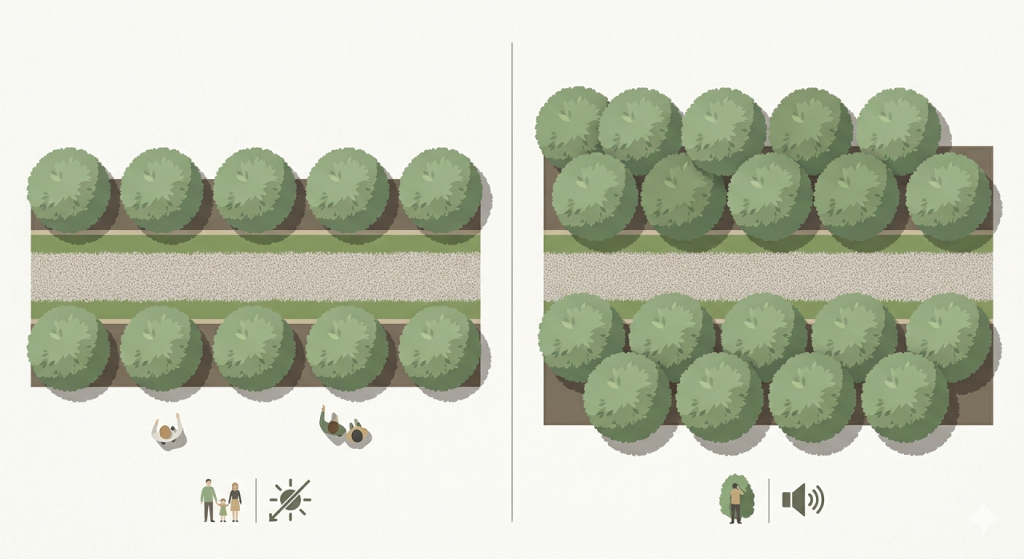
A single row of plants spaced evenly creates a formal, architectural look. It’s clean and controlled. It works well for narrow spaces or when you’re creating a property line hedge.
Staggered or double-row planting creates a more natural appearance and denser screening. You’re planting in a zigzag pattern or two offset rows. This fills in faster, blocks sightlines more effectively, and looks less like a living fence.
For example: Instead of a single row of Thuja Green Giant spaced 8 feet apart, you plant two rows offset from each other, with 10-12 feet between rows and 12-15 feet between plants in the same row. The staggered pattern eliminates the gaps you’d see straight-on with a single row.
Use single-row planting when:
- Space is limited (narrow planting beds)
- You want a formal hedge aesthetic
- Budget limits the number of plants
Use staggered or double-row when:
- You have the space (8+ feet of depth)
- You want faster, denser screening
- You’re creating a naturalistic landscape, not a formal hedge
Ignoring Mature Size
This is the mistake that haunts you 10 years later. Planting 30-foot trees under power lines. Putting 15-foot-wide plants 5 feet from your house. Installing screening 3 feet from the property line when the mature width is 12 feet.
At installation, those 6-foot plants look small. It’s hard to picture them at mature size. But they get there faster than you expect, and then you’re either pruning constantly or dealing with overgrown plants crowding structures, utilities, or property lines.
This is where professional design makes a difference. Oakfield designs privacy screenings based on how the plants will look in 5, 10, and 20 years—not just at installation day. We account for mature size, Maryland soil conditions, sun exposure, and long-term maintenance so you don’t end up with overcrowded plants or unexpected gaps.
Designing Layered Privacy Screening (Not Just a Green Wall)
The bottom line: The best privacy landscapes don’t look like a fence made of plants. Layering creates depth, year-round interest, and more effective screening.
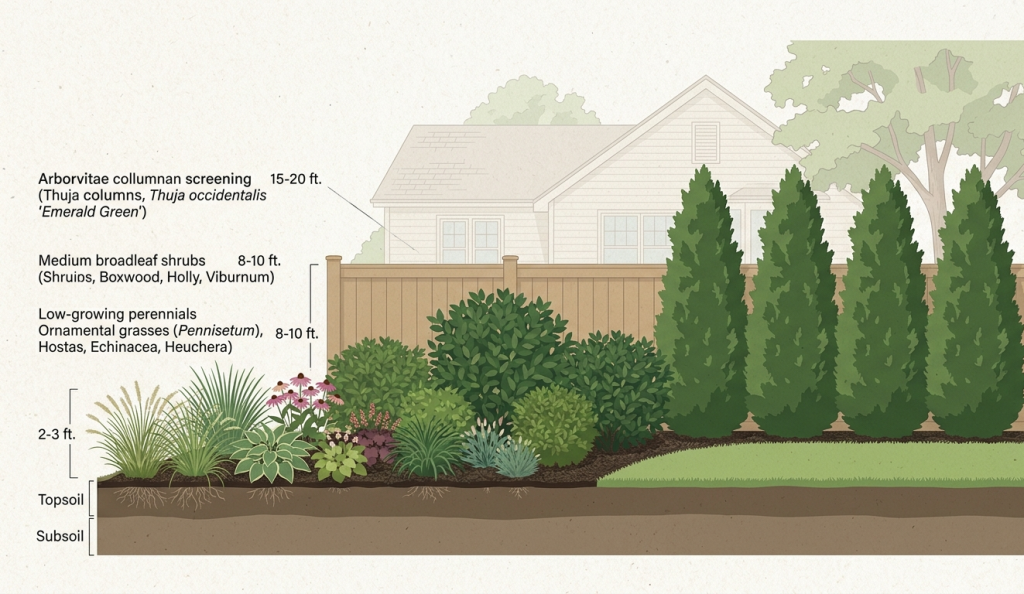
Picture this: A single row of Thuja Green Giant provides the tall evergreen backbone—that’s your main privacy screen. In front of that, Skip Laurel and American Holly create a mid-layer at 8-12 feet. The different textures (needled vs. broadleaf) and the seasonal berries on the holly add visual interest. At the base, native perennials like Black-Eyed Susan and ornamental grasses add color, movement, and seasonal change.
What does that give you? Privacy that looks like an intentional garden bed, not an afterthought. And it’s actually more effective screening than a single row of plants at the same height.
Here’s why layered planting works better: Sightlines are rarely horizontal. You’re blocking views from your neighbor’s deck (looking down) or from the road (looking up if your property is elevated). Layering with plants at different heights blocks those angled sightlines more effectively than a simple hedge.
The evergreen plants provide the year-round backbone. Deciduous shrubs or perennials in front add seasonal color, texture, and wildlife value without compromising winter privacy. The result is a landscape that performs well functionally while looking designed and cohesive.
This is the approach we use on luxury landscaping projects where screening needs to blend with the overall estate design. But the concept works at any budget level—even a simple three-layer planting (tall evergreens + mid-height shrubs + low perennials) performs better and looks better than a single-row hedge.
Oakfield’s design-build approach means the same team that designs your layered screening is the team installing it. There’s no handoff between a designer’s plan and an installation crew that’s never seen the property. Eric walks the property, evaluates sightlines and existing conditions, designs the screening to fit your specific views and budget, and oversees the installation. You get a privacy solution designed to mature beautifully—and one point of contact from start to finish.
How Long Until Your Privacy Screening Actually Provides Privacy?
The bottom line: Realistic timelines depend on plant choice, installation size, and design approach. Here’s what to actually expect.
Immediate Privacy (Year 1)
This is possible, but it requires specific choices and a bigger upfront investment.
You’re installing larger specimens—8-10 feet tall or bigger. You’re using staggered or double-row planting to eliminate gaps. And you’re choosing faster-growing plants like Thuja Green Giant or Skip Laurel.
Cost consideration: Larger plants cost significantly more—sometimes double or triple the price of standard 5-6 foot sizes. But you get privacy immediately instead of waiting years.
We’ve done installations in Bel Air where clients were hosting events and needed screening before summer. We sourced 10-12 foot Thuja Green Giant, planted them in a staggered pattern, and delivered a functional privacy screen within weeks of installation.
3-5 Year Privacy
This is the most common timeline for our projects, and it’s the sweet spot for balancing cost and results.
You’re starting with standard installation sizes—5-6 feet tall. You’re spacing properly for the specific plant. And you’re preparing soil correctly so plants establish quickly and grow at their expected rate.
Most evergreens reach effective screening height (12-15 feet) within this timeframe:
- Thuja Green Giant: 3-4 years
- Skip Laurel: 4-5 years
- Nellie Stevens Holly: 4-6 years
- Cryptomeria: 5-7 years
This assumes decent growing conditions, proper installation, and consistent watering in the first two years.
Most of our clients want privacy within 2-3 years, not 10. That’s why we source field-grown specimens in the largest practical sizes and use growth-rate data to set realistic expectations during the design consultation. No surprises—just a clear timeline based on real performance in Harford County.
5-10 Year Privacy
This timeline usually means smaller specimens, slower-growing plants, or budget installations without proper soil prep.
Examples:
- Emerald Green Arborvitae (starting at 4-5 feet): 6-8 years to reach 12 feet
- American Holly (starting at 4-5 feet): 8-10 years to reach screening height
- Any plant in poor soil without amendments: Add 2-4 years to expected timeline
If you’re quoted a price that seems too good to be true, ask about plant sizes and soil preparation. A cheap installation with undersized plants in unprepared soil will take years longer to perform.
Maintenance: What to Expect After Installation
The bottom line: Privacy screening plants aren’t set-and-forget, but they don’t have to be high-maintenance either. Here’s what’s actually involved.
Low-Maintenance Options
Eastern Red Cedar, American Holly, and Cryptomeria need minimal intervention once established.
Year 1-2: Consistent watering (1-2 inches per week during growing season). Mulch to retain moisture and suppress weeds. Monitor for pests or disease (rare but possible).
Year 3+: Occasional pruning to remove dead branches or shape plants if desired. Mulch refresh every 2-3 years. Fertilization optional (these plants perform fine without it in most Maryland soils).
That’s it. These plants evolved to handle Maryland’s climate without constant attention. Once their roots are established, they’re self-sufficient.
Moderate Maintenance
Thuja Green Giant, Skip Laurel, and Nellie Stevens Holly need a bit more attention.
Annual pruning keeps them at the desired height and width. You can let them grow naturally and prune every 2-3 years, but they’ll get large. Most homeowners prune annually once plants reach mature size.
Seasonal fertilization (spring and fall) helps maintain dense growth and dark green color. It’s not required, but it improves performance noticeably.
Mulch refresh and occasional watering during drought periods keeps plants looking their best.
Plan on 2-4 hours of maintenance per year for a typical privacy screening (50-75 feet of hedge). You can do it yourself if you’re comfortable on a ladder with hedge trimmers, or hire it out.
Higher Maintenance
Formal hedges that need shearing multiple times per year—tight, geometric shapes with Privet or heavily pruned Arborvitae.
You’re looking at 3-4 pruning sessions per growing season. That’s significant time investment or annual maintenance contracts.
We rarely recommend this level of maintenance for privacy screening unless the formal hedge aesthetic is specifically what you want. There are easier ways to get privacy.
Oakfield’s Maintenance Programs
Oakfield offers seasonal maintenance programs tailored to Maryland’s climate. Many of our privacy screening clients opt for spring and fall visits—we prune, mulch, monitor plant health, and address any issues before they become problems.
The goal is protecting your investment. You spent thousands on a privacy screening. A few hundred dollars per year in professional maintenance ensures it continues performing for decades instead of declining from neglect.
Why Professional Installation Beats DIY for Privacy Screening
The bottom line: You can buy plants at a nursery and install them yourself. But professional installation means better plant sourcing, proper technique, and designs that work long-term. Here’s what you’re actually paying for.
Plant Sourcing and Quality
Big-box stores sell container-grown plants. They’re convenient, but the root systems are often circling and pot-bound. They’re smaller sizes (3-5 feet) because that’s what fits on a pallet. And they’re common varieties—you’re getting standard Arborvitae, not specialty cultivars.
Professional landscapers source from wholesale nurseries that specialize in field-grown plants. These plants are grown in the ground, then dug with intact root balls. The root systems are more developed. Larger sizes are available (8-12 feet). And the variety selection includes specialty plants you won’t find at retail.
Oakfield sources plants through relationships with specialty nurseries across the Mid-Atlantic. When a client wants Cryptomeria or a specific holly cultivar, we can get it. When you need 10-foot Thuja for immediate screening, we have access to growers who can supply field-grown specimens.
That difference—quality root systems, larger sizes, better variety—is worth thousands in long-term performance. A $200 big-box plant that struggles for years isn’t a deal compared to a $400 field-grown plant that establishes quickly and thrives.
Site Assessment and Design
DIY means you’re guessing at spacing, hoping the soil is adequate, and assuming plants will perform as advertised.
Professional installation starts with site assessment:
- Sun and shade patterns throughout the day (affects plant selection)
- Soil testing and drainage evaluation (determines amendments needed)
- Existing grade and water flow (prevents drainage problems)
- Underground utilities (call Miss Utility, but also evaluate above-ground clearances for mature plants)
- Mature size planning (spacing that works now and in 20 years)
One client in Abingdon wanted privacy from a busy road. They initially planned a single row of arborvitae along the property line. When Eric evaluated the site, he found compacted clay soil and realized the property was elevated above the road—meaning sightlines were angled up.
We designed a layered screen: Thuja Green Giant for height and quick screening, Skip Laurel for mid-level density, and ornamental grasses at the base to absorb road noise and add movement. We amended the soil, adjusted spacing to account for the angle, and positioned the planting bed further from the property line to avoid future issues with mature width.
The result provided better screening, addressed the noise issue they hadn’t even mentioned initially, and looked like an intentional garden bed instead of a property-line fence. That’s what design expertise delivers—solutions that address problems you didn’t know you had.
Installation Technique
Proper planting depth. Correct backfill (amended soil, not just the clay you dug out). Staking when needed. Initial pruning to encourage proper branching. First-year watering plans that actually keep plants alive through establishment.
We’ve seen enough DIY installations go wrong: plants sinking as soil settles (because they were planted too deep), root balls left in burlap and wire that restrict growth, no soil amendments in pure clay, inconsistent watering that stresses plants during the first summer.
Professional installation avoids those mistakes. It also comes with plant guarantees—if something fails in the first year due to installation issues, we replace it. You don’t get that assurance with DIY.